John/Togs Tognolini

John/Togs Tognolini
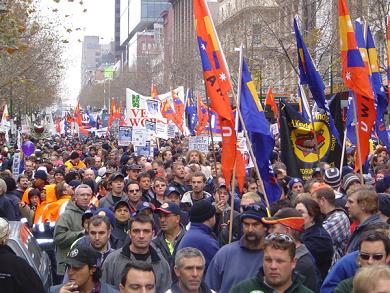
March for Humanity August 3 2025. On the Sydney Harbour Bridge with 300,000 other people protesting against Israel's Genocide against the Palestinians in Gaza.

Blog Archive

Popular Posts

Pageviews last month

Showing posts with label Howard's Workplace Laws/The Fight of Our Working Lives. Show all posts

Thursday, November 16, 2006

The Socialist Alliance Charter of Worker and Trade Union Rights


There’s a group in Australia that’s been badly ripped off over the past 20 years. It’s this country’s 11 million workers, employed and unemployed—the majority of the population.

The wages share of the country’s wealth has fallen from 61% to 53.5% since 1983. If Australia’s workers had been able to maintain that 1983 share in 2004, we would have had $56 billion more in our pockets for 2003 alone.

That would have been $56 billion more to meet our basic needs for health, education for our children and leisure, and $56 billion less for luxury yachts, racehorses and waterfront real estate that drives inner-city housing way out of the reach of the working-class people who once lived there.

True, the total pie has expanded. And some of us have been able to maintain and even increase our standard of living. But more often than not the price has been more stressful, unsafe and unrewarding jobs, enforced overtime and double shifts—less hours for family and leisure. We’re working harder. According to the Australian Centre for Industrial Relations Research and Training, 60% of Australians feel that their lives are a lot less secure than ten years ago. 30% of male workers are working more than 50 hours a week and more than half of them wish they could work less. 1.2 million workers in Australia feel they have to do unpaid overtime.

Women workers have been losing out most—70% of part-time jobs are done by women and 45% of women’s jobs are part-time, up from 36.5% in 1986. The gap between men’s and women’s wages is widening: in the two years to May 2002 women’s wages increased by $33 as against $58 for men. Twenty years ago full-time pay for women was 86% of the male wage; now it’s 81%.

BUT DESPITE THIS PICTURE some workers — a minority — haven’t done too badly in recent years. Some examples:

* Victorian construction workers won a 36-hour week against ferocious opposition from employers and government.

* National Tertiary Education Union members at Sydney University won a landmark 36 weeks of paid maternity leave as part of their last enterprise agreement.

* NSW teachers forced the Carr government to maintain funding for public education, and provide additional funding for their recent 12% pay increase.

* In its Campaign 2000, the Victorian branch of the Australian Manufacturing Workers’ Union won a 15% wage increase over three years, as well as forcing the employers to grant better long service leave and decent income protection for injured workers. The campaign also won limits on the employment of casuals and contractors along with a single finishing date on agreements—protecting industry-wide bargaining. This was the best result for manufacturing and the AMWU in all of Australia.

THESE GROUPS OF WORKERS have one thing in common. They belong to strong unions, which have put the defence of their members’ wages and conditions first and foremost, refusing to accept what the boss, the government and courts thought was their due.

They have refused to knuckle under to state and federal governments — ALP and Liberal — and as a result have been called every name under the sun and even had to face royal commissions into their alleged crimes.

These unions have also proven to workers in the industries they cover that there is a point to belonging to a union. They are among the few unions where membership has increased.

For example, under the new militant leadership of the Western Australian Maritime Union of Australia, union coverage at Patrick, Fremantle, has risen from 53% to 99%.

This confirms that the old saying "If you don't fight you lose" is as true as it ever was. The majority of union leaderships that have stopped fighting — because their ALP mates have been in government or because they never knew how — have carried on losing both conditions and members.

As a result the percentage of workers who belong to a union has more than halved over the past 20 years, from 48% in 1984 to 23% today.

Things are particularly bad among young workers—less than 15% of workers under 25 belong to a union.

Workers in this country urgently need to rebuild fighting, democratic unionism that abides by the principle: "Touch One, Touch All". Nothing else stands between us and low pay, speed-ups and stress at work, and victimisation and exploitation by the employer.

SOCIALIST ALLIANCE MEMBERS are in the forefront of the struggle to rebuild Australia’s unions, active in their own unions and in building solidarity with all union struggles. As an organisation the Alliance acts in solidarity with those unions that are in the front line of the fight for wages and conditions, and is committed to increasing the membership, morale, organisation and fighting strength of the union movement.

Socialist Alliance unionists look to work with all unionists — ALP, Green or non-party — who share this goal. Our Charter of Worker and Trade Union Rights sums up our stance on the critical issues face.

When union members elect militant, democratic leaders they can make enormous steps forward. By throwing out the careerists and dead wood they can begin the job of turning the union into an organisation that’s strong enough to defend the interests of all its members against those of the employer.

But that’s still not enough because the strongest union in the world can only do so much. And in periods of recession it can do even less. This means that working people and our unions can’t do without politics — our own, working-class, politics. We can’t defend our own interests if we just stick to "union issues", no matter how strongly we fight for them.

There’s a working-class point of view on every issue: we need to uncover it, debate it and organise to fight for it. And as we do this it pays remember these words of Peter Reith, John Howard’s former minister for industrial relations, in an address to a gathering of employers: "Never forget which side we’re on. We are on the side of making profits. We’re on the side of the people owning private capital."

Socialist Alliance has the same starting point, but from the other side of the fence. We never forget which side we’re on. We’re on the side of the working people — the vast majority — and our policies are aimed at defending their rights and interests. We’re against the system that is driven by private profit.

But there’s a problem. The party that working people have traditionally expected to advance their interests, the ALP, has let down its supporters time and time again. In fact it has been the ALP that has carried out most of the dirty work of imposing "economic rationalism" (permanent free kicks to big business).

It was Hawke, Keating and Co who deregulated the finance sector, cut wages through the Accord, flogged off public assets, gave huge gifts to big business and tried to crush militant unionism by deregistering unions. State Labor governments have been in the forefront of the attack on workers compensation.

Socialist Alliance was formed to build the working-class political alternative to the ALP. As steps along that road we argue for unions to take a stand on all political issues — from refugees to Aboriginal rights to Iraq, from alternative economic policy to women’s rights — and to organise publicly for pro-worker policies. In this we strive to revive the best traditions of Australian unionism, from the wharfies’ 1940s action in support of the Indonesian independence struggle to the NSW Builders Labourers Federation’s green bans of the 1970s.

The Alliance is taking every possible opportunity to initiate and host debate about how to rebuild an authentic political voice for working people within individual unions and across the movement as a whole. If you agree with the Socialist Alliance policies and approach, vote for us!

But most of all—get active! Join us in the exciting struggle to create that new party that working people in Australia need!

The Socialist Alliance Charter of Worker and Trade Union Rights

Jobs for all at a living wage

* Legislate the minimum wage at around 60 per cent of average weekly earnings ($560 at the end of 2003).

* Shorten the working week (without loss of pay) to spread around available work.

* Stop privatisation and rebuild a modern, democratically managed public sector.
Repeal all anti-union laws, defend and extend the right to organise

* Enact a workplace Bill of Rights that guarantees workers and unions the right to organise and protest. Full recognition of unions and union representatives.

* Repeal the Workplace Relations Act, abolish Australian Workplace Agreements and Sections 45D and E of the Trade Practices Act.

* Return to awards of general application and minimum standards.

* Oppose the Building and Construction Industry Improvement Bill.

* Oppose the Building Industry Taskforce and its interference in unions.

* Guarantee the right of unions to cancel a bargaining period and begin a new one.

* Oppose secret ballots on industrial action.

* Oppose all attempts to outlaw or restrict pattern bargaining, protected industrial action, picketing and secondary boycotts.

* Ban lockouts and the discriminatory sacking of union delegates.

* Remove the prohibition on striking workers receiving unemployment benefit.

* Oppose union liability to pay damages for industrial action.

* Oppose court and government restrictions on who can stand in union elections.

* Oppose government interference in the internal affairs of unions.
Make work and workers' entitlements secure

* Place limits on the use of casuals, contractors, labour hire and part-time workers. Casuals to be made permanent after a fixed period.

* That full-time workers have the right to convert to part-time work when they need to because of poor health or returning to work after childbirth.

* Labour hire workers and casual workers not to receive lower wages and conditions than their permanent co-workers.

* Legislate a definite proportion of apprentices to tradespeople according to industry/trade.

* Compel companies to participate in funds that guarantee workers' entitlements.

* Place workers at the top of the list of creditors in case of company bankruptcy.

* Restore all workers' rights to civil action in the courts.
For a healthy, safe and secure workplace

* Put serious penalties into industrial health and safety legislation.

* Ensure full powers for health and safety representatives to close down unsafe and unhealthy sites.

* Impose prison sentences on employers responsible for the deaths of workers.

* Legislate full, unlimited, employer-funded injury, sick and disability pay.

* Enforce full employer liability and responsibility for incurable industrial diseases (eg asbestosis, mesothelioma etc) and permanent injuries to workers.

* End the attacks on workers' compensation and restore the rights to compensation that have been stripped away.

* For retraining on full pay of workers in environmentally unsustainable industries.
For equality at work and an end to discrimination

* Impose equal pay for work of equal or comparable worth.

* End junior pay rates.

* Legislate 12 months' parenting leave fully paid by employer contributions to a publicly managed scheme; the right to return to the same job without losing seniority; and generous paid leave to allow parents to take time off work to care for sick children and attend school activities.

* Address the under-representation of women in traditionally male occupations with positive discrimination programs in hiring, training and access to university courses.

* Campaign for the government and/or employers to provide free, 24-hour childcare and holiday care centres.

* Return all stolen wages to Indigenous workers or their descendants.

* Legislate a program of affirmative action aimed at breaking down the concentration of Indigenous Australians, migrants and refugees in the dirtiest, most repetitive and most dangerous jobs.

* Impose heavy fines on employers who breach equal opportunity laws.

* Make sexual and racial harassment in the workplace a punishable offence.

* End the unequal workplace status of gays and lesbians.
For unity and solidarity among all workers

* End union dobbing in of "illegal" workers to DIMIA and the federal police.

* Fight for the unionisation of non-union and "illegal" workers and compel the employer to give them the full wage and entitlements. Oppose any identity card for migrant workers.

* Fight for union rights everywhere, especially in those countries where unionism is illegal or under threat.

* Promote international bargaining against multinational attempts to locate work where wages are lowest.

* Build the strongest possible links with unions in other countries.

Tuesday, November 14, 2006

ACTU congress focuses on federal election by Sue Bolton, Melbourne


More than 600 delegates representing 2 million union members met for the Australian Council of Trade Unions (ACTU) congress on October 25-26.

The two-day meeting — it is usually four days — focused on an alternative industrial relations policy and the campaign to elect the Labor Party to federal government. All other issues, such as apprenticeships and vocational training, uranium mining and section 457 visas, were deferred to the December ACTU executive meeting.

Only one plan was put forward to defeat the Howard government: to vote Labor in. While voting Howard out should be a key goal for unionists, the ACTU’s plan for how to do this was limited to more TV advertising, electoral campaigning in marginal seats, working within Howard’s laws, and coming up with an alternative IR policy that the ALP is comfortable with.

Over the next 12 months, the ACTU will focus on promoting its alternative policy by intensifying its TV advertising and marginal seat campaigning. ACTU assistant secretary Chris Walton informed delegates that unions will target 22 Coalition-held ats with 20 full-time marginal-seat campaign coordinators being funded by all medium to large unions.

The ACTU will also work to improve workplace organisation and mobilise people against Howard’s IR laws. The delegates were urged to go all out to get their members to the November 30 national day of action against Work Choices.

Unions have pledged $20 million to the ACTU’s campaign fund, to be raised through a $5.50 levy on each union member over two years. The ACTU is also collecting funds through its Your Rights at Work website, recently raising $50,000 for a billboard on the Tullamarine Freeway in just a few days.

The congress launched “Unions Australia”, a project aiming to recruit the 1.5 million people not currently in a union but who would like to join. The Australian Bureau of Statistics reported a 4% increase in union membership in 2005-06: an extra 70,000 union members. Unions Australia allows workers to join a union by phoning a hotline (1300 486 466) or via the internet ().

The ACTU’s alternative IR policy was passed without major amendment. The main elements are:

•legislated minimum employment standards in combination with comprehensive awards;

•10 legislated minimum employment standards;

•reinstatement of an unfair dismissal system;

•right of workers to join unions and be represented by their union;

•enforceable legal right to collective bargaining where a majority of workers want a collective agreement, although such agreements could be union or non-union;

•both unions and employers be required to bargain in good faith;

•enterprise bargaining is the basis of the policy although pattern bargaining would also be allowed. However, industry-wide bargaining is not considered;

•Australian Workplace Agreements (AWAs — individual contracts) to be abolished;

•a national Labor government to use its constitutional powers to legislate a national industrial relations system while recognising that state governments will continue to have a role in regulating the workplace; and

•no employer greenfields agreements that enable employers to establish wages and working conditions for employees without negotiating with unions when a company changes hands or a new company or work site is established.

Amendments were put by the Victorian left unions to include the right to strike among the fundamental policy principles and to guarantee the right to penalty rates among the 10 minimum employment standards.

Some useful statistics were included in the congress delegate kits, but their implications were largely ignored by the congress. For example, the earnings of the typical low-paid worker have declined relative to high-paid workers. In 1994, individuals in the lowest 10% of wage distribution were paid 45.2% of people in the highest 10%; by 2004 the ratio had declined to 40.8%. The congress did not discuss any industrial campaigning options to increase the wages of minimum-wage workers.

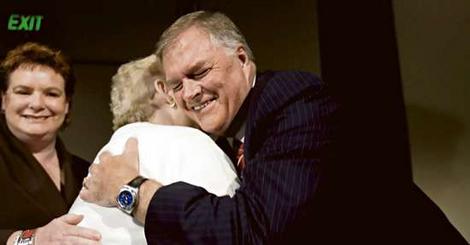
ALP leader Kim Beazley addressed the congress to a standing ovation. He stated repeatedly that a Labor government would introduce a “fair” industrial relations system based on “Australian values”, although he never defined Australian values.

Beazley committed a Labor government to carrying out the central elements of the ACTU’s IR policy. However, he was at pains to convince delegates not to demand too much of a Labor government, or of employers, saying that “bargaining requires good faith conduct on both sides”.

“You must act in good faith — whether you’re an employee or employer, an industry association or a union. Under Labor’s system, you’ll be treated in the same way, subject to the same rules.” The problem is, of course, that workers and employers are not equal; employers’ control of capital gives them power over workers.

Beazley said, “Where a party acts in bad faith — employer or union — the independent umpire can step in to get them back to the negotiating table”, then listed several indicators of bargaining in good faith. One was that while both parties need to respond to questions from other parties, employers must be allowed “to protect their legitimate commercial interests”. This is a massive loophole for companies planning to restructure and sack workers, or move offshore or interstate.

Beazley declared: “Unlike John Howard, I won’t fix all the rules to favour one side. I believe in a fair balance in the roles of employers and employees. Some would want us to tilt all the rules the other way. But I won’t make that mistake.” He then reinforced the point: “I will govern in the interests of all Australians, never just for the vested interests of a few; in the national interest, not sectional interests.”

ACTU secretary Greg Combet supported Beazley’s argument, saying, “To win government, and legitimately represent the Australian people, you must not just represent sectional interests”.

From: Comment & Analysis, Green Left Weekly issue #690 15 November 2006.

Monday, November 13, 2006

COMMUNITY PICKET LINES BY LIAM MITCHELL


Community activists have bolstered picket lines at Botany Cranes (Exell St, Banksmeadow) and Thompson’s Roller Shutters (Henderson St, Turella) on several mornings over a period of several weeks.

The community pickets were organised by Worker Solidarity, a new group that aims to mobilise people from the general community to support workers in disputes with employers where the union-organised pickets are restricted or outlawed by the Work Choices laws.

On October 25, 150 people participated in a community picket at Botany Cranes to support Barry Hemsworth, a construction union (CFMEU) delegate sacked after opposing management plans to make its crane drivers responsible for their own risk assessments without proper occupation health and safety training. It was the third picket organised by Worker Solidarity outside Botany Cranes.

The company had been parking its 20 mobile cranes in the surrounding suburbs to avoid having them held up in the yard by picketers. However, on October 30, 30 picketers arrived at the site to find all the cranes inside the yard. A blockade ensued, preventing the cranes from leaving for up to two and a half hours. Picketers withstood a crane driver loyal to management attempting to drive his massive crane through the picket line.

Two days later, 40 community activists joined a picket line at Thompson’s Roller Shutters in Turella. Eight Thompson’s workers had been on strike for three weeks in pursuit of a collective union agreement with the company. They had held a picket line at the entrance to the factory every day.

Thompson’s has refused for six months to negotiate a collective agreement with the Australian Manufacturing Workers Union, trying force the workers onto individual contracts (AWAs) instead. As part of the collective agreement, union members want their redundancy entitlements increased to the industry standard.

The striking workers have also been supporting a fellow union member who has been subjected to racist abuse and intimidation for some time. He has made numerous complaints to management, which has taken no action. The worker was sacked, allegedly for “causing division” among Thompson’s employees, after he lodged another complaint following a particularly disgusting incident of racist abuse.

Further, an apprentice at Thomson’s, who stayed inside during the dispute, was sacked after talking to the strikers during his lunch break. When he took the strikers’ lunch orders to the local shop, the boss rang the shop to cancel the order.

To find out how you can support the workers at Botany Cranes and Thomson’s, email Worker Solidarity at .

From: Australian News, Green Left Weekly issue #690 15 November 2006.

Tuesday, November 07, 2006

Fight back against Work Choices and Racism in the Workplace, Support the Striking Workers at Turrella


Wednesday 8 November, 5.45am for 6:00 am

Thompson's Roller Shutters

6 Henderson Street Turrella

Next to Turrella Station (turn left at Stn exit)

Thompson's Roller Shutters, Turrella is an unfortunate example of
what life is like for workers under the Howard Governments new industrial
relations laws. After trying to force its workers to sign AWA's for over
six months the Thompson's management has taken advantage of the absence of
unfair dismissal laws and fired an employee of 13 years for complaining to
management about racial vilification within his Turrella workplace.

After weeks of harassment including racist comments written on his locker
to Lebanese bread being left in the staff toilets with racist notes
attached the man sought help from management. Not only did Thompson's
management refuse to take any steps against racial abuse in their factory
but they decided to fire this employee for "causing division" among the
workers.

Since this sacking 9 workers have gone on strike outside the Henderson
Street factory in solidarity with the sacked worker and in refusal of
management's plans to place all employees on one of Howard's beloved
AWA's. These workers, some who have been with Thompson's for over 18
years, have been trying to negotiate a collective bargaining agreement
with the company for over 7 months.

So far 7 full timers have signed AWA's and remain in the factory while 9
casual labour hired staff have been brought into take over the jobs of the
9 workers who have decided to strike.

After visiting this picket late last week members of Worker Solidarity NSW
are urging comrades and concerned citizens to participate in a peaceful
community assembly outside the Henderson Street factory this Wednesday 8
November. WSNSW believe that this kind of direct action is the most
effective way to express solidarity with those workers who are brave
enough to oppose the ongoing attacks against workers rights in Australia.

For more info:
Call Daniel on 0406 049 871

Monday, November 06, 2006

Protest Work Choices: All out on November 30! by Troy McGuinness


November 30 is a truly national day of protest, with more than 300 rally points across metropolitan and rural Australia. Regional Victorian workers are being encouraged to come to Melbourne on November 29 to be ready for an early start the next day at the Melbourne Cricket Ground, or the “G”.

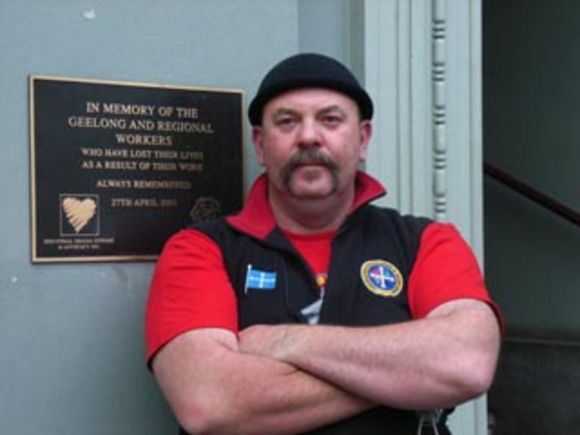
Tim Gooden, secretary of Geelong Trades Hall, told Green Left Weekly that, “It’s important there’s a massive turnout from all unions, workers and community groups because that’s the way to get the message across that we don’t accept Howard’s anti-worker laws.”

The October 25 Australian Financial Review reported that ACTU president Sharan Burrow had told the 500 delegates at the ACTU congress the day before that, “November 30 would be a case of everybody out”. She didn’t mention “strike” or “stop work”, but it was clear what she intended. Burrow also told the congress that besides the skeleton crews needed for the elderly and sick, everyone else should attend the nationwide protest.

Aemployers begin testing out Howard’s anti-worker laws, disputes have flared at Amcor, Heineman Electric, Boeing, Toyota, CSR, Finlay Engineering, Tronics and Port Campbell Gasworks in Victoria, and Alcoa in Pinjarra, Western Australia.

It wasn’t until after the huge turn-outs at last year’s November 15 national rallies that Kim Beazley committed a Labor government to “ripping up” Work Choices.

Gooden said that’s the other reason workers and the community need to mobilise in great numbers on November 30 — to keep the pressure up on Labor to follow through on its promises. “As we’ve seen many times before, Labor will have to be pushed to stick by its word. We don’t just want Work Choices repealed, we want all the other anti-worker laws scrapped as well.”

Many have said, correctly, that these laws are an attack on human rights, that is the rights of workers to join together in unions and organise to defend our class interests. This is also why blue- and white-collar workers have to work together in this campaign. Susan Price, National Tertiary Education Union UNSW branch president, told GLW, “In the past, a lot of white-collar workers associated industrial struggle with blue-collar workers. But now the NTEU is being targeted along with the Construction, Forestry, Mining and Energy Union because of the gains it made under enterprise bargaining.”

Amelia Taylor from the United Casual Workers Alliance on the Gold Coast told GLW that the November 30 protest “should be so large no one will be able to buy a cup of coffee afterwards, because all the cafes and shops, even the little ones, will have shut down for the rally”.

Taylor said that more than 70% of Gold Coast workers are casual, with no bargaining power. Irregular rostering has a negative effect on family life. Some casual workers are made to pay for their own uniform, docked from their first pay packet. Given that these workers are generally young and on youth wages, this often means that their entire first weeks’ pay is consumed.

The Coalition government has also passed pernicious laws dealing with the building industry. Workers who take “illegal” industrial action risk fines of up to $28,600. Workers who don’t answer questions, fail to turn up to an interrogation, or reveal the contents of an interrogation by the Australian Building and Construction Commission face an automatic six months’ jail term.

Other anti-worker laws that work hand-in-glove with Work Choices include: the “welfare to work” law, the “anti-terror” laws that compromise freedom of speech and assembly, and the laws that allow bosses to employ guest workers on section 457 visas on below-standard wages and working conditions.

Price said that some of the most exploited workers in Australia now are refugees on temporary protection visas and guest workers. “Recently, the CFMEU organised for some Indian and Korean guest workers to address a public meeting. These workers are experiencing the most gross exploitation from bosses in the construction industry. They ended their speeches with the call for workers of the world to unite. November 30 should also be about fighting for the rights of these workers.”

The scale of the attacks haven’t been seen in more than 100 years, Western Australian Maritime Union of Australia assistant secretary Ian Bray told GLW. “We’ve got to show that we’re not just worried about the laws for ourselves, we’re worried about their impact on our kids.”

According to Gooden, the other reason why a massive turn out on November 30 is important is because “it gives workers the confidence that they can defy Howard’s laws … There is nothing the government can do because it can’t fine or jail everybody”. Bray agreed, concluding: “We’re in for the fight of our working lives. A big mobilisation on November 30 will demonstrate that workers are angry, and will fight until these laws are abolished.”

[Troy McGuinness, a former postal worker, was one of hundreds victimised by Australia Post for participating in previous national union protests against Work Choices.]

From: Australian News, Green Left Weekly issue #689 8 November 2006.

Saturday, November 04, 2006

Geelong hosts Union Activists Workshop by Sue Bolton


Union activist workshop Geelong 2006 Union activists travelled from Victorian country centres such as Port Campbell, Portland, Hamilton and the Latrobe Valley to Geelong to join union activists from Melbourne, Geelong and capital cities from all over the country to discuss the topic “Can militant unions thrive and survive under WorkChoices?”.

Geelong Trades Hall was packed with 130 unionists for a Trade Union Activists’ Workshop on October 28. Unionists came from a wide range of unions, with sizeable contingents coming from the Australian Manufacturing Workers Union, National Tertiary Education Union, the Construction, Forestry, Mining and Energy Union, Australian Education Union, Maritime Union of Australia, Community and Public Sector Union and the Communication Workers Union-postal and telecommunications branch.

Some of the activists attending were from industrial disputes in Melbourne and Port Campbell where Union Solidarity activists has run community pickets.

Some of the participants included workers from industrial disputes which have benefited from community picket lines run by Union Solidarity.
Geelong Trades Hall Council organiser Tim Gooden explained that although “Socialist Alliance initiated the workshop, it was open to anyone who wanted to participate regardless of whether they were members of the Labor Party, the Greens, Socialist Alliance or not in any party.”

He said that the workshop was organised because many trade union activists are frustrated with the strategy being used by the ACTU to fight WorkChoices.

“Everyone knows that we need to get rid of the Howard government and of course a Labor government would be a step forward from the Howard government but that’s not the end of the story,” said Gooden.
“The problem is that the ACTU has no Plan B for if the Howard government is re-elected or if the Labor Party is elected and then betrays the movement. There’s also the problem that the ACTU has only ever had an electoral strategy for fighting Howard’s anti-worker laws. They haven’t had an industrial strategy.”

“We organised the workshop to exchange ideas and experiences between unionists in different industries, unions and states,” said Gooden.
The workshop opened with French activist and academic Stephane Le Queux describing the struggle by students and workers in France early this year that defeated a law that attacked young workers. The victory was built on mass protests and civil disobedience.

Many activists from interstate were keen to learn about the Union Solidarity network and the community picket lines that have been happening in Victoria.
Union Solidarity was described as a broad union-community organization which supported any group of workers under attack, regardless of what union they were members of. It was explained that Union Solidarity operated on the principle that it was prepared to support any group of workers, the workers still make the decisions about how to run the dispute.

Activists from interstate reported that Union Solidarity had been set up in Perth and Workers Solidarity had been established in Sydney and was doing important work in solidarity with a sacked delegate at Botany Cranes.

Gippsland Trades and Labour Council secretary John Parker described the Gippsland TLC as being based on the principles of community unionism. That meant that the TLC was prepared to support any community group that needed support, as well as calling on the broader community to support workers’ picket lines and the campaign against the anti-worker laws.

Parker said that the community unionism approach was important because militant unions had become separated from the broader community. Militant unions had won wage rises, rights and conditions while millions of workers who didn’t have unions to fight for them had been left behind.
One workshop participant said that a dangerous trend in some unions is for union leaders to tell members that the union movement would be totally defeated if the Howard government is re-elected. “This is a very dangerous line,” he said, “because it can become a self-fulfilling prophesy. Of course we want to defeat the Howard government, but the union leadership has to build the confidence of members to fight any government that implements anti-worker laws.”

Various ideas were raised during the workshop for regional stopwork rallies, civil disobedience and non-compliance with some of the most draconian laws.
Other issues discussed at the workshop included how to involve more young workers in unions, how to fight the exploitation of guest workers, and the need for the union movement to oppose the Welfare to Work legislation.

It was pointed out that there wasn’t enough information about victories or new attacks being circulated between unions and between union activists in different states. Some union officials only find out about important disputes that their union is involved in in other states from reports in Green Left Weekly instead of from their own union.

Many unionists at the workshop expressed an interest participating in another workshop next year and in being kept informed through the establishment of an email network.

- Sue Bolton, Socialist Alliance national trade union committee convenor

Tuesday, October 31, 2006

'I'm not prepared to pay these fines' -- WA construction worker


John Pes has become the public face of the 107 Western Australian construction workers who have been threatened with fines of up to $28,600 after taking strike action on the Leighton Kumagai-run Perth to Mandurah rail construction project in February.

No longer in the construction industry, Pes, like his former workmates, is now feeling the full impact of the Howard government’s draconian anti-worker legislation.

The WA press has been relentless in its campaign of demonising construction workers and their union, the CFMEU. Talking with Pes, I got the distinct impression I was talking to a hard working blue-collar worker, doing his best to earn a living to raise a young family.

I asked him why he had given interviews to Murdoch’s Australian newspaper and the ABC TV’s 7.30 Report and not the West Australian. “I haven’t spoken to the West Australian because they haven’t even tried to negotiate with me for an interview”, he answered. “And I can tell you right now, if they do I’ll tell them to go away. It doesn’t matter what union it is, they just write stuff to make us look bad, all the time!”

Pes described the actual conditions he and his fellow workers had worked under on the Leighton Kumagai-run project. The workers faced a standard work week of 56 hours. He said many of the workers had to work well in excess of these hours, damaging their home lives and family relationships.

He said his own experience in the construction industry had been fine up until he began work on the Leighton Kumagai tunnel project. He said that because the previous attention paid to the CFMEU by the federal Building Industry Task Force — the predecessor organisation to the Australian Building and Construction Commission (ABCC) — had been ineffectual for the Howard government and the construction bosses, he believed the huge cost overruns incurred by Leighton Kumagai on the tunnel section of the rail project had been used to trigger the cur

A line in the sand/An open letter to all unionists from Tim Gooden


The situation in Western Australia, where at least 107 construction workers have been served writs with the possibility of $28,000 fines, represents a fundamental attack on our rights as workers and trade unionists.

Regardless of the outcome of this case in the federal court, and regardless of whether or not the workers are fined, the union movement must actively oppose this latest attack by the federal government and its hit men in the Australian Building and Construction Commission.

The laws under which the ABCC operates remove our control over our own labour — our right to determine when and who we sell it to. In essence, the laws make striking criminal behaviour.

This is not just a Western Australian problem, or a CFMEU problem. It is a problem for the union movement as a whole. It therefore requires a national response.

The best response would be for as many unions as possible, in as many states as possible, to take at least one or two days’ nationally coordinated strike action. This would challenge the government to “fine one, fine all”. The big business bosses, if faced with widening industrial disputes and declining production, would turn on Howard in order to protect their profits.

Secondly, Howard must be confronted every time he appears in public. Like happened at the Blacktown Workers Club last week and every time he has come to Geelong, he should be met with a sea of union flags and megaphones.

Third, whenever a worker is hauled before the federal court, charged for taking industrial action, all workers should be called upon to converge on the federal court building in their city at lunchtime, acts of solidarity that cannot be ignored by the media.

This issue must be made as public as possible, and real action taken, starting now, to build up the momentum for a national strike.

There will be no “next time” if we let this dispute go through the wicket-keeper. If there is no national response from the union movement and the government gets away with fining the WA construction workers, no workers in Australia will have the confidence to go on strike to defend their own interests or their union.

Last week, ABCC boss John Lloyd was asked by Melbourne ABC radio talk-back host Jon Faine if he was planning to also charge the hundreds of thousands of workers who took “unlawful” industrial action on June 28 to participate in the ACTU national protest against Work Choices. His response was, not surprisingly, “no”, but when asked why, he could not explain. We need to exploit this weakness in their strategy; they cannot get away with charging us all.

We can and will raise the money for the legal fight and any fines imposed on the WA workers. We will look after our brothers and sisters and ensure that no-one goes without.

But this is a line-in-the-sand dispute that we must not duck. Offering only statements of solidarity and money to the WA unionists will not solve the longer-term problems faced by these workers, or the rest of the workers’ movement. We need to take collective action that will stop Howard in his tracks, and overturn his anti-worker laws.

Tim Gooden
Geelong Trades Hall secretary

From Green Left Weekly, July 19, 2006.
Visit the Green Left Weekly home page.


Union leader: Guest-worker exploitation must stop by Sue Bolton, Melbourne.


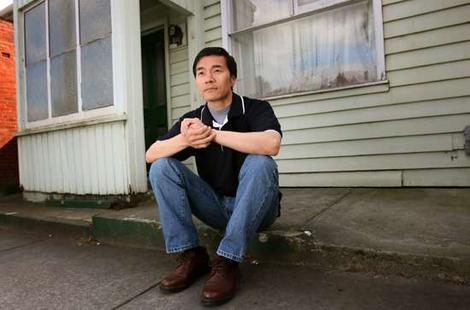
Dismissed Printing Worker Jack Zhang


Two cases of ruthless exploitation of Chinese guest workers have recently come to light in the printing industry, throwing the spotlight on the plight of the growing number of guest workers.

Victorian state secretary of the Australian Manufacturing Workers Union’s (AMWU) print division Jim Reid told Green Left Weekly that Melbourne company Aprint was the first printing company the union became aware of that had sacked an employee on a section 457 guest-worker visa (s457 visa).

There are four Chinese guest workers at Aprint. They paid $10,000 to an agent in Shanghai to find them a job in Australia. After they arrived, however, the Aprint boss claimed it had cost him $10,000 to bring each of the workers to this country, so he deducted “reimbursement” of $200 per week out of each worker’s wage.

When one of the workers, Jack Zhang, had worked for Aprint for a year and the company had deducted all of the $10,000 from his wages he was told that the company wasn’t happy with his work and he was sacked. “That’s when Jack came to us”, Reid said.

Zhang had outlaid more than $20,000 for the “privilege” of working in Australia — $10,000 upfront and $200 per week to his boss. After he was sacked, he was immediately replaced by another worker brought from China.

“When Jack contacted the union, he wasn’t sure what a union was”, Reid said. “Once we became aware of what happened, we organised a press release, and spoke to the immigration department, the Victorian Workplace Rights Advocate and the Office of Workplace Services. I understand that the OWS is now prosecuting Aprint for underpayment and the company faces substantial fines.”

Reid said Zhang had worked 60 hours per week at Aprint for $752, just over $12 per hour. “Jack is a qualified tradesperson. He’s worked in the printing industry nearly all his adult life. He was working beside Australian tradespeople who were earning $28 an hour. He was paid below the award and he wasn’t paid any penalty rates, even when he worked on the weekend.”

When Zhang was sacked he faced deportation for being unemployed. The AMWU found Zhang a job at another printing company, which took over sponsorship. “Jack’s now working in a fully unionised shop so he’s very happy. The AMWU also organised and paid for accommodation for Jack until he was able to get a wage at his new job”, Reid explained.

Reid told GLW that the other Chinese guest workers at Aprint are being paid way below the trade rate. “I’ve met each of them. They’re all really nice blokes who’ve come to Australia, like most migrants, looking for a better life for themselves and their families, and they’ve been ruthlessly exploited by disgusting employers.”

Reid explained that “the big issue is why would an employer employ Australian workers at the going rate of $28 an hour if he can employ imported skilled labour for $12-$15 an hour. In the case of Aprint, this was nothing to do with a lack of skilled employees available locally. We are aware that at Aprint, Australian workers lost their jobs to make way for the Chinese migrants.

“No-one has any concerns with migrants coming into the country, particularly skilled migrants, but we do have an issue if they’re coming in to displace Australian workers and are being ruthlessly exploited and paid under the going rates.”

Reid said the AMWU became aware of the second case a couple of days after Zhang’s story appeared in the Age newspaper. A Chinese man who spoke English rang the union about Zhihong Fu, who had been really badly treated by the company Lakeside Packaging.

Zhihong spoke no English, so Reid spoke to him through an interpreter. “Fu came to Australia after paying $27,000 for his visa”, Reid said. “He sold his house in China and borrowed money from family and friends to pay the $27,000.

“Fu was told that he would be working as a maintenance supervisor, but when he arrived here he was given the most menial of jobs. Lakeside Packaging was using him as a labourer and a cleaner.

“One of Fu’s jobs was laying electrical cabling. Fu has no English at all and here he was working with materials that require a licence to use.

“Fu was working on a ladder and it fell away. He fell five metres to the ground, bumped his head, broke two teeth and broke his right forearm. Fu’s boss told him that he didn’t need to worry about going to hospital but fortunately his workmates had more sense and took him to hospital.

“Fu’s boss then pressured him to return to work. After a couple of days, Fu returned to work with his right hand — his dominant hand — in plaster. While using an electric drill with his left hand, because his right hand was in plaster, the drill kicked and broke his left arm.

“So now Fu had two arms in plaster but again the boss was pressuring him to come back to work. Fu was contacted by the agency in Shanghai, which told him he should get back to work and apologise to the boss for causing trouble.

Reid said that when Fu explained that the doctor had given him six weeks off work, the boss wrote to him telling him he would be sacked and deported back to China.

“So Fu was in Australia for less than a year, he’s spent $27,000 on a visa, he’s been worked like a dog for all of that time, he’s broken two wrists and now he’s being deported!”, Reid said. “We contacted the media and the union’s lawyers are making applications to the Equal Opportunity Commission and WorkCover, and an unlawful dismissal application in the Australian Industrial Relations Commission. We’ve also found an employer who has offered Fu a job as soon as he is able to work again.”

“But for the union, both Fu and Jack would have been left high and dry”, Reid told GLW. “I can only imagine what these guys must have been going through, coming all the way from China with no local support base, no family, no friends and very little English. It must have been hellish.”

In both cases, the companies made the workers sign Australian Workplace Agreements (individual contracts) that forbade them from joining a union or participating in political activity. The clause in Fu’s contract stated: “Under no circumstances shall the employee participate in riots, strikes, political, union or radical religious activities.”

Reid said that migrant workers, whether in Australia legally or illegally, “should not be treated poorly. If people haven’t gone through the normal [migration] process, there’s usually a reason. People may be fleeing oppressive regimes. They may be in fear of their lives or face political persecution. They may not be able to practice a particular religion. Some of them may be purely economic refugees and I find it very difficult to condemn someone who is looking for a better life for themselves and their family.

“The union is concerned about the s457 visas. They are meant to fill labour shortages, but that’s not what is happening. People at Aprint were displaced from their jobs to make way for migrants on s457 visas, and companies in the printing industry are not finding it difficult to get tradespeople.

“If it was only about a skills shortage, why would employers be paying these workers less than half the Australian tradesperson’s rate? Quite clearly, it is more about reducing wages and conditions. In the last 10 years, the number of s457 visas approved has gone from 24,000 to 70,000.

“Anyone coming to Australia, and especially if they’re coming through a government scheme, should be treated exactly the same as other workers in Australia, not as cheap labour. If the government was fair dinkum, it would oversee the conditions under which these workers are employed after they arrive. Instead, the government takes a hands-off approach and these workers are left completely at the mercy of unscrupulous employers.”

The AMWU argues that if there is a skills shortage, we should be training Australian kids, in the first instance, Reid explained. “We don’t want a situation where anytime there is a skills shortage we simply import labour … We know that the real unemployment rate in Australia is much higher than the official statistics. If it means training older workers whose jobs have been displaced by technological change then that should be done.

“After doing that, if there’s still a skills shortage, we should bring in skilled migrants, provided they are paid the same rates and being treated exactly the same as people who are already employed in Australia.”

Sunday, October 29, 2006

Defiance leads the 107 campaign by Graham Matthews

Bernadette Peters is a part-time cleaner and a full-time activist. She is also the partner of Mal Peters, one of the “Leighton Kumagai 107", who were fined $22,000 by the Australian Building and Construction Commission (ABCC) for a strike in February in defence of a sacked health and safety delegate.

Bernadette and Mal Peters have spoken at public meetings and work sites up and down the country, raising awareness and campaigning for the rights of the 107 workers. Bernadette spoke to Green Left Weekly about the campaign and how Work Choices is affecting working families, like hers.

“These fines started with John Howard’s IR laws”, she said. “The pressure that [the fines] are putting on these families is unfair. A lot of the 107 are only young; they’ve got young families. What working-class person has that sort of money to hand over?”

Mal Peters, like many of the 107, was served with the writ at his home. According to Bernadette, families of the workers were harassed by the ABCC process servers. They “were showing-up on people’s doorsteps at no matter what time of the day or night. My husband had just pulled up in the driveway — it must have been 9pm — and somebody hiding behind the bushes went up to the car and asked: ‘Are you Mal Peters?’ He didn’t know what was going on. He said ‘Yes’, and they handed him the writ.”

Successful prosecutions would be devastating for the 107 and their families. “We don’t know what the outcome will be and that is what is upsetting the families. Nobody’s got that amount of money, but if they don’t pay, they go to jail or they’re talking about taking our homes.” But they remain defiant. “If we have to go to jail, we’ll go to jail. And it’s the same for the rest of the men.”

Bernadette has some idea how tough life can get. Her father was a coalminer for 30 years in Scotland until coming to Australia with his 11 children.

“He was a staunch union and Labor man all his life. He would turn in his grave if he knew that this was happening. My father and his father before him fought for many of the working rights we have today. And now John Howard wants to take all that away.”

Bernadette and Mal have toured the eastern states, with the support of the Construction, Forestry, Mining and Energy Union (CFMEU), to help get a fighting fund set up. “But it’s not just for these workers”, Bernadette explained. “It’s for anyone who faces the same, and it could easily happen if John Howard gets his way.”

On returning from their first trip in August, Mal, who had taken two weeks’ annual leave, was sacked by Leighton Kumagai. “They said they no longer needed him”, Bernadette said, adding, “that’s another court case we’ve got underway”. “They sacked him because he spoke up. They didn’t say that was the reason, obviously. But there was no other reason.”

Bernadette praised the solidarity shown to the 107 and their families. “It’s been brilliant, and not just from Australia, but from overseas as well. It means that we don’t stand alone.” Among the many messages of support featured on the 107 website are messages from LaborStart in the US, Unison in Britain and the Scottish Socialist Party.

[Bernadette and Mal Peters will be speaking in Sydney on October 31 and November 1. For details, see the Activist Calendar on page 23. To support the 107 campaign, visit .]

Wednesday, October 04, 2006

Death of a Scaffolder


by John Tognolini,


When 41-year-old scaffolder and father of three Paul Hughes fell eight stories to his death in Sydney’s CBD on January 6, it put the spotlight not only on one of the building industry’s most dangerous occupations but also John Howard’s new industrial relations laws.

Paul’s father Frank, a retired scaffolder with 32 years’ experience, said he had seen “too many people killed”. Unless the new IR laws are stopped, he added, “there will be a lot more workers killed. I urge every worker to join the union and protect yourselves because it is the only protection you will have.”

“The death of Paul Hughes is a disastrous start to 2006", said Andrew Ferguson, NSW secretary of the construction division of the CFMEU. “We have one worker killed every week on a building site in Australia and we have a federal government trying to restrict the right of entry of union officials and safety experts. If these types of policies continue, then, unfortunately, there will be more workers killed.”

Five hundred construction workers formed a guard of honour for Paul’s coffin on January 10, when it was taken past the site to his funeral, and Maori priest Malcolm Karipi conducted a short, traditional service for Paul’s workmates.

From Green Left Weekly, January 25, 2006.