John/Togs Tognolini

John/Togs Tognolini
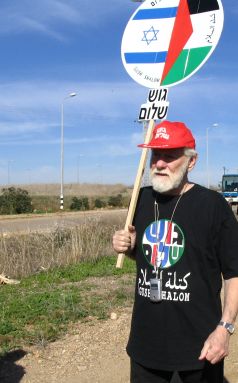
March for Humanity August 3 2025. On the Sydney Harbour Bridge with 300,000 other people protesting against Israel's Genocide against the Palestinians in Gaza.

Blog Archive

Popular Posts

Pageviews last month

Showing posts with label New Romans Middle East. Show all posts

Monday, January 08, 2007

3,000 Dead: So Who's Counting? By Cindy Sheehan


Cindy Sheehan during her 2006 visit to Australia

t r u t h o u t | Guest Contributor
Monday 01 January 2007

Gerald Ford, an incompetent, never-elected past president, is being memorialized today by one of his good buddies and close confidantes, Dastardly Dick. The execution of Saddam Hussein is being celebrated by a bloodthirsty media and another never-elected, execution-happy, incompetent president. Dozens, if not hundreds, more innocent Iraqis were killed today, and more than likely, the 3,000th soldier crossed the threshold from life into the next world.

We have seen this movie and heard this song before. As Yogi Berra once said: "It's deja vu all over again!" In September 2004, our nation crossed the blood-soaked 1,000-troop line during a heated campaign between someone who actually went to war who was branded a coward, and someone who went AWOL from the military at the same time and was glorified as a tough leader.

In October 2005, our inept leaders' policies killed the 2,000th soldier. While I and two dozen others were getting arrested during a "die-in" in front of the White House, MoveOn.org was organizing the second candlelight vigil in little over a year at another 1,000-troop mark.

On June 16th, 2006, the 2,500th soldier was pointlessly killed, and White House press spokes-liar Tony Snow said that it was "just a number." As when the Writ of Habeas Corpus was taken away from all of us; when Bloody George added a signing statement to a Senate bill that institutionalized torture, and when yet another criminal against humanity was approved to replace the previous war criminal as Secretary of War, we, en masse, exclaimed, "That's horrible! What can we do to stop these maniacs?!" Then a vast majority of us, numbering in the millions, "shook it off," shrugged our shoulders in defeatist hopelessness and false helplessness, then went about our business of being Americans, disregarding the fact that while we are "being Americans," there are billions of humans on this planet who are not, and millions of humans in Iraq who are being ravaged by the malevolent forces in DC.

When the "number" reaches 3,000 today, or tomorrow, another pain-draped coffin will be coming home to a mother whose heart will be forever folded in abject despair, whether she agrees with Bloody George's war or not. Another mother's head will be bowed with grief as the flag that covered her child's coffin is handed to her, after it has been as carefully folded as her child was carelessly sent to war. The father will age 10 years in a few hours, and perhaps a husband or wife will lose a life's companion, or a child will have to endure the pain of losing a mother or father way too early.

As I was lying on a freezing-cold floor, dressed in black and white prison stripes in Waco, Texas, the other night, feeling sorry for myself for a minute, I thought of our brave young people in Iraq whom corporate greed has sentenced to a prison of a war that is turning more nightmarish by the minute, and I didn't feel so bad. I thought of the innocent Iraqis who cannot escape from the prison of an occupation that is killing them by the hundreds of thousands every year, and I felt downright fortunate. Then I recalled that Bloody George and his "Holes in the Head" gang were just contemplating sending upwards of 40,000 more troops to Iraq (and, in fact, that was why I was in jail that night), and I got downright terrified.

As Bloody BushCo are contemplating escalating the mayhem, I know that many groups and communities are already planning candlelight vigils, which should be held to honor our wonderful and brave young people who have been killed for no reason. However, candlelight vigils will not stop 3,001 or 3,002 - and saints forbid that we will be mourning number 4,000 sometime too soon in the too-near future.

Gold Star Families for Peace, as a group and individually, deeply mourn each and every loss, no matter what color the skin or what religion was claimed by the deceased. GSFP strongly abhors and disagrees with any troop "surge," and calls for a new commitment to radical, nonviolent activism through a "peace surge."

Do your candlelight vigils. Sing "Give Peace a Chance," and/or "We Shall Overcome." Before the last note has died down, head over go to your Congress rep's office and do a sit-in, and urge your representative to vote "No" on any future funding for killing and "Yes" to accountability for Bloody BushCo. Tell him/her that you are not leaving until he/she agrees to do what you tell them to. Your elected official works for you - not the other way around.

Hang signs on freeway overpasses. Support the Military Redress petition which active duty soldiers are organizing. Send money to peace groups and/or progressive media. Come to Washington, DC, and march with us on January 27. Come to Camp Casey at Easter to demonstrate on the president's doorstep. Reduce your dependency on oil and oil-based products. Simplify your life. "Live simply so others may simply live."

We all have the dreaded experience of being asked by someone who is not such a close friend, to help them move. I am going to presume to ask you to help me move. Help me move the world closer to peace. Help the countless people working in the vineyard of nonviolence in this move. Sometimes the task is arduous, and we have to sacrifice a great deal; sometimes the move is joyous, and we revel in companionship, love, and the reward of each baby step taken and every small victory celebrated. However, the movement is always sacred and more urgent than ever.

3,000 dead! So who's counting? I can guarantee that there is a dear loved one of a soldier somewhere holding his or breath, praying that the soldier doesn't become "just a number" to Tony Snow or another dollar in the blood bank to the war profiteers.

3,000 dead. I can virtually guarantee who is not counting: Bloody George, who readily admits that he gets a good night's sleep every night, while he has condemned millions of people all over the world to agonizing nights of intensely worried or anguished insomnia. Why should Bloody George lose sleep? War business is booming, and his own children are safely surrounded by the Secret Service. I can never remember when peace has been so absent, yet so urgent.

Won't you do one thing every day to help prevent the next thousand Americans and next one hundred thousand Iraqis? Please?

In Search of Peace is a series of reflections on Cindy's journey toward true and lasting peace.

Cindy Sheehan is the mother of Spc. Casey Sheehan, who was killed in Bush's war of terror on 04/04/04. She is the co-founder and president of Gold Star Families for Peace and the Camp Casey Peace Institute. She is the author of three books; the most recent is Peace Mom: A Mother's Journey Through Heartache to Activism.

-------

Tuesday, November 28, 2006

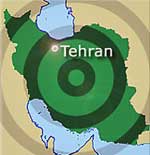
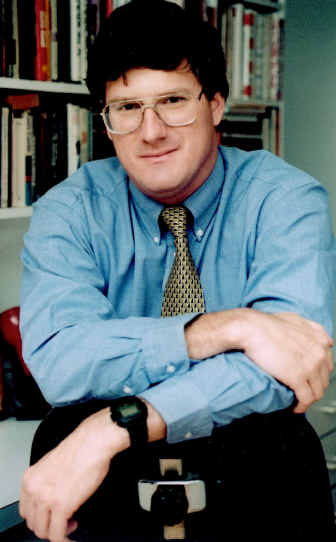
Scott Ritter's New Book Target Iran interview with AMY GOODMAN


AMY GOODMAN: A new book by former weapons inspector, Scott Ritter, claims the Bush administration is determined to wage war against Iran. In Target Iran: The Truth About the White House’s Plans for Regime Change, Scott Ritter examines the administration’s regime change policy and the potential of Iran to threaten U.S. national security interests. He writes, “The path the United States has currently embarked on regarding Iran is a path that will inevitably lead to war. Such a course of action will make even the historical mistake we made in Iraq pale by comparison,” he writes. Scott Ritter joins us in the studio now. Welcome to Democracy Now!

SCOTT RITTER: Well, thanks.

AMY GOODMAN: What do you think is the key to understand about Iran right now, about the U.S., well, about your title targeting -- Target Iran?

SCOTT RITTER: Well, the most important thing is to understand the reality that Iran is squarely in the crosshairs as a target of the Bush administration, in particular, as a target of the Bush administration as it deals -- as it relates to the National Security Strategy of the United States. You see, this isn’t a hypothetical debate among political analysts, foreign policy specialists. Read the 2006 version of the National Security Strategy, where Iran is named sixteen times as the number one threat to the national security of the United States of America, because in the same document, it embraces the notion of pre-emptive wars of aggression as a legitimate means of dealing with such threats. It also recertifies the Bush administration doctrine of regional transformation globally, but in this case particularly in the Middle East. So, we’re not talking about hypotheticals here, regardless of all the discussion the Bush administration would like you to believe there is about diplomacy. There is no diplomacy, as was the case with Iraq. Diplomacy is but a smokescreen to disguise the ultimate objective of regime change.

AMY GOODMAN: Can you talk about the difference in approach the U.S. takes to North Korea, which has, according to their own reports, set off a nuclear bomb, and Iran?

SCOTT RITTER: Well, the only thing that the Bush administration’s approach towards North Korea and the Bush administration’s approach towards Iran have in common is that the endgame is regime change. Other than that, what you see -- I guess the other thing they have in common is the total incoherence of their approach. Look, North Korea and Iran, you can’t compare; it’s apples and oranges.

North Korea is a declared nuclear power. They even declared their intent to have nuclear weapons. They haven’t hidden this from anybody. They withdrew from the Non-Proliferation Treaty in total conformity with the rule of law. They put the world on notice. They said, we will not participate. They gave them the appropriate timeline. They invited the inspectors out. And then, surprise, surprise, despite the fact that the Bush administration said, “Well, they’re just bluffing,” well, they’re not bluffing. They just popped one off. And guess what. If we continue to push North Korea irresponsibly -- because again, what are we talking about here?

What do we want to achieve in North Korea? Do we really care about the North Korean people, want human rights to -- no, regime change. This is all about regime change. This is about the United States being able to dictate the terms of coexistence with everybody else in the world. Do people understand that our policy towards China is regime change? Do they understand what the ramifications of that is? That’s what’s going on with North Korea. And we shouldn’t be surprised that they did exactly what they said they were going to do.

Now, we take Iran. Iran is a nation that says, “We don’t have a nuclear weapons program. We have no intention.” In fact, when North Korea exploded their device, the Iranians condemned it. They said nuclear weapons cannot be part of a global equation. And yet, we continue to try and lump them together as if North Korea and Iran are part and parcel of the same policy. Well, maybe they are part and parcel of the same incoherent approach that the Bush administration has taken to dealing with nuclear proliferation.

AMY GOODMAN: Scott Ritter, you just returned from Iran?

SCOTT RITTER: I came -- I was in Iran in early September, yes.

AMY GOODMAN: And what did you do there?

SCOTT RITTER: I went there as a journalist for Nation magazine. I was there to research an article that hopefully will come out some time in November. You know, it was funny, the Iranian government, like many governments, says one thing, does another. I had a whole agenda that had been agreed upon in advance, that I was going to go and interview X, interview Y, visit sites, see etc. And I got there to find out that the Iranian government, regardless of what we had coordinated here in the United States, had no clue (a) that I was coming and (b) that I had an agenda. So, I show up in Iran, and I’m on my own.

What an eye-opening experience to be on your own in a nation that has been called an Islamic fascist state. I have been to dictatorships in the Middle East. I have been to nations that have a high security profile. Iran is not one of these nations. I’m a former intelligence officer who has stated some pretty strong positions on Iran, and yet I had full freedom of movement in Iran with no interference whatsoever. And as a result, although I didn’t have the approved agenda, I had my own agenda, which allowed me to interview senior government officials, senior military officials, senior intelligence officials, and to visit sites that were deemed sensitive. The conclusion is that the American media has gotten it wrong on Iran. It’s a very modern, westernized, pro-Western, and surprisingly pro-American country that does not constitute a threat to the United States whatsoever.

AMY GOODMAN: You’re a former weapons inspector in Iraq.

SCOTT RITTER: Correct.

AMY GOODMAN: Can you talk about similarities or differences you see between the lead-up to the invasion of Iraq and what’s happening now with Iran?

SCOTT RITTER: The biggest similarity that we need to point out is that in both cases no evidence was put forward to sustain the allegations that are being made. Iraq was accused of having weapons of mass destruction programs, reconstituting chemical, biological, nuclear, long-range ballistic missile programs. There was an inspection process in place that had access, full access to the facilities in question, and no data was derived from these inspections that backed up the Bush administration's allegations. And yet, Iraq was told, it’s not up to the inspectors to find the weapons. It’s up to Iraq to prove they don't exist. Iraq had to prove a negative. And they couldn't. We now know that in 1991, Saddam Hussein had destroyed the totality of his weapons programs. There weren’t any left to find, discover. There was no threat.

We now have Iran. It’s alleged to have a nuclear weapons program. And yet the International Atomic Energy Agency, the inspectors who have had full access to the sites in Iran, have come out and said, “Well, we can’t say that there isn’t a secret program that we don’t know about. What we can say, as a direct result of our investigations, there is no data whatsoever to sustain the Bush administration's claims that there is a nuclear weapons program.” And yet, the Bush administration once again is putting the onus on Iran, saying, “It’s not up to the inspectors to find the nuclear weapons program. It’s up to the Iranians to prove that one doesn’t exist.” Why do we go down this path? Because you can’t prove a negative. There’s nothing Iran can do that will satisfy the Bush administration, because the policy at the end of the day is not about nonproliferation, it’s not about disarmament. It’s about regime change. And all the Bush administration wants to do is to create the conditions that support their ultimate objective of military intervention.

AMY GOODMAN: Scott Ritter, one of the things you talk about in your book is that no attention has been paid to the Supreme Leader's pronouncement in the form of a fatwa, that Iran rejects outright the acquisition of nuclear weapons.

SCOTT RITTER: Well, when we say “Supreme Leader,” first of all, most Americans are going to scratch their head and say, “Who?” because, you see, we have a poster boy for demonization out there. His name is Ahmadinejad. He’s the idiot that comes out and says really stupid vile things, such as, “It is the goal of Iran to wipe Israel off the face of the world,” and he makes ridiculous statements about the United States and etc. And, of course, man, he -- it’s a field day for the American media, for the Western media, because you get all the little sound bites out there, Ahmadinejad, Ahmadinejad, president of Iran. But what people don't understand is, while he can vocalize, his finger is not on any button of power. If you read the Iranian constitution, you’ll see that the president of Iran is almost a figurehead.

The true power in Iran rests with the Supreme Leader. The Supreme Leader is the Ayatollah Khamenei. He is supported by an organization called the Guardian Council. Then there’s another group called the Expediency Council. These are the people that control the military, the police, the nuclear program, all the instruments of power. And not only has the Supreme Leader issued a fatwa that says that nuclear weapons are not compatible with Islamic law, with the Shia belief system that he is responsible, in 2003 he actually reached out to the Bush administration via the Swiss embassy and said, “Look, we would like to normalize relations with the United States. We’d like to initiate a process that leads to a peace treaty between Israel and Iran.” Get this, Israel and Iran. He’s not saying, “We want to wipe Israel off the face of the earth.” He is saying, “We want peace with Israel.” And they were willing to put their nuclear program on the table.

Why didn’t the Bush administration embrace this? Because that leads to a process of normalization, where the United States recognizes the legitimacy of the theocracy and is willing to peacefully coexist with the theocracy. That’s not the Bush administration's position. They want the theocracy gone. They will do nothing that legitimizes that, nothing that sustains peace. They rejected peace. So, it’s not Ahmadinejad that represents the threat to international peace and security when it comes to American-Iranian relations. It’s the Bush administration, because the Bush administration refuses to put peace on the table. Bush talks about diplomacy. There will not be diplomacy, true diplomacy, until he puts Condoleezza Rice on an airplane, sends her to Tehran to talk to the Supreme Leader.

AMY GOODMAN: We’re talking to Scott Ritter. He has written a new book. It’s called: Target Iran: The Truth About the White House’s Plans for Regime Change. And the picture on the cover has an image of a U.S. gun, of a gun with an American flag. Talk about the image you have here and the backdrop of it.

SCOTT RITTER: You know, I wish I could take credit for that image. But unfortunately, that is the work of -- not unfortunately, fortunately that’s the work of a really good graphic designer with Nation Books who came up with, I think, a cover that is not only attractive but symbolic. But I think the point is here that Iran is the target. You know, we talk about America and the symbols of America. And yet, we have an American flag transformed into a symbol that the world recognizes when you say the United States: a weapon. And it’s very sad to think of the United States, the nation that’s supposed to espouse human rights, individual civil liberties, that when you talk about the United States around the world today, they think about us only in terms of violence, violence brought on by guns, because that’s what we’ve become, a nation of violence.

AMY GOODMAN: The scenario you envision around the U.S. and Iran?

SCOTT RITTER: War. The bottom line is that the Bush administration has two more years left to govern here in the United States. They have a policy of regional transformation in the Middle East: regime change. We see that policy in play today in Iraq with all of its horrible manifestations. You’d think that they would have learned something, but they haven’t. They continue to articulate that Iran needs to be transformed into a viable democracy, although, according to your news broadcast today and then other news coming out, it looks like we’re going to give up on democracy in Iraq.

Look, Bush has already said that he doesn’t want to leave Iran to the next president, that this is a problem he needs to solve now. And the other factor that we haven’t woven in here that we need to is the role played by Israel in pressuring the United States for a very aggressive stance against Iran. Israel has drawn a red line that says, not only will they not tolerate a nuclear weapons program in Iran, they will not tolerate anything dealing with nuclear energy, especially enrichment, that could be used in a nuclear program. So, even if Iran is telling the truth -- Iran says, “We have no nuclear weapons program. We just want peaceful nuclear energy” -- Israel says, “So long as Iran has any enrichment capability, this constitutes a threat to Israel,” and they are pressuring the United States to take forceful action.

AMY GOODMAN: In what way?

SCOTT RITTER: Oh, it’s diplomatic pressure. We see -- starting in 2002, you saw the Israeli prime minister and the defense minister come running to the United States in the lead-up to the war with Iraq, saying, “Hey, let's not worry too much about Iraq. That’s not really a big problem. I know we’ve got a lot of rhetoric going on about weapons of mass destruction, but the big problem’s Iran.” And the Bush administration said, “We don't want to talk about Iran right now. We’re dealing with Iraq.” In the immediate aftermath of the war, Israel came and said, “Alright, thank you for getting rid of Saddam. We now want you to focus on Iran.” And the United States continued to put Iran on the back burner. And it wasn’t until the Israeli government leaked some intelligence to an Iranian opposition group, the Mojahedin-e-Khalq, who came out and said, “Hey, look, there’s this site in Natanz. They’re doing enrichment there.” And suddenly the United States was forced to say, “Oh, we’ve got to put Iran back on the front burner.” And it’s been Israel that’s been dictating the pace of media operations, let’s say, on Iran.

AMY GOODMAN: Something the media says is that Iran doesn’t need nuclear power -- it has plenty of oil -- that nuclear power is just its way of getting nuclear weapons.

SCOTT RITTER: Well, there can be no doubt that Iran has plenty of oil, but that oil is the only thing Iran has going for it, in terms of a viable world-class economy. In 1976, the Shah of Iran came to the United States, sent his representatives to intercede and say, “Look, we’ve done an analysis, and we’ve got a finite amount of oil. And right now we need to export it. And if we don't export it, we don't make money, etc. We don't have enough oil to sustain this. We need to come up with an indigenous energy policy that frees up our oil for exportation. We want to use nuclear energy.” And the U.S. government went, “Good idea, Shah. We're all for it.” That was Gerald Ford.

The chief of staff of the White House at the time was Dick Cheney. The Secretary of Defense was Donald Rumsfeld. So, this argument that both Cheney and Rumsfeld put out today that Iran is a nation awash in a sea of oil, there is no need for a nuclear energy program, they both supported Iran's goals of achieving nuclear energy in 1976. Not only nuclear energy, but they also supported the Shah when he said, “We cannot allow a nuclear energy program’s fuel to be held hostage by the vagaries of sanctions and war. We need an indigenous fuel-manufacturing capability inclusive of the full uranium enrichment process.” And guess what the U.S. government said in 1976. “No problem, Shah. Good deal.” Of course, in 1979, the Islamists come in and suddenly we change our opinion. The bottom line is, Iran has every right legally to a nuclear energy program, and economically, we’ve already deemed it a responsible way to go.

AMY GOODMAN: Scott Ritter, both the Pulitzer Prize-winning investigative journalist Seymour Hersh and retired Air Force Colonel Sam Gardiner have said covert actions have already begun in Iran, U.S. military. Do you think that is true?

SCOTT RITTER: I respect the reporting of Seymour Hersh. I respect the analysis of Sam Gardiner. And I respect the integrity of people who have talked to me who are in a position to know. Look, we’re already overflying Iran with unmanned aerial vehicles, pilotless drones. On the ground, the CIA is recruiting Mojahedin-e-Khalq, recruiting Kurds, recruiting Azeris, who are operating inside Iran on behalf of the United States of America. And there is reason to believe that we’ve actually put uniformed members of the United States Armed Forces and American citizens operating as CIA paramilitaries inside Iranian territory to gather intelligence.

Now, when you violate the borders and the airspace of a sovereign nation with paramilitary and military forces, that’s an act of war. That’s an act of war. So, when Americans say, “Ah, there’s not going to be a war in Iran,” there's already a war in Iran. We’re at war with Iran. We’re just not in the declared conventional stage of the war. The Bush administration has a policy of regime change. They’re going to use the military, and the military is being used.

AMY GOODMAN: We only have a minute, but the role of the media in all this. In the lead-up to the invasion, they slammed you, they smeared you, as you were a UN weapons inspector who was opposed to the invasion.

SCOTT RITTER: Well, you know, they can come at me again all they want. I could care less. It’s like water off a duck's back. The problem’s not me. The issue is not me. The issue is truth and facts. I think it’s clear today that we weren’t given the truth and the facts about the reality of Iraq in the lead-up to the war, and it's clear the media is not doing the same with Iran. We are being preprogrammed to accept, at face value, true anything negative about Iran. That’s one of the reasons why I wrote the book, to put it into a proper perspective.

AMY GOODMAN: Scott Ritter. His book is Target Iran: The Truth About the White House’s Plans for Regime Change. He is a former UN weapons inspector. And tonight, you will be at the Ethical Culture Society in New York City, along with Pulitzer Prize-winning journalist Seymour Hersh.

Saturday, November 18, 2006

Locals Accuse U.S. of Massacre in Ramadi by Dahr Jamail and Ali al-Fadhily


Inter Press Service

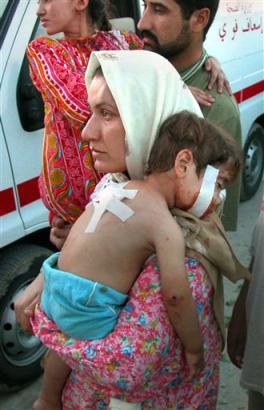
RAMADI, Nov 17 - U.S. military tank fire killed scores of civilians in Ramadi, capital of Al-Anbar province, late Monday night, according to witnesses and doctors. Anger and frustration were evident at the hospitals and during the funerals in the following days.

Iraqi doctors and witnesses at the scene of the attack said U.S. tanks killed 35 civilians when they shelled several homes in the Al-Dhubat area of the city.

Ramadi, located 110 km west of Baghdad, has been beset with sporadic but intense violence between occupation forces and insurgents for several months.

On Tuesday, hundreds of people carried the 35 coffins of the dead to a graveyard in a funeral procession which closely resembled an angry demonstration.

"We heard the bombing and we thought it was the usual fighting between resistance fihters and the Americans, but we soon realised it was bombing by large cannons," 60-year-old Haji Jassim explained to IPS at the burial. "We weren't allowed by the Americans to reach the destroyed houses to try to rescue those who were buried, so certainly many of them bled to death."

Jassim claimed that everyone killed was innocent, that they were not fighters. He said that when he and others attempted to reach the rubble of the destroyed homes, located near mosques whose minaret's loudspeakers had broadcast pleas for help, "There was a big American force that stopped us and told us the usual ugly phrases we hear from them every day."

Jassim, speaking with IPS while several other witnesses listened while nodding their heads, said that ambulances did not appear on the scene for hours because "we realised that the Americans did not allow them to move," and that as a result, "there were people buried under the rubble who were bleeding to death while there was still a chance to rescue them."

Jassim then burst into tears and walked away saying prayers to Allah to bless the souls of the dead.

A doctor at Ramadi's main hospital, Abdullah Salih, told reporters that 35 bodies had been brought in and he also believed that others had not been retrieved since access had been limited by ongoing U.S. military operations.

Another doctor, Kamal al-Ani, said that in addition to the dead, another 17 wounded had been brought into the hospital.

The scene at the hospital was tragic as doctors confirmed the reason of death for many as severe bleeding that had gone on for several hours. Most of the doctors were unwilling to discuss too many details for fear of U.S. military reprisals.

"You can notice the number of dead is at least twice as high as the number of wounded," one of the doctors, speaking on condition of anonymity, told IPS. A local Iraqi policeman who identified himself as Khalif Obeidi told IPS that tanks had destroyed several houses in the area during the U.S. raid, killing more than 30 civilians.

"We know that those killed were innocent," said Obeidi, "although there have been attacks on the Americans from near that area in the past."

Residents of the city and relatives of the dead who were at the funeral were furious.

"There is no other way for the Sunnis than to fight," Ali Khudher, a 25-year-old carpenter who lost a relative in the attack told IPS. "It is a religious war and no one can deny that now."

Others who attended the mass funeral chanted anti-American, anti-Israeli, anti-Iranian and even slogans against the Islamic Party which is now part of the Iraqi government.

Tempers run high in Ramadi also because the city has often been the scene of large-scale U.S. military operations and their inherent forms of collective punishment.

Last June, thousands of residents were forced from their homes due to military operations, according to Maurizio Mascia, programme manager for the Italian Consortium of Solidarity (ICS), a non-governmental group based in Amman, Jordan that provides relief to refugees in Iraq.

At that time, Mascia told IPS, "The Americans, instead of attacking the city all at once like they've done in their previous operations in cities like Fallujah and Al-Qa'im, are using helicopters and ground troops to attack one district at a time in Ramadi."

Mirroring a complaint heard often from residents of Ramadi, Mascia said, "The main dangers for the population are the MNF (multi-national force) at the checkpoints and the snipers: both usually shoot at any movement that they consider dangerous -- causing many victims among civilians."

In a phone conversation with IPS, a spokesman for the U.S. military in Baghdad said he had no specific details of the incident and that "the U.S. military has been conducting ongoing patrols and security details in Al-Anbar for months now. Our efforts are always to attack the terrorists and protect the civilian population."

Posted by Dahr_Jamail at November 17, 2006 06:01 PM

Tuesday, November 14, 2006

HANGING SADDAM HUSSEIN - BURYING WESTERN COMPLICITY from MEDIA LENS


The BBC website’s reporting of the judgement was big, bold and triumphal: “Celebrations hail Saddam verdict in Baghdad's Shia-dominated Sadr City.” (BBC news online, November 5, 2006)

The following day, the New York Times website echoed the emphasis:

"Quotation Of The Day: ‘This is a very great happiness. I will never forget this day.’ Abdul Razzaq Hassan, a laborer, on the sentencing of Saddam Hussein."

A few lines below, however, a more realistic version of events could be found: "In a Divided Iraq, Reaction to Saddam Death Sentence Conforms to Sectarian Lines - The guilty verdict was met with carefree celebration in Shiite towns and brooding bitterness in Sunni ones." (Sabrina Tavernise, New York Times, November 6, 2006)

In other words, the response in Iraq was, of course, mixed. But both the BBC and the New York Times chose a focus that presented the verdict as a joyous success for the occupying forces.

Although Britain outlawed the death penalty 40 years ago, the editors of the Independent had few qualms about the former tyrant’s fate:

“Shed no tears for Saddam. He was undoubtedly guilty of mass murder... The chemical weapons attack he ordered on the Kurdish town of Halabja in 1988 alone killed at least 5,000.“ (Leader, ‘Justice in Baghdad - It's too late for the conviction of Saddam to help heal Iraq,’ The Independent, November 6, 2006)

It was predictable that Halabja would be mentioned. It was equally predictable that crucial context would be missing. In the same edition of the paper, the Independent’s outspoken reporter Robert Fisk noted some of the things that Saddam had not been allowed to comment on in his trial: “sales of [British and American] chemicals to his Nazi-style regime so blatant - so appalling - that he has been sentenced to hang on a localised massacre of Shias rather than the wholesale gassing of Kurds over which George W Bush and Lord Blair of Kut al-Amara were so exercised when they decided to depose Saddam“. (Fisk, ‘This was a guilty verdict on America as well,’ The Independent, November 6, 2006)

Fisk's point was obvious, and vital for anyone who cares about democracy and honest government. But the Independent editorial turned a blind eye to it.

We wrote to Mary Dejevsky who has written many Independent editorials on foreign affairs. We asked her: “Today's Independent leader mentions Halabja, but not the US-UK support that made it possible - why not?” (Email to Dejevsky, November 6, 2006)

Dejevsky replied the same day: “I can honestly say I have absolutely no idea. Probably because the person writing the leader had enough to say about trial, death penalty etc.”

Alas, newspaper space is always in short supply. But the real problem is never discussed: a rigorous form of intellectual segregation that ensures there is little or no room in mainstream pages for the black deeds of our governments. Rare doses of honesty are permitted - typically from a few veteran reporters such as Fisk, John Pilger and Seymour Hersh - but these act as fig leaves obscuring the deep bias of most mainstream reporting and commentary.


Halabja And “Opportunities For Sales”

Five months after Halabja, British foreign secretary Geoffrey Howe noted in a secret report that "opportunities for sales of defence equipment to Iran and Iraq will be considerable". (Quoted, Mark Curtis, Web of Deceit, Vintage, 2003, p.37)

The British government doubled export credits to Baghdad, rising from £175 million in 1987 to £340 million in 1988.

In the first year after the gassing, the British government consistently rejected reports that its ally, Saddam Hussein, had used chemical weapons, stating that the evidence "was compelling but not conclusive". Human Rights Watch reported that its evidence was simply ignored by the Foreign Office, describing the British government as "singularly unreceptive". (Ibid)

Also after Halabja, the US approved the export of virus cultures and a $1 billion contract to design and build a petrochemical plant that the Iraqis planned to use to produce mustard gas. Profits were the chief concern. Indeed, "so powerful was the grip of the pro-Baghdad lobby on the administration of Republican President Ronald Reagan," Dilip Hiro wrote, "that it got the White House to foil the Senate's attempt to penalise Iraq for its violation of the Geneva Protocol on Chemical Weapons to which it was a signatory". (Hiro, 'When US turned a blind eye to poison gas', The Observer, September 1, 2002)

Walter Lang, a former senior US defence intelligence officer, explained: "The use of gas on the battlefield by the Iraqis was not a matter of deep strategic concern." (Patrick E. Tyler, ‘Officers say U.S. aided Iraq in war despite use of gas’, New York Times, August 18, 2002)

The US continued to support Iraq after the Iran-Iraq war because of "our duty to support US exports," the State Department declared in early 1990. (Quoted, Noam Chomsky, ‘Hegemony or Survival’, Routledge, 2003, p.111)

In fact, it was the United States that helped Saddam into power. In a rare glimpse of the truth in the New York Times, historian Roger Morris observed:

"As its instrument the CIA had chosen the authoritarian and anti-Communist Baath Party, in 1963 still a relatively small political faction influential in the Iraqi Army. According to the former Baathist leader Hani Fkaiki, among party members colluding with the CIA in 1962 and 1963 was Saddam Hussein.” (Morris, 'A Tyrant 40 Years in the Making,' The New York Times, March 14, 2003)

Western scholars and human rights groups report that the 1963 coup was accompanied by a major bloodbath. Using “lists of suspected Communists and other leftists provided by the CIA,” the Baathists murdered untold numbers of Iraq's educated elite - “killings in which Saddam Hussein himself is said to have participated". (Ibid)


Trooping The Colour

The media’s patriotic response to the judgement on Saddam Hussein is not an isolated phenomenon. When US tanks entered Baghdad on April 9, 2003, BBC journalists did not conceal their delight. The BBC's Nicholas Witchell declared of the rapid advance: "It is absolutely, without a doubt, a vindication of the strategy." (BBC News at Six, April 9, 2003)

The BBC's breakfast news presenter, Natasha Kaplinsky, beamed as she described how Blair "has become, again, Teflon Tony". The BBC's Mark Mardell agreed: "It has been a vindication for him." (BBC1, Breakfast News, April 10, 2003)

The mainstream media consistently rally to the patriotic cause in this way. Indeed it is so standard that it is unnoticed, like the air we breathe.

On June 11, 2005, senior BBC news presenter and interviewer, Huw Edwards, provided the celebratory commentary for Britain’s Trooping The Colour military parade, describing it as “a great credit to the Irish Guards“. A more militaristic, jingoistic occasion it is hard to imagine. And yet this is a media professional who is otherwise offered up as one of the BBC's neutral journalists on politics and foreign affairs.

The Independent editorial discussed above even declared:

“Had Iraq now become the showcase for Middle Eastern democracy that Mssrs Bush and Blair promised, Saddam's trial might have been the crowning achievement of the process.”

The "crowning achievement" of a “process” that involved nothing less than the supreme war crime - the launching of a war of aggression. And based on the clearest case of government lying and public deception in modern times.

Once again, at key moments in history, the liberal media stand ready to wave the flag.

Sunday, November 12, 2006

Bechtel Departure Removes More Illusions by Dahr Jamail and Ali al-Fadhily


Inter Press Service

BAGHDAD, Nov 9 (IPS) - The decision of the giant engineering company Bechtel to withdraw from Iraq has left many Iraqis feeling betrayed. In its departure they see the end of remaining hopes for the reconstruction of Iraq.

"It is much worse than in the time of Saddam Hussein," Communist Party member Nayif Jassim told IPS. "Most Iraqis wish Saddam would be back in power now that they lived out the hardships of the occupation. The Americans did nothing but loot our oil and kill our people."

Bechtel, whose board members have close ties to the Bush administration, announced last week that it was done with trying to operate in the war-torn country. The company has received 2.3 billion dollars of Iraqi reconstruction funds and U.S. taxpayer money, but is leaving without completing most of the tasks it set out to.

On every level of infrastructure measurable, the situation in Iraq is worse now than under the rule of Saddam Hussein. That includes the 12 years of economic sanctions since the first Gulf War in 1991, a period that former UN humanitarian coordinator for Iraq Dennis Halliday described as "genocidal" for Iraqis.

The average household in Iraq now gets two hours of electricity a day. There is 70 percent unemployment, 68 percent of Iraqis have no access to safe drinking water, and only 19 percent have sewage access. Not even oil production has matched pre-invasion levels.

The security situation is hellish, with a recent study published in the prestigious British medical journal Lancet estimating 655,000 excess deaths in Iraq as a result of the invasion and occupation.

The group Medact recently said that easily treatable conditions such as diarrhoea and respiratory illness are causing 70 percent of all child deaths, and that "of the 180 health clinics the U.S. hoped to build by the end of 2005, only four have been completed -- and none opened."

A proposed 200 million dollar project to build 142 primary care centres ran out of cash after building just 20 clinics, a performance that the World Health Organisation described as "shocking."

Iraqis are complaining louder now than under the sanctions. Lack of electricity has led to increasing demand for gasoline to run generators. And gasoline is among the most scarce commodities in this oil-rich country.

"We inherited an exhausted electricity system in generating stations and distributing nets, but we were able to supply 50 percent of consumer demand during heavy load periods, and more than that during ordinary days," an engineer with the Ministry of Electricity told IPS.

"The situation now is much worse and it seems not to be improving despite the huge contracts signed with American companies. It is strange how billions of dollars spent on electricity brought no improvement whatsoever, but in fact worsened the situation."

The engineer said "we in the ministry have not received any real equipment for our senior stations, and the small transformers for the distributing nets were of very low standard."

Bechtel's contract included reconstruction of water treatment systems, electricity plants, sewage systems, airports and roads.

Two former Iraqi ministers of electricity were charged with corruption by the Iraqi Commission of Integrity set up under the occupation. One of them, Ayham al-Samarraii, was sentenced to jail but was taken away by his U.S. security guards. He insisted that it was not he who looted the ministry's money.

Managers at water departments all over Iraq say that the only repairs they managed were through UN offices and humanitarian aid organisations. The ministry provided them with very little chlorine for water treatment. New projects were no more than simple maintenance moves that did little to halt collapsing infrastructure.

Bechtel was among the first companies, along with Halliburton, where U.S. Vice-President Dick Cheney once worked, to have received fixed-fee contracts drawn to guarantee profit.

Ahmed al-Ani who works with a major Iraqi construction contracting company says the model Bechtel adopted was certain to fail.

"They charged huge sums of money for the contracts they signed, then they sold them to smaller companies who resold them again to small inexperienced Iraqi contractors," Ani told IPS. "These inexperienced contractors then had to execute the works badly because of the very low prices they get, and the lack of experience."

Some Iraqi political analysts, rather optimistically, look at Bechtel's departure from a different angle.

"I see the beginning of a U.S. withdrawal from Iraq," Maki al-Nazzal told IPS. "It started with Bechtel and Haliburton's propaganda, and might end with their escape from the field. They came with Bremer and introduced themselves as heroes and saviours who would bring prosperity to Iraq, but all they did was market U.S. propaganda."

U.S. President George W. Bush told reporters on a visit to Iraq last June: "You can measure progress in megawatts of electricity delivered. You can measure progress in terms of oil sold on the market on behalf of the Iraqi people."

By his standards, the position in Iraq is now much worse.

Now let's charge Saddam's accomplices by John Pilger.


In his latest column for the New Statesman, John Pilger wonders why Saddam should be alone in the dock. Surely, those who aided and abetted his crimes, and were accomplices in other great crimes committed against the Iraqi people, should be prosecuted, too.

Let's start with George Bush senior, Saddam's sponsor, and let's not forget those journalists who echoed Bush junior's and Blair's lies that justified the invasion of Iraq.

In a show trial whose theatrical climax was clearly timed to promote George W Bush in the American midterm elections, Saddam Hussein was convicted and sentenced to hang. Drivel about “end of an era” and “a new start for Iraq” was promoted by the usual false moral accountants, who uttered not a word about bringing the tyrant’s accomplices to justice. Why are these accomplices not being charged with aiding and abetting crimes against humanity? Why isn’t George Bush Snr being charged?

In 1992, a congressional inquiry found that Bush as president had ordered a cover-up to conceal his secret support for Saddam and the illegal arms shipments being sent to Iraq via third countries. Missile technology was shipped to South Africa and Chile, then “on sold” to Iraq, while US Commerce Department records were falsified. Congressman Henry Gonzalez, chairman of the House of Representatives Banking Committee, said: “[We found that] Bush and his advisers financed, equipped and succoured the monster...”

Why isn’t Douglas Hurd being charged? In 1981, as Britain's Foreign Office minister, Hurd travelled to Baghdad to sell Saddam a British Aerospace missile system and to “celebrate” the anniversary of Saddam’s blood-soaked ascent to power. Why isn’t his former cabinet colleague, Tony Newton, being charged? As Thatcher’s trade secretary, Newton, within a month of Saddam gassing 5,000 Kurds at Halabja (news of which the Foreign Office tried to suppress), offered the mass murderer £340m in export credits.

Why isn’t Donald Rumsfeld being charged? In December 1983, Rumsfeld was in Baghdad to signal America’s approval of Iraq’s aggression against Iran. Rumsfeld was back in Baghdad on 24 March 1984, the day that the United Nations reported that Iraq had used mustard gas laced with a nerve agent against Iranian soldiers. Rumsfeld said nothing. A subsequent Senate report documented the transfer of the ingredients of biological weapons from a company in Maryland, licensed by the Commerce Department and approved by the State Department.

Why isn’t Madeleine Albright being charged? As President Clinton’s secretary of state, Albright enforced an unrelenting embargo on Iraq which caused half a million “excess deaths” of children under the age of five. When asked on television if the children’s deaths were a price worth paying, she replied: “We think the price is worth it.”

Why isn’t Peter Hain being charged? In 2001, as Foreign Office minister, Hain described as “gratuitous” the suggestion that he, along with other British politicians outspoken in their support of the deadly siege of Iraq, might find themselves summoned before the International Criminal Court. A report for the UN secretary general by a world authority on international law describes the embargo on Iraq in the 1990s as “unequivocally illegal under existing human rights law”, a crime that “could raise questions under the Genocide Convention”. Indeed, two past heads of the UN humanitarian mission in Iraq, both of them assistant secretary generals, resigned because the embargo was indeed genocidal. As of July 2002, more than $5bn-worth of humanitarian supplies, approved by the UN Sanctions Committee and paid for by Iraq, were blocked by the Bush administration, backed by the Blair and Hain government. These included items related to food, health, water and sanitation.

Above all, why aren’t Blair and Bush Jnr being charged with “the paramount war crime”, to quote the judges at Nuremberg and, recently, the chief American prosecutor – that is, unprovoked aggression against a defenceless country?

And why aren’t those who spread and amplified propaganda that led to such epic suffering being charged? The New York Times reported as fact fabrications fed to its reporter by Iraqi exiles. These gave credibility to the White House’s lies, and doubtless helped soften up public opinion to support an invasion. Over here, the BBC all but celebrated the invasion with its man in Downing Street congratulating Blair on being “conclusively right” on his assertion that he and Bush “would be able to take Baghdad without a bloodbath”. The invasion, it is reliably estimated, has caused 655,000 “excess deaths”, overwhelmingly civilians.

If none of these important people are called to account, there is clearly only justice for the victims of accredited “monsters”.

Is that real or fake justice?

Fake.

IRAQ POST US ELECTIONS-PATRICK COCKBURN, BAGDAD


Conciliation Toward Iran and Syria?
"We Worry About Staying Alive, Not the U.S. Elections"

By PATRICK COCKBURN

"A mortar round exploded on the roof of my next-door neighbour's house, frightening my whole family," said Marwan, a friend in Baghdad. "We worry about staying alive, not about the outcome of elections in the US or whether Saddam Hussein lives or dies."

Iraqis see that, realistically, the options available to the US are limited because it is so firmly stuck in a morass. It is not just that Donald Rumsfeld did not succeed in fulfilling his early boasts about defeating the insurgents.

The more astute and carefully thought-out strategy of the outgoing US envoy in Baghdad, Zalmay Khalilzad, has also failed. He has tried for over a year to conciliate the five million Sunni Arabs whose uprising defeated US ambitions and led to this week's defeat of the Republicans at the polls. He brought Sunni politicians into government, started talks with rebels and tried to reverse de-Baathification.

It did not work and attacks on US troops have risen. Islamists and nationalists are not likely to compromise with US occupiers. At the same time, the Shia majority has become more alienated from the US. Only Kurds support occupation wholeheartedly.

Another reason, one that goes to the root of the US quandary, underlies why Washington has shifted to the Sunni. America did not overthrow Saddam in 1991 because it did not want his regime to be succeeded by Shia parties sympathetic to Iran.

But, 15 years later, this is the dire situation facing the US. As a result, American policy is, in practice, to have an Iraqi government strong towards the insurgents but weak in all other respects.

Just before the midterms, the US Army was gearing up to confront the Mehdi Army of the Shia cleric Muqtada al-Sadr. The siege of Sadr City, home to 2.5 million Shias in Baghdad, was abandoned on the insistence of Prime Minister Nouri al-Maliki. But some Iraqi politicians believe that, with the vote out of the way, the US will be eager for a fight.

A likely change in US policy over the next two years is to be more conciliatory towards Iran and Syria. At the start of the war President Bush said more or less openly that, after regime change in Baghdad, Tehran and Damascus would get the same treatment. They had every incentive to make sure that the US would fail in Iraq. But it has never been clear how much the Iranian and Syrian governments did aid the guerrillas. Given Washington's ability to shoot itself in both feet, Iraq's neighbors may not have had to do much so far. But they, along with Turkey, could do things in future as US power in Iraq wanes.

Mr Bush will continue to decide US policy in Iraq and this will limit the amount of change Iraqis are going to see. The administration spent three years digging itself into a deep hole--and may spend the same amount of time digging itself out.

Patrick Cockburn is the author of 'The Occupation: War, resistance and daily life in Iraq', published by Verso. from Countrpunch

Saturday, November 11, 2006

The War of the Snipers


"Juba Returns," and Other Snuff Films from Iraq

American soldiers stand around in a busy Baghdad street unaware that they are being closely watched. A gunner stands in the turret of a US armored vehicle guarding the men on foot.

The sniper team watching the US troops from several hundred yards is waiting for a clear shot. There is the sniper himself and a spotter who is also operating a video camera. For a few moments they are frustrated by the number of Iraqis milling around and obscuring the soldiers.

"People are around them", warns the spotter .

"Want me to find another place?"

"No, no. Give me a moment" says the man with the gun.

There is a pause and then the crash of a shot and the gunner in the vehicle is hit and slumps forward. "Allahu Akbar" -- God is Great, says the sniper.

The dialogue comes from one of many CD-videos being distributed in Baghdad by the Islamic Army showing their snipers at work. One distributed in Sunni parts of Baghdad at the end of Ramadan last month shows 28 separate attacks in several of which US soldiers are seen being hit in the head from long distance.

The most recent propaganda video is about a black-masked man identified as "Juba, the Baghdad Sniper" and shows him prowling Baghdad in search for unwary American troops. At one moment Juba is seen adding another 'kill' to a list of 37 on a piece of paper on a wall.

Possibly the film is a collection of videos of different snipers at work.

The film is important for two reasons. There do seem to be more highly accurate snipers hunting US soldiers. The most effective weapon used by insurgents hitherto has been the bomb in or beside the road--the notorious IED (Improvised Explosive Devices). These have caused at least 998 or 35 per cent of US combat deaths. There are no precise figures from the American side for casualties caused by snipers but 272 soldiers have been killed by small arms fire and a further 425 by unspecified hostile fire. US soldiers are peculiarly vulnerable to snipers because much of the fighting in Iraq takes place in an urban or semi-urban environment so it is relatively easy for a sniper to hide and to escape. Although US soldiers are weighed down with body armor these days there is no point in vehicle patrols unless one soldier at least is visible and looking around him.

The personalizing of a single sniper called Juba also shows an advance in insurgent propaganda techniques, in this case by the Islamic Army. Previous videos often just show US Humvees disappearing in a cloud of dust as an IED explodes. In this one, entitled "Juba Returns" , an earlier version started circulating in Baghdad in November 2005 -- the commander who narrates the film says the Islamic Army now has a fair number of snipers. He adds: "The idea of filming the operation is very important because the scene that shows the falling soldier after he is hit has far more impact on the enemy."

Snipers have always fascinated film makers, propagandists and the general public because they personalize men making war. The most famous in recent wars was Vassili Zaitsev who in the space of a few days during the Battle of Stalingrad became a Soviet national hero for killing 40 German soldiers, newspapers gloatingly dwelling on this Siberian hunter's ability to kill a man with a single bullet. Accounts were published, apparently fictional, about how the Germans had sent the head of their sniper school from Berlin to kill Zaitsev. After a prolonged duel the Siberian sniper shot him.

In Baghdad the rise of the sniper will increase the already numerous ways that Iraqi civilians can die. It is they , and not the Americans or the insurgents , who make up the great majority of the casualties. It has long been evident that US snipers have been picking off people who use their mobile phones close to a US position and are suspected of planning to detonate a bomb. I myself once stopped my car to use a satellite phone on an apparently empty road north from Baghdad when a single shot rang out and a bullet hit the road just in front of us. Looking around I saw it had come from a US position 800 yards away that I had not noticed.

Many Iraqis receive no warning shots and are killed immediately. Other victims of US snipers are people walking along roads with shovels who are suspected of planting IEDs but may be farmers or construction workers.

The Islamic Army snipers show themselves on video attacking Americans. But there are growing reports from Baghdad of Sunni and Shia snipers shooting into districts of the other community. As communities live in increasingly homogenous neighbourhoods a Sunni sniper firing at civilians in the street can be increasingly certain of hitting a Shia and vice versa.

The "Juba Returns" video says that Islamic Army snipers favor the Tabuk sniper rifle which was produced in Iraq from a Yugoslav design.

It is accurate up to 500-600 yards and has the advantage of using standard Kalashnikov ammunition that is available all over Iraq.

The "commander" in the video says that Islamic Army marksmen rely on a training manual written by a retired US special forces officer called Major John L. Plaister entitled "Ultimate Sniper" It is freely available from bookshops and was updated for "today's Global War on Terror."

The puerile worship of the sniper is a relatively modern development in the US. During the Civil War snipers were much disliked by both sides because they killed men who were normally left alone by other soldiers such as men relieving themselves. As a result snipers were seldom taken prisoner but were shot on the spot by their captors.

Patrick Cockburn is the author of 'The Occupation: War, resistance and daily life in Iraq', from CounterPunch

Lessons of Iraq War Start With US History by Howard Zinn


Published on Tuesday, March 14, 2006 by The Progressive

On the third anniversary of President Bush's Iraq debacle, it's important to consider why the administration so easily fooled so many people into supporting the war.

I believe there are two reasons, which go deep into our national culture.

One is an absence of historical perspective. The other is an inability to think outside the boundaries of nationalism.

If we don't know history, then we are ready meat for carnivorous politicians and the intellectuals and journalists who supply the carving knives. But if we know some history, if we know how many times presidents have lied to us, we will not be fooled again.

President Polk lied to the nation about the reason for going to war with Mexico in 1846. It wasn't that Mexico "shed American blood upon the American soil" but that Polk, and the slave-owning aristocracy, coveted half of Mexico.

President McKinley lied in 1898 about the reason for invading Cuba, saying we wanted to liberate the Cubans from Spanish control, but the truth is that he really wanted Spain out of Cuba so that the island could be open to United Fruit and other American corporations. He also lied about the reasons for our war in the Philippines, claiming we only wanted to "civilize" the Filipinos, while the real reason was to own a valuable piece of real estate in the far Pacific, even if we had to kill hundreds of thousands of Filipinos to accomplish that.

President Wilson lied about the reasons for entering the First World War, saying it was a war to "make the world safe for democracy," when it was really a war to make the world safe for the rising American power.

President Truman lied when he said the atomic bomb was dropped on Hiroshima because it was "a military target."

And everyone lied about Vietnam -- President Kennedy about the extent of our involvement, President Johnson about the Gulf of Tonkin and President Nixon about the secret bombing of Cambodia. They all claimed the war was to keep South Vietnam free of communism, but really wanted to keep South Vietnam as an American outpost at the edge of the Asian continent.

President Reagan lied about the invasion of Grenada, claiming falsely that it was a threat to the United States.

The elder Bush lied about the invasion of Panama, leading to the death of thousands of ordinary citizens in that country. And he lied again about the reason for attacking Iraq in 1991 -- hardly to defend the integrity of Kuwait, rather to assert U.S. power in the oil-rich Middle East.

There is an even bigger lie: the arrogant idea that this country is the center of the universe, exceptionally virtuous, admirable, superior.

If our starting point for evaluating the world around us is the firm belief that this nation is somehow endowed by Providence with unique qualities that make it morally superior to every other nation on Earth, then we are not likely to question the president when he says we are sending our troops here or there, or bombing this or that, in order to spread our values -- democracy, liberty, and let's not forget free enterprise -- to some God-forsaken (literally) place in the world.

But we must face some facts that disturb the idea of a uniquely virtuous nation.

We must face our long history of ethnic cleansing, in which the U.S. government drove millions of Indians off their land by means of massacres and forced evacuations.

We must face our long history, still not behind us, of slavery, segregation and racism.

And we must face the lingering memory of Hiroshima and Nagasaki.

It is not a history of which we can be proud.

Our leaders have taken it for granted, and planted the belief in the minds of many people that we are entitled, because of our moral superiority, to dominate the world. Both the Republican and Democratic Parties have embraced this notion.

But what is the idea of our moral superiority based on?

A more honest estimate of ourselves as a nation would prepare us all for the next barrage of lies that will accompany the next proposal to inflict our power on some other part of the world.

It might also inspire us to create a different history for ourselves, by taking our country away from the liars who govern it, and by rejecting nationalist arrogance, so that we can join people around the world in the common cause of peace and justice.

Howard Zinn, who served as a bombardier in the Air Force in World War II, is the author of "A People's History of the United States" (HarperCollins, 1995). He is also the co-author, with Anthony Arnove, of "Voices of a People's History of the United States" (Seven Stories Press, 2004).

Friday, November 10, 2006

Rumsfeld's Henny Penny Excuse by Shane Elson


Rumsfeld's Henny Penny Excuse by Shane Elson

As our thoughts turn to the results of the US congressional mid-terms, we
should spare a thought for one of the unfortunate causalities of this
political skirmish. It seems the first person to be sidelined as
"collateral damage" is Donald Rumsfeld who resigned to leave his protege,
George W. Bush to hold the can. Rummy is spoken of as a 'good ole boy'.
A "patriot" according to George W Bush. A defender of all things American.
Well most things American.

Well a few things American. Actually, nothing really American as such but more like a defender of good ole fashioned capitalist enterprise and number one - himself.You see, going into
Iraq was for Rummy, a rather cathartic experience. He and his fellow
"hawks" in the White House, had their hearts set on giving Saddam a bit of
'what for' ever since George the Shrub's dad decided that his oil interests
in the region were safe and pulled out the troops. Back then it was a
slap in the face for Rummy who had, only some six or seven years earlier
been shaking hands with Saddam and whispering sweet nothings in his ear.
Saddam was supposed to reciprocate and open up his country to the
exploitation of the US multinationals. However, Saddam got cold feet.
Well, actually, he didn't get cold feet. Rather, he began to listen to
those who told him the wealth was far greater than that which the US was
willing to pay. So, as any good business man does, he began to look around
for others who might offer him a better deal.

The Russians, the French, the Germans and even the British, who has made a hasty retreat some 40 years earlier, were interested. Gaining the interest of other potential
bidders spurred Saddam on to reconsider the US deal and he eventually got
back to his American suitors and wanted to renegotiate it. There was
uproar. The 'friend' of the US was now turning into the 'enemy' of the US.
A 'dictator' was "outed" and new ground rules spelled out in no uncertain
terms. The US, while allowing a tyrant to dictate to others would brook no
back-chat from any one, let alone a tin pot, cigar smoking, Arab tyrant
they had invested a lot of money in so their interests were protected.
So, with Rummy mincing about in the background, not quite being in the
inner circle of Bush the First's clique, the US decided that a little
country many of us had never heard of, with a name we weren't sure of, in
a place we didn't know, was going to be, literally, the beach head for
it's attack against the "butcher of Baghdad".

And, so it was, with CNN cameras to capture the action the US troops stormed ashore, hero's before the first bodies had their lives removed. The neo-cons, including the
current Vice President, Dick Chenney, were beside themselves with glee.
This was their moment to retrieve the pride from the ignominy that was the
withdrawal from Vietnam some 20 years prior and the chance for the US to
declare the cold war won and they the victors. Unfortunately for them,
George Senior had other ideas.

The Bush family investments in the region lay just off the coast in the oil terminals that kept the tankers fed with Iraqi oil. Bush Senior realised that if he allowed the troops to
storm all the way to Baghdad that the oil might dry up completely. His
terminals were fed from the northern and eastern oil fields and the pipes
that delivered the oil were vulnerable. In short, he needed Saddam in
power to hold the various, potentially warring factions at bay so the
crude could keep flowing. So he took the only option open, made a bold
business decision and pulled out of Iraq once he was sure Saddam realised
that if he wanted to continue in the lifestyle to which he had become
accustomed, then he should reconsider his options.

Saddam didn't like this and thought the Americans were part crazy and part bluff. However,
the international sanctions that were subsequently imposed began to hurt
the Iraqi people. While Saddam was quite free to wheel and deal in oil for
food, his people began to suffer. Again the practicalities of wealth
demanded that so long as the oil kept flowing out, and Saddam kept a lid
on the potential revolt of his suffering people for as long as possible,
the US would not act against him.

However, Saddam, like any other dictator, had a breaking point and by the late 1990's was attempting to establish deals with, again, the Russians, the French and the Germans.
While not ready to give away the wealth of his country, it would seem he
was ready to do deals just to stop the devastation of the sanctions. When
the 2000 US elections rolled around and Rummy and his mates found
themselves in the driving seat, they saw their chance to act. With George
W as their ventriloquist's dummy, the neo-cons enacted their plans.
Their "Project for a New American Century", concocted in the back alleys
of the White House by such notables as Paul Wolfowitz, Dick Chenney,
Richard Perle, William Crystal, Jeb Bush and Donald Rumsfeld was rolled
into action. Three years later the 'victors', no doubt, held a quite
little party somewhere to celebrate their win. Now, three years after that
little shindig, Rummy, following Perle's lead, has jumped ship leaving
behind him a right royal mess for someone else to clean up.

In doing so, Rummy has shown his true colours. He is no patriot, no good ole
American boy and certainly no defender of the US. Like so many of the
administration and I guess all of us, he is interested firstly in himself
and ensuring his own comfort and pleasure then trying to ensure these two
things are not upset but such inconveniences as, say, indictment by a now
potentially hostile Senate. Like Ken Lay of Enron infamy, Rummy will
defend his actions all the way to the grave.

In the three years since Rumsfeld's great adventure in Iraq began as many coalition soldiers have been killed as those who died in the fall of the twin towers and up to
four times as many will forever carry the scars. Tens of thousands of
Iraqi's have been killed, maimed or rendered incapacitated. Thousands of
men and women have been incarcerated and hundreds tortured all while
Rumsfeld derided anyone who questioned his determination as "Henny
Penny's" to whom the sky was forever falling.

What we now know of Rumsfeld is that he is the real chicken. No doubt, and as the US President has already said, Rumsfeld will be hailed by the neo-cons as a hero and
history will be rewritten to cast him as a 'visionary' and 'master
strategist'. However, for the thousands who actually took part in the
battles and skirmishes, he will forever remain a twisted and bitter old
man for whom "collateral damage" was term used only on the innocent
victims of war and never those who directed it.

Wednesday, November 08, 2006

Justice and Hypocrisy, A Guilty Verdict on America, as Well by By ROBERT FISK


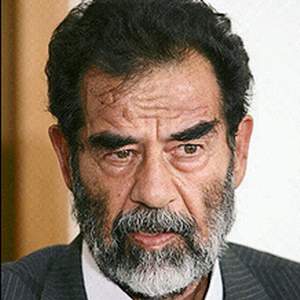
So America's one-time ally has been sentenced to death for war crimes he committed when he was Washington's best friend in the Arab world. America knew all about his atrocities and even supplied the gas--along with the British, of course--yet there we were yesterday declaring it to be, in the White House's words, another "great day for Iraq". That's what Tony Blair announced when Saddam Hussein was pulled from his hole in the ground on 13 December 2003. And now we're going to string him up, and it's another great day.

Of course, it couldn't happen to a better man. Nor a worse. It couldn't be a more just verdict--nor a more hypocritical one. It's difficult to think of a more suitable monster for the gallows, preferably dispatched by his executioner, the equally monstrous hangman of Abu Ghraib prison, Abu Widad, who would strike his victims on the head with an axe if they dared to condemn the leader of the Iraqi Socialist Baath Party before he hanged them. But Abu Widad was himself hanged at Abu Ghraib in
1985 after accepting a bribe to put a reprieved prisoner to death instead of the condemned man.

Bu we can't mention Abu Ghraib these days because we have followed Saddam's trail of shame into the very same institution. And so by hanging this awful man, we hope--don't we?--to look better than him, to remind Iraqis that life is better now than it was under Saddam.

Only so ghastly is the hell-disaster that we have inflicted upon Iraq that we cannot even say that. Life is now worse. Or rather, death is now visited upon even more Iraqis than Saddam was able to inflict on his Shias and Kurds and--yes, in Fallujah of all places--his Sunnis, too. So we cannot even claim moral superiority. For if Saddam's immorality and wickedness are to be the yardstick against which all our iniquities are judged, what does that say about us? We only sexually abused prisoners and killed a few of them and murdered some suspects and carried out a few rapes and illegally invaded a country which cost Iraq a mere 600,000 lives ("more or less", as George Bush Jnr said when he claimed the figure to be only 30,000). Saddam was much worse. We can't be put on trial. We can't be hanged.

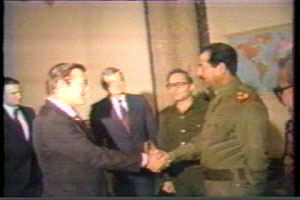
"Allahu Akbar," the awful man shouted--God is greater. No surprise there. He it was who insisted these words should be inscribed upon the Iraqi flag, the same flag which now hangs over the palace of the government that has condemned him after a trial at which the former Iraqi mass murderer was formally forbidden from describing his relationship with Donald Rumsfeld, now George Bush's Secretary of Defence. Remember that handshake? Nor, of course, was he permitted to talk about the support he received from George Bush Snr, the current US President's father. Little wonder, then, that Iraqi officials claimed last week the Americans had been urging them to sentence Saddam before the mid-term US elections.

Anyone who said the verdict was designed to help the Republicans, Tony Snow, the White House spokesman, blurted out yesterday, must be "smoking rope". Well, Tony, that rather depends on what kind of rope it might be. Snow, after all, claimed yesterday that the Saddam verdict--not the trial itself, please note--was "scrupulous and fair". The judges will publish "everything they used to come to their verdict."

No doubt. Because here are a few of the things that Saddam was not allowed to comment upon: sales of chemicals to his Nazi-style regime so blatant--so appalling--that he has been sentenced to hang on a localised massacre of Shias rather than the wholesale gassing of Kurds over which George W Bush and Lord Blair of Kut al-Amara were so exercised when they decided to depose Saddam in 2003--or was it in 2002? Or 2001? Some of Saddam's pesticides came from Germany (of course).

But on 25 May 1994, the US Senate's Committee on Banking, Housing and Urban Affairs produced a report entitled "United States Chemical and Biological Warfare-related Dual-use exports to Iraq and their possible impact on the Health Consequences (sic) of the Persian Gulf War".

This was the 1991 war which prompted our liberation of Kuwait, and the report informed Congress about US government-approved shipments of biological agents sent by American companies to Iraq from 1985 or earlier. These included Bacillus anthracis, which produces anthrax; Clostridium botulinum; Histoplasma capsulatum; Brucella melitensis; Clostridium perfringens and Escherichia coli. The same report stated that the US provided Saddam with "dual use" licensed materials which assisted in the development of chemical, biological and missile-system programmes, including chemical warfare agent production facility plant and technical drawings (provided as pesticide production facility plans).

Yes, well I can well see why Saddam wasn't permitted to talk about this. John Reid, the British Home Secretary, said that Saddam's hanging "was a sovereign decision by a sovereign nation". Thank heavens he didn't mention the £200,000 worth of thiodiglycol, one of two components of mustard gas we exported to Baghdad in 1988, and another £50,000 worth of the same vile substances the following year.

We also sent thionyl chloride to Iraq in 1988 at a price of only £26,000. Yes, I know these could be used to make ballpoint ink and fabric dyes. But this was the same country--Britain--that would, eight years later, prohibit the sale of diphtheria vaccine to Iraqi children on the grounds that it could be used for--you guessed it--"weapons of mass destruction".

Now in theory, I know, the Kurds have a chance for their own trial of Saddam, to hang him high for the thousands of Kurds gassed at Halabja. This would certainly keep him alive beyond the 30-day death sentence review period. But would the Americans and British dare touch a trial in which we would have not only to describe how Saddam got his filthy gas but why the CIA--in the immediate aftermath of the Iraqi war crimes against Halabja--told US diplomats in the Middle East to claim that the gas used on the Kurds was dropped by the Iranians rather than the Iraqis (Saddam still being at the time our favourite ally rather than our favourite war criminal). Just as we in the West were silent when Saddam massacred 180,000 Kurds during the great ethnic cleansing of 1987 and 1988.

And--dare we go so deep into this betrayal of the Iraqis we loved so much that we invaded their country?--then we would have to convict Saddam of murdering countless thousands of Shia Muslims as well as Kurds after they staged an uprising against the Baathist regime at our specific request--thousands whom webetrayed by leaving them to fight off Saddam's brutal hordes on their own. "Rioting," is how Lord Blair's meretricious "dodgy dossier" described these atrocities in 2002--because, of course, to call them an "uprising" (which they were) would invite us to ask ourselves who contrived to provoke this bloodbath. Answer: us.

I and my colleagues watched this tragedy. I travelled on the hospital trains that brought the Iranians back from the 1980-88 war front, their gas wounds bubbling in giant blisters on their arms and faces, giving birth to smaller blisters that wobbled on top of their wounds. The British and Americans didn't want to know. I talked to the victims of Halabja. The Americans didn't want to know. My Associated Press colleague Mohamed Salaam saw the Iranian dead lying gassed in their thousands on the battlefields east of Basra. The Americans and the British didn't care.

But now we are to give the Iraqi people bread and circuses, the final hanging of Saddam, twisting, twisting slowly in the wind. We have won. We have inflicted justice upon the man whose country we invaded and eviscerated and caused to break apart. No, there is no sympathy for this man. "President Saddam Hussein has no fear of being executed," Bouchra Khalil, a Lebanese lawyer on his team, said in Beirut a few days ago. "He will not come out of prison to count his days and years in exile in Qatar or any other place. He will come out of prison to go to the presidency or to his grave." It looks like the grave. Keitel went there. Ceausescu went there. Milosevic escaped sentence.

The odd thing is that Iraq is now swamped with mass murderers, guilty of rape and massacre and throat-slitting and torture in the years since our "liberation" of Iraq. Many of them work for the Iraqi government we are currently supporting, democratically elected, of course. And these war criminals, in some cases, are paid by us, through the ministries we set up under this democratic government. And they will not be tried. Or hanged. That is the extent of our cynicism. And our shame. Have ever justice and hypocrisy been so obscenely joined?

Robert Fisk is a reporter for The Independent and author of Pity the Nation. He is also a contributor to CounterPunch's collection, The Politics of Anti-Semitism. Fisk's new book is The Conquest of the Middle East.

From CounterPunch

Protecting Neither Facilities nor People by Dahr Jamail and Ali al-Fadhily


BAGHDAD, Nov 7 (IPS) - The Facilities Protection Service (FPS) created after the invasion of Iraq in 2003 has become the principal set of death squads in Iraq, senior leaders say.

"The first accomplishment of Paul Bremer (former U.S. administrator in Iraq) in Iraq was dissolving the Iraqi army and all security establishments," a consultant with an Iraqi ministry told IPS on condition of anonymity. "The man was granted the highest decoration by his President for a job well done."

The U.S. occupation authorities and the Iraqi leaders working with them set up new army and police forces under supervision of the Multi National Forces (MNF). It was decided that each ministry could establish its own protection force away from the control of the ministries of interior and defence.

Under Coalition Provisional Authority (CPA) Order Number 27, the FPS was established on April 10, 2003, the day after the fall of Baghdad.

This document states: "The FPS may also consist of employees of private security firms who are engaged to perform services for the ministries or governorates through contracts, provided such private security firms and employees are licensed and authorised by the Ministry of Interior."

Global Security.Org, a U.S. based security research group, says: "The Facilities Protection Service works for all ministries and governmental agencies, but its standards are set and enforced by the Ministry of the Interior. It can also be privately hired. The FPS is tasked with the fixed site protection of ministerial, governmental, or private buildings, facilities and personnel."

The security website adds: "The majority of the FPS staff consists of former service members and former security guards. The FPS will now secure public facilities such as hospitals, banks and power stations within their district. Once trained, the guards work with U.S. military forces protecting critical sites like schools, hospitals and power plants."

General Harith al-Fahad of the former Iraqi army says the FPS turned out to be no such thing. "All the forces formed were actually militias, not organised forces, because they were formed according to rations given to each party in power," he told IPS at a café in Baghdad, with explosions echoing in the background.

"Those politicians brought their followers into the so-called security forces. Others took bribes of 500 to 700 dollars from each applicant to be accepted regardless of standard regulations."

When sectarian violence spread across Iraq after the Shia shrine in Samarra was destroyed in February this year, "the FPS appeared to be the main force that conducted assassinations in Baghdad, and there is evidence that they did it for money."

This seems to continue. U.S. officers training Iraqi police told reporters last week that infiltration of police units by militia members could delay the handover of control of the Iraqi security forces for years.

"How can we expect ordinary Iraqis to trust the police when we don't even trust them not to kill our own men?" Capt. Alexander Shaw said. Shaw is head of the police transition team of the 372nd Military Police Battalion, a Washington-based unit charged with overseeing training of all Iraqi police in western Baghdad.

"To be perfectly honest, I'm not sure we're ever going to have police here that are free of the militia influence," he said.

Most of the infiltration is coming from the two large Shia militias, the Badr Organisation that is the armed wing of the pro-Iranian Supreme Council for Islamic Revolution in Iraq, and the Mehdi Army, the militia of the Shia cleric Muqtada al-Sadr.

Shaw said about 70 percent of the Iraqi police force has been infiltrated, and police officers are too afraid to patrol many areas of the capital.

"None of the Iraqi police are working to make their country better," Brig. Gen. Salah al-Ani, chief of police for western Baghdad told reporters recently. "They're working for the militias or to put money in their pocket."

Dr. Nameer Hadi recently left his post at a major Baghdad hospital because he felt threatened by the FPS.

"I saw them kill in cold blood a lady patient when they learned that she was the wife of a Sunni tribe leader," he told IPS. "I am a Shia believer, but this kind of crime is unbearable."

It is common knowledge in Baghdad that the FPS consists mainly of criminals who looted banks and government offices at the beginning of the U.S. invasion in April 2003. Many also believe that once the looters spent the money they stole, they needed a new source of income, and they were hired by local and regional powers for organised crime campaigns.

Iraq's interior minister Jawad al-Bolani rejected allegations last month that Iraq's police and military have played a major role in the death squads. He said it was the FPS, whose numbers he estimated to be 150,000, that was to blame for the astronomical level of violence.

"Whenever we capture someone, we rarely find anyone is an employee of the government ministries," Bolani said. "They've turned out to be mostly from the FPS."

In an interview on al-Arabiya satellite channel Oct. 21, official spokesman of the Iraqi government Dr. Ali al-Dabbagh accepted that security forces need to be "purified." He blamed mistakes made during the "Bremer Period" for the current level of killings.

With attacks on government targets mounting, it is also not certain how far the FPS has been effective in protecting facilities.

Posted by Dahr_Jamail at November 7, 2006 08:51 PM
Inter Press Service

Monday, November 06, 2006

Lieberman and the Decline of Israeli Democracy by URI AVNERY

URI AVNERY

In its original German form - Liebermann - the name means "lovable man". It is hard to imagine a name less appropriate for the new Deputy Prime Minister of Israel.

He is not lovable, neither in his personality nor in his views - and that is the understatement of the year.

His personal lovability can be judged by the fact that he was once arrested for beating up a boy who had quarreled with his son.

This week, the arrival of Liberman at the center of the political system marks the start of a new chapter in the annals of the State of Israel.

* * *

The time is not accidental. In all the 56 years of its existence, Israeli democracy has never been at such a low point as it is today.

In the elections half a year ago, almost 40% of the electorate did not vote at all - double the usual percentage.

Since then, corruption affairs have followed each other. The President of the State is awaiting indictment on several charges of rape and sexual misconduct. The Prime Minister is the subject of a whole series of investigations for corruption, in collusion with an assortment of local and foreign billionaires. Two ministers are already standing trial. Over Ariel Sharon and his family, a dark cloud of corruption affairs was hovering when he suffered his stroke. There is a general feeling that the ruling group in Israel is cynical and corrupt.

The corruption and cynicism of this group expresses itself also in its public behavior. Politicians in Israel - and around the world - have never been notable for their fulfillment of election promises. But here this has reached a new low - everything is being betrayed quite openly, in full view of the public.

Ehud Olmert campaigned on the basis of a specific and detailed plan - the "Convergence". Now, without batting an eyelid, he announces that it has been abandoned. He has only one plan left: to stay in power, whatever it takes.

Amir Peretz collected votes as the leader who was about to carry out a real "social" revolution, to put an end to the oppression of the weak and the underprivileged - the elderly, the sick, the unemployed and all the rest. The gap between rich and poor in Israel is one of the widest in the industrialized world. Peretz also promised to work towards peace with the Palestinians.

On the morrow of the elections, Peretz betrayed his promises openly, shamelessly and with Chutzpa. In order to further his personal career, he did not claim any social ministry, accepting the Ministry of Defense instead. Since then, he has been demanding the expansion of the military budget at the expense of social outlays. Instead of peace, he made war. This week he also violated his undertaking not to sit in a government that includes Avigdor Liberman. Almost all the Labor Party ministers are partners to this blatant betrayal, with the honorable exception Ofir Pines-Paz, who has resigned. (Four of his colleagues in the Labor Party, including Ehud Barak, are competing to take his place.)

The first noteworthy act of the Olmert-Peretz team was to get Israel into a superfluous and hopeless war. The irresponsibility of this decision to start a difficult and complex war compares only with the irresponsibility with which the war itself was conducted in all its phases. To add insult to injury, they blocked the appointment of an independent Judicial Commission of Inquiry.

The war has left the public with a profound sense of distress, on top of the disgust aroused by the political betrayals and the corruption affairs. Our democracy now appears completely rotten, corrupt and incompetent. A Hebrew proverb says that "the breach in the wall calls for the thief". The present situation calls for fascist forces.

Enter Liberman.

* * *

THE SPIN managers of Olmert and Peretz try to calm us down. What's so special about Liberman, they ask us.

So he advocates Transfer, the expulsion of the Arab citizens from Israel. He threatened to destroy Egypt by blowing up the Aswan Dam. He demanded the execution of the Israeli Arab Knesset members for meeting with Syrian and Hamas leaders. So what? Rehavam Ze'evi, whose memory was honored this week by a special commemoration session of the Knesset, proposed ethnic cleansing, and General Effi Eytam, the chief of the National Union party, uses similar language.

Such a person should not be allowed to enter the government? Why not? After all, Liberman has already been a member of the government, and so had Ze'evi and Eytam.

This argument misses the point. The Liberman who joined Sharon's government five years ago represented a marginal group of new immigrants, which was not taken seriously. Sharon was a strong leader, and his ministers were unimportant. But the Liberman that has joined the Olmert government is something else: the leader of a strong party that is getting stronger, under a Prime Minister who is a small party functionary, with whom most of the public is fed up.

The Liberman party is quite different from the fictitious Kadima Party and the decomposing Labor Party. It is organized on military lines, with Liberman as its one, unquestioned leader. It has organized most of the immigrants from the former Soviet Union, and is expanding into other communities, too. It appeals to the poor and downtrodden. It resembles the Bolshevik party that Liberman knew as a young man in the Soviet Union. (To coin a formula: Bolshevism minus Marxism equals Fascism.)

When the democratic system arouses public contempt, and when the view that "all politicians are crooks" and "the system is rotten to the core" is gaining ground, such a person is a real danger to democracy.

* * *

AN OLD maxim says that Israel can fulfill only two of its three desires: to be a Jewish state, to be a democratic state and to hold on to all of the territory between the Mediterranean and the Jordan. It can hold on to the whole territory and be democratic - but then it will not be a Jewish state. It can hold on to the territory and be Jewish - but than it will not be a democratic state. It can be a Jewish and democratic state - but then it cannot hold on to all the territory.

This has been the basis of Israeli policy from the very beginning. The main argument for Sharon's "Separation" and Olmert's "Convergence" was exactly this: that in order for Israel to remain Jewish and democratic, it must give up those parts of the occupied Palestinian territories with a dense Arab population.

The extreme Right has an answer that resembles the egg of Columbus: all three aims can indeed be attained. The solution is ethnic cleansing - the expulsion of the whole of the Arab population.

That is difficult to carry out in a democratic system. Therefore, this aim almost automatically means that there must be a "strong leader". Meaning: an overt or disguised dictatorship.

Mostly this is not said openly, but by hints accompanied with a wink. Liberman, too, does not say so openly. But if one listens closely to what he says, one can draw the conclusions oneself.

* * *

THE MOST depressing phenomenon at this moment is the lack of public reaction.

The betrayal of the Labor Party could have been expected. Amir Peretz did indeed swear that he would never sit in a government with Liberman, but in order to remain a minister he is quite prepared to sell his principles. No great outcry could be expected from Meretz either, after Yossi Beilin had his well publicized breakfast with Liberman and heaped praise on him and his herrings.

But the general public does not seem shocked, either. Here and there some articles did appear, but they did not point out the existential danger threatening the Israeli republic. Even the Arab public in Israel, whose very existence is menaced by Liberman, has not set in motion a real protest. On the 1976 "Land Day", when the Arab citizens protested against the expropriation of their land, it looked different. As it did in October 2000, when the Israeli Arab public protested against a suspected threat to the al Aqsa mosque.

What is the reason for this weak reaction, which is so like the last days of the Weimar republic?

There is a growing disdain for the democratic system. There is a general fatigue after the shocks of the last year. There is a withdrawal into private cares. For the "persons in the street", it is difficult to imagine the dangers. He and she are so used to democracy, that they cannot imagine what it means to live without it. They are sure that "It Can't Happen Here".

Perhaps they are right?

At the end of the 19th century, there was a French general called Georges Boulanger. Everybody expected him to carry out a military coup d'etat at any moment. But the general hesitated, postponed the much talked-about coup again and again, until somebody threw in his face: "General, at your age Napoleon was already dead!" It is said that this broke the spell, the authorities started to take action and the general fled abroad.

Perhaps Liberman will also turn out to be a scarecrow. But I would not bet on it, if the Israeli public does not wake up in time.

Uri Avnery is an Israeli writer and peace activist with Gush Shalom. He is one of the writers featured in The Other Israel: Voices of Dissent and Refusal. He is also a contributor to CounterPunch's hot new book The Politics of Anti-Semitism.