Click on Michael West 'Australia is staring down another cost of living hit as war drives up oil and gas prices, while Canberra ducks bigger questions at home. This West Report examines the political fallout, Pauline Hanson’s rise amid collapsing social cohesion, Labor’s refusal to act on charities linked to illegal settlements and the IDF, and the sweeping ASIO reforms that could expand detention powers without traditional safeguards.
It is a picture of a government willing to look away from one set of risks while handing itself more power over another.  Support us ❤️ patreon.com/thewestreport Our Journalism 📰 michaelwest.com.au Merch 👕 https://lonelykidsclub.com/collection...Sunday, March 22, 2026
Oil Shock, Charity Money and Warrantless ASIO Powers | Scam of the Week by Michael West
Wednesday, December 31, 2025
The party line on how Bondi is being weaponised against Palestine by Anneke Demanuele, Omar Sherrife & Jordan van den Lamb
'Episode 15 - The party line on how Bondi is being weaponised against Palestine ft Amy Remeikis As the dust settles on the horrific Bondi shooting, the nature of the bigoted onslaught has become clearer. This episode starts by looking at the tirade of lies and far-right propaganda spread by The Australian and other media outlets. Given Jillian Segal’s prominence, we do a little digging into her family’s history as managers of hyper-exploitative diamond mining companies in Apartheid South Africa as well as her links with racist lobby group, Advance Australia. To get a deeper look at the media landscape of the backlash we interview journalist Amy Remeikis on the media response to Bondi and how they have normalised racism and anti-Palestinian politics. We then take a look at the appalling attacks on rights going on in the UK, where the government has banned Palestine Action and has sought to criminalise support for the Palestinian people and their resistance to genocide, a direction that Australian state and federal governments appear to be moving in. NSW Premier Chris Minns gets a particular shout-out, as a key protagonist in the moves to censor pro-Palestine speech and increase authoritarianism and anti-protest laws in Australia. Finally, we explore the tensions in the ALP around this issue and why Albanese has invited the Israeli President, Isaac “no innocent civilians in Gaza” Herzog, to visit Australia.'
Content Israel's propaganda machine endangers
every Jew on the planet - including me | Middle East Eye: https://www.middleeasteye.net/opinion...
Politicising a Terror Attack | Michael West: https://michaelwest.com.au/politicisi...
Jillian Segal's plan to combat antisemitism
straight from lobby group wish-list | Tom Tanuki: https://independentaustralia.net/poli...
Black South Africans mine-workers [including
employees of the Segal family] under Apartheid | The CJPME Foundation: https://www.cjpmefoundation.org/black...
Massacre as political theatre: our shameful
national response to Bonde | Amy Remeikis: https://thepoint.com.au/opinions/2512...
Chabad Picks a Side: The Ben-Gvir Alliance |
Shomrim: https://www.shomrim.news/eng/chabad-b...
Huge thanks to our tireless editors Charlie Wardrop and Persephone Waxman.
I spupport the Party Line on
Pateron, if you can do that too, great. If you can't do that please share. I'm
also a founding of NSW Socialists & Socialist Party and Naarm/Melbourne is
my home town.
John/Togs Tognolini
Wednesday, October 17, 2012
John Pilger:Australia's Julia Gillard is no feminist hero
The Guardian's description of Australia's opposition leader Tony Abbott as "neanderthal" is not unreasonable. Misogyny is an Australian blight and a craven reality in political life. But for so many commentators around the world to describe Julia Gillard's attack on Abbott as a "turning point for Australian women" is absurd. Promoted by glass-ceiling feminists with scant interest in the actual politics and actions of their hero, Gillard is the embodiment of the Australian Labor Party machine - a numbers-crunching machine long bereft of principle that has betrayed Australia's most vulnerable people, especially women.
Shortly before Gillard's lauded rant against Abbott, her government forced through legislation that stripped A$100 from the poorest single parents - almost all of them women. Even Labor's own caucus reportedly regarded this as "cruel". But that is nothing compared with Gillard's attacks on Aboriginal people, who remain Australia's dirty secret, suffering preventable diseases such as trachoma (blindness in children), which has been eliminated in much of the developing world, and scourges that hark back to Dickensian England, such as rheumatic heart disease, even leprosy. I have seen Aboriginal homes in which 30 people are forced to live, because the government refuses to build public housing for them. Indigenous young people are incarcerated in Australian prisons at five times the rate of black South Africans during the apartheid era.
Gillard has continued with gusto the authoritarian and mendacious 2007 "emergency intervention" designed to push Aboriginal Australians off their valuable land and box them into "hub centres": a version of apartheid. She and her indigenous affairs minister Jenny Macklin have implemented this inhumanity in defiance of international law. In a speech last year, Gillard, like most of her predecessors, blamed the victims of Australia's unresolved rapacious past and present. I have just spent several months in Aboriginal Australia; and the views I have gathered from remarkable, despairing, eloquent indigenous women of Gillard and her "feminism" are mostly unknown or ignored or dismissed in this country. Watching Gillard address the United Nations last month and claim that Australia embraced "the highest ideals" of human rights law was satirical, to say the least. Australia has been repeatedly condemned by the UN for its racism.
Gillard came to power by plotting secretly with an all-male cabal to depose the elected prime minister. Kevin Rudd. Two of her conspirators, according to diplomatic cables released by WikiLeaks, sought inspiration in the US embassy where Gillard enjoyed an unusually high approval rating. This was understandable.
Her views on aggressive war might be described as neanderthal if they were not Victorian; referring to the dispatch of Australian colonial troops to Sudan in 1885 to avenge a popular uprising against the British, she described the forgotten bloody farce as "not only a test of wartime courage, but a test of character that has helped define our nation and create the sense of who we are." Invariably flanked by flags, she uses such guff to justify sending more young Australians to die in faraway places such as Afghanistan, essentially as American mercenaries -- more soldiers have died under her watch than that of any recent prime minister. Her true feminist distinction, perversely, is her removal of gender discrimination in combat roles in the Australian army. Thanks to her, women are now liberated to kill Afghans and others who offer no threat to Australia. One Sydney feminist commentator was beside herself. "Australia will again lead the world in a major reform", she wrote. A passionate supporter of the Israeli state, Gillard in 2009 went on a junket to Israel arranged by the Australian Israel Cultural Exchange during which she refused to condemn Israel's blood-fresh massacre of 1400 mostly women and children in Gaza.
With political trickery reminiscent of the former arch-conservative prime minister John Howard, Gillard has sought to circumvent Australian law in order to send refugees who arrive by boat to an impoverished hell on isolated Pacific islands, such as Nauru. According to the UN High Commission for Refugees, these people are "90 per cent genuine refugees". They include children who, as government studies show, go insane in such confinement.
Australian feminism has a proud past. With New Zealanders, Australian women led the world in winning the vote and were at the forefront of the struggle for equal pay. During the slaughter of the First World War, Australian women mounted a uniquely successful campaign against a vote for conscription - known as "the blood vote". On polling day, a majority of Australians followed the women. That is feminism.
16 October 2012
Friday, October 05, 2012
John Pilger:The life and death of an Australian hero, whose skin was the wrong colour
Arthur Murray died the other day. I turned to Google Australia for tributes, and there was a 1991 obituary of an American ballroom instructor of the same name. There was nothing in the Australian media. The Australian newspaper published a large, rictal image of its proprietor, Rupert Murdoch, handing out awards to his employees. Arthur would have understood the silence.
I first met Arthur a generation ago and knew he was the best kind of trouble. He objected to the cruelty and hypocrisy of white society in a country where his people had lived longer than human beings had lived anywhere. In 1969, he and Leila had brought their family to the town of Wee Waa in outback New South Wales and camped beside the Namoi River. Arthur worked in the cotton fields for a flat rate of A$1.12 an hour. Only "itinerant blackfellas" were recruited for such a pittance; only whites had unions in the land of "fair go". Having not long been granted the vote, the First Australians were still not counted in the national census - unlike the sheep.
Working conditions in the cotton fields were primitive and dangerous. "The crop-sprayers used to fly so low," Arthur told me, "we had to lie face down in the mud or our heads would've been chopped off. The insecticide was dumped on us, and for days we'd be coughing and chucking it up." In 1973, a Sydney University study reported its "astounded" finding of fish floating dead on the surface of the Namoi River, poisoned by the "utterly mad, uncontrolled" level of spraying, which continued.
Arthur and the cotton-chippers made history. They went on strike, and more than 500 of them marched through Wee Waa. The Wee Waa Echo called them "radicals and professional troublemakers", adding that "it is not fanciful to see the Aboriginal problem as the powder keg for Communist aggression in Australia". Abused as "boongs" and "niggers", the Murrays' riverside camp was attacked and the workers' tents smashed or burned down.
Although food was collected for the strikers, hunger united their families. Leila would wake before sunrise to light a wood fire that cooked the little food they had and to heat a 44-gallon drum, cut in half lengthways, and filled with water that the children brought in buckets from the river for their morning bath. With her ancient flat iron she pressed their clothes, so that they went to school "spotless", as she would say.
The enemies Arthur and his comrades made were the Australian equivalent of those standing in the way of Martin Luther King's civil rights campaigners in the United States. They were the police, local politicians, the media. "Who in the town was with you?" I asked Arthur. He thought for a while. "There was a chemist," he said. "who was kind to Aboriginal people. Mostly we were on our own." Soon after the cotton workers won an hourly rate of A$1.45, Arthur was arrested for trespassing in the grounds of the Returned Servicemen's Club. His defence shocked the town; it was land rights. All of Australia was Aboriginal land, he said.
On 12 June, 1981, Arthur and Leila's son, Eddie, aged 21, was drinking with some friends in a park in Wee Waa. He was a star footballer confident he would be selected to tour New Zealand with the Redfern All Blacks Rugby League team. At 1.45 pm he was picked up by the police for nothing but drunkenness. Within an hour he was dead in a cell, with a blanket tried round his neck. At the inquest, the coroner described police evidence as "highly suspicious" and their records were found to have been falsified. Eddie, he said, had died "by his own hand or by the hand of a person or persons unknown". It was a craven finding familiar to Aboriginal Australians. Everyone knew Eddie had too much to live for.
Arthur and Leila set out on an extraordinary journey for justice for their son and their people. They endured the ignorance and indifference of white society and its multi-layered political and judicial bureaucracies. They won a royal commission, only to see the royal commissioner, a judge, suddenly appointed to a top government administrative job in the critical final stages of the hearing. They eventually won the right to exhume Eddie's body, and suffered terribly in the process, in order to prove the true cause of death, and they proved it; his sternum had been crushed by a blow while he was alive. And they reaffirmed how common their story was. "They're killing Aboriginal people," Leila told me. "... just killing us." Today, Aborigines are imprisoned at five times the rate of blacks in apartheid South Africa, and their death and suffering in custody is widespread.
In 2000, the New South Wales Police Minister, Paul Whelan, met Arthur and Leila in his office in Sydney and ordered an investigation by a specialist unit, the Police Integrity Commission. He promised them that this "would not be the end of the road". There was no serious inquiry and the minister retired to his stud farm. He has returned none of my calls.
Leila could not read, yet this remarkable woman memorised almost every document and judgement. She died in 2004, broken hearted. Incredibly, Arthur reached the age of 70 when most Aboriginal men are dead by the age of 45. In a typical case this year, CCTV footage in Alice Springs police station showed a policewoman cleaning blood off the floor while a stricken Aboriginal man was left to die. Australia, said Prime Minister Julia Gillard on 26 September, deserves a seat at the top table of the United Nations because it "embraces the high ideals" of the UN. No country since apartheid South Africa has been more condemned by the UN for its racism than Australia.
When I last saw Arthur, we walked down to the Namoi riverbank and he told me how the police in Wee Waa were still frightened to go into the cell where Eddie had died and had pleaded with him to "smoke out" Eddie's spirit. "No bloody way!" Arthur told them.
Peace to all their spirits; justice to all their people.
With thanks to Simon Luckhurst, Roderic Pitty & Robert Cavanagh
4 October 2012
Sunday, July 03, 2011
The invasion of Australia - official at last by John Pilger
![]() |
| John Pilger |
The City of Sydney has voted to replace the words “European arrival” in the official record with “invasion”. The deputy lord mayor, Marcelle Hoff, says it is intellectually dishonest to use any other word in describing how Aboriginal Australia was dispossessed by the British. “We were invaded,” said Paul Morris, an Aboriginal adviser to the council. “It is the truth and it shouldn’t be watered down. We wouldn’t expect Jewish people to accept a watered-down version of the Holocaust, so why should we?”
In 2008, the then prime minister Kevin Rudd formally apologised to Aborigines wrenched from their families as children under a policy inspired by the crypto-fascist theories of eugenics. White Australia was said to be coming to terms with its rapacious past, and present. Was it? The Rudd government, noted a Sydney Morning Herald editorial, “has moved quickly to clear away this piece of political wreckage in a way that responds to some of its supporters’ emotional needs, yet it changes nothing. It is a shrewd manoeuvre.”
The City of Sydney ruling is a very different gesture, and admirable; for it reflects not a liberal and limited “sorry campaign”, seeking feel-good “reconciliation” rather than justice, but counters a cowardly movement of historical revision in which a collection of far-right politicians, journalists and minor academics claimed there was no invasion, no genocide, no Stolen Generation, no racism.
The platform for these holocaust deniers is the Murdoch press, which has long run its own insidious campaign against the indigenous population, presenting them as victims of each other or as noble savages requiring firm direction: the eugenicists’ view. Favoured black “leaders” who tell the white elite what it wants to hear while blaming their own people for their poverty, provide a PC cover for a racism that often shocks foreign visitors. Today, the first Australians have one of the shortest life expectancies in the world and are incarcerated at five times the rate of blacks in apartheid South Africa. Go to the outback and see the children blinded by trachoma, a biblical disease, entirely preventable, eradicated in third world countries but not in rich Australia. The Aboriginal people are both Australia’s secret and this otherwise derivative society’s most amazing distinction: the world’s oldest society.
In its landmark rejection of historical propaganda, Sydney, the country oldest and largest city, recognises black Australia’s “cultural endurance” and, without saying so directly, a growing resistance to an outrage known as “the intervention”. In 2007, John Howard sent the army into Aboriginal Australia to “protect the children” who, said his minister for indigenous affairs, were being abused in “unthinkable numbers”. It is striking how Australia’s incestuous political and media elite so often rounds on the tiny black minority with all the fervour of the guilty, unaware perhaps that the national mythology and psyche remain culpably damaged while a nationhood, once stolen, is not returned to the original inhabitants.
Journalists accepted the Howard government’s reason for “intervening” and went hunting for the lurid. One national TV programme used an “anonymous youth worker” to allege “sex slavery” rings among the Mutitjulu people. He was later exposed as a federal government official and his “evidence” discredited. Of 7433 Aboriginal children examined by doctors, just four were identified as possible cases of abuse. There were no “unthinkable numbers”. The rate was around that of white child abuse. The difference was that no soldiers invaded the beachside suburbs, no white parents were swept aside, their wages diminished and welfare “quarantined”. It was all a mighty charade, but with serious purpose.
The Labor governments that followed Howard have reinforced the new controlling powers over black homelands: the strict Julia Gillard especially: a prime minister who lectures her compatriots on the virtues of colonial wars that “make us who we are today” and imprisons refugees from those wars indefinitely, including children, on an offshore island not deemed to be Australia, which it is.
In the Northern Territory, the Gillard government are effectively driving Aboriginal communities into apartheid areas where they will be “economically viable”. The undeclared reason is that the Northern Territory is the only part of Australia where Aborigines have comprehensive land rights, and that here lies some of the world’s biggest deposits of uranium, and other minerals. The most powerful political force in Australia is the multi-billion dollar mining industry. Canberra wants to mine and sell and those bloody blackfellas are in the way again. But this time they are organised, articulate, militant, a resistance of conscience and culture. They know it is a second invasion. Having finally uttered the forbidden word, white Australians should stand with them.
1 July 2011
Sunday, January 09, 2011
. Australia the postcard by Simon Caterson
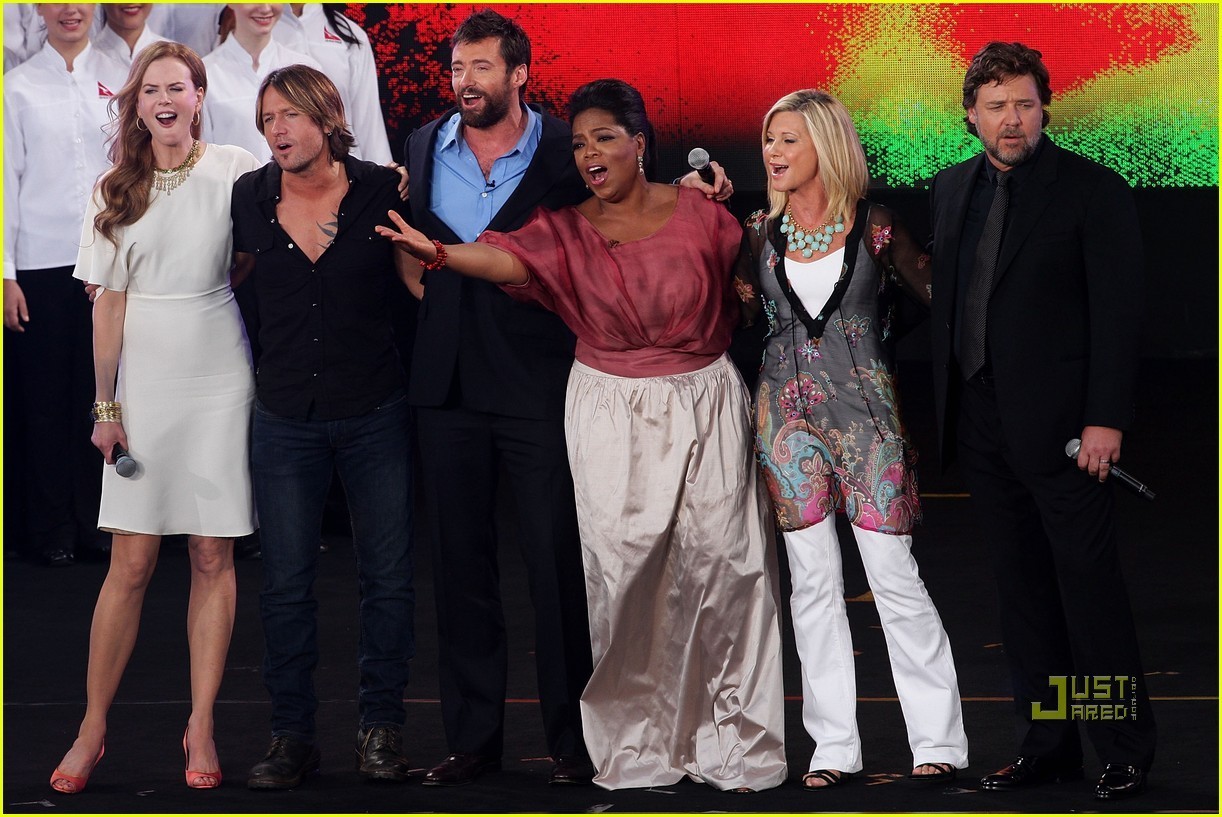
The highly publicised visit by Oprah Winfrey and her planeload of fellow travellers has reminded us that in addition to the Australia that Australians know, and which finds expression in local culture, there is an alternate, export version of Australia. It is an Australia whose image is shaped by tourism marketing meetings. It is a postcard culture on a grand scale, a giant outdoor movie set as big as a continent. For better or worse, what is presented for consumption overseas is an image of Australia that could almost be America.
The reigning king and queen of this parallel Australian world are Hugh Jackman and Nicole Kidman. Since they starred together in the big-budget Baz Luhrmann-directed historical outback romance Australia, to which taxpayers contributed about $40 million, Kidman and Jackman have become regular guests at the annual G'Day USA expo in Los Angeles, have appeared in the promotion of Australia's unsuccessful $46 million bid for the FIFA World Cup and, inevitably, featured as guests during filming of Oprah's Australian shows.
Kidman, who is American by birth and has a home in Tennessee, intimated to Oprah that her mum thinks her UNESCO ambassadorship is more impressive than the best actress Oscar she won for portraying the English author Virginia Woolf. Australia was Kidman's first Australian film in nearly a decade, although her absence from involvement in the local film industry did not preclude a nomination for Australian of the Year in 2004.
As his setpiece for Oprah, Jackman attempted a spectacular aerial entrance in action-movie style. Jackman thus followed the Errol Flynn example in doing his own stunt work. Flynn, the first Australian leading man to become a major star in Hollywood, made his name swinging on a rope from ship to ship during the battle scenes in the 1930s pirate film Captain Blood. Jackman, however, was merely arriving for an interview segment on a daytime talk show.
In January last year Kidman appeared on stage at G'Day USA, an event partly sponsored by taxpayers through Tourism Australia. Jackman's scheduled appearance on stage with Kidman and her husband, expatriate country singer Keith Urban, was thwarted by filming commitments. Awards for most successful Australian actor in Hollywood were presented to Simon Baker for his starring role in the TV show The Mentalist and to Toni Collette for United States of Tara, while the sporting award went to Greg Norman. Like Baker and Collette, Norman lives in the US. G'Day USA will be doing it all again later this month.
Also last year Jackman hosted the American Australian Association Benefit Dinner held in New York, where he has a home. According to the association's website, one of the key supporters of its philanthropic endeavours is Rupert Murdoch, the Australian-born American citizen whose company News Corporation owns 20th Century Fox, the movie studio that, in association with Tourism Australia, produced Australia, a film that self-consciously referenced Golden Age Hollywood epics such as Gone With the Wind.
In the export-oriented image of Australia, Americans may be welcomed as honorary Australians. The award to Greg Norman at G'Day USA was presented by John Travolta, who is associated with the national overseas airline as a pilot ambassador with a vintage Qantas-liveried Boeing 707 that is parked in the garage at his home in Florida and whose fervour as a fan of the Socceroos gave him entry to the team dressing room for post-match victory celebrations during the 2006 World Cup. Travolta's apparent enthusiasm for Australia is shared by Oprah, who while taping her Sydney shows proclaimed herself "an unofficial ambassador for Australia".
Among Oprah's guests during her "Ultimate Australian Adventure" were the American-born Terri Irwin, widow of Steve Irwin, and her two children. The Irwins became familiar figures to many Americans in part through guest appearances on Oprah's show, and Steve went on to star in the Hollywood-backed 2002 feature film The Crocodile Hunter: Collision Course.
As the apparent personification of a certain type of earthy outback frontiersman, Irwin in many ways filled the boots of Paul Hogan, who pioneered the confluence of American-oriented movies and tourism advertising campaigns with Crocodile Dundee, still the highest-grossing Australian film, and the "shrimp on the barbie" ad campaign. Hogan also married an American.
We may wonder why all this effort and public money have gone into generating an image of Australia that is inextricably bound up with America when Americans account for less than 10 per cent of tourists to this country, according to the latest official figures released by the Department of Resources, Energy and Tourism.
The simple fact is that, for ordinary Americans who typically get no more than two week's annual leave, Australia, no matter how welcoming, is too far away and too expensive for a casual vacation. Oprah thanked Australians for teaching her to "work to live, not live to work", but her compatriots may not have the luxury of choice in that regard. Besides, Americans, the vast majority of whom never apply for a passport, do not yearn to travel overseas to the degree that Australians do. Why travel to Australia, for instance, when Australia, in common with the rest of the world, wants so much to come and be with you?
The creation of the export image of Australia cannot be just about persuading Americans to travel here in greater numbers. No doubt there is an asymmetrical marketing strategy at work in tapping into the American popular culture that, in turn, permeates the world. As Oprah was quick, and characteristically shrewd, to point out: "It is immeasurable what four hours of a love festival about your country, broadcast in 145 countries around the world, can do.
Presumably New Zealanders, Chinese, Japanese and Britons, who comprise the overwhelming majority of the tourists most likely to travel to Australia, will be suitably impressed by Oprah's American-flavoured Australia while being entertained by international guests such as Bon Jovi, U2 and Jay-Z, each of whom just happened to be passing through during the Australian leg of a world tour.
The selling of Australia to and via America is also the conscious promotion of Australia to itself. This aspect of Oprah's government-sponsored visit was revealed in an announcement made last month by Australian Tourism's managing director, Andrew McEvoy, who said that by visiting sites such as Uluru and Byron Bay, Oprah had renewed interest among locals for travel within Australia. "We are seeing a reawakening of Australia in our own backyard," McEvoy declared.
Apparent confirmation of an immediate "Oprah effect" on tourism within Australia came from the Tourism Minister, Martin Ferguson, who produced figures of a $71 million boost to local tourism from Oprah, and $14 million in new tourism business originating in the US.
Perhaps it really does take someone like Oprah to induce Australians, one of the most urbanised peoples on earth, to see some of the more remote parts of their country. Meanwhile, the likes of Hogan, Jackman and Kidman are simply making the best living they can by being professional Australians when the assignment calls for them to assume that role. It would be unfair to pillory expatriate celebrities for simply going where the work is and doing whatever well-paid job they've been offered.
The deeper truth about the alternative Australia is the need Australians evidently still feel to seek attention from and to attach themselves to America, just as previous generations subsumed themselves in all things British. Australia's undiminished, if redirected sense of cultural dependence continues to manifest our sense of geographic isolation and our small population size. In attempting through tourism marketing campaigns to overcome the physical distance that has always shaped life and culture in Australia, we may only have become more distant from ourselves.
In the preface to the 2001 edition of his classic The Tyranny of Distance, first published in the mid-1960s, Geoffrey Blainey cautioned that "distance is tamed but far from dead". Blainey was responding to the prediction by the British academic Frances Cairncross, in her 1997 book Distance is Dead, that modern communications and transport technology would soon close the previously yawning gap between different parts of the world. The internet, Cairncross prophesied, would encourage greater competition in the travel industry, forcing down the prices of tickets and accommodation.
All this has come to pass, yet Australians still feel the need to reimagine their country in American cultural terms in order to entice people to travel here, or simply to register our existence. As Blainey observed of Australia and its distance-conditioned national psyche, "distance was tamed more quickly on the map than in the mind".
According to Alain de Botton, author of The Art of Travel, "Wherever we choose to go, we're apt to come up against the inevitable gap between our dreams and the reality, but once we accept that, we're on the road to recovery."
The Australian identity crisis is far from resolved, but the somewhat cartoonish export image of Australia has not passed without criticism.
In the wake of the failed FIFA World Cup bid, the script of which called for the Prime Minister to appear alongside an animated surfing kangaroo, and even found space for the ghoulish resurrection of Hogan's character Mick Dundee, the film director Peter Weir attacked what he described as "childish symbols and campaigns" used to sell Australia.
Weir vowed to an interviewer that he would never follow other prominent Australian directors such as Luhrmann and Philip Noyce in making short promotional films about Australia: "I couldn't do it. It's not my sort of script."
Mercifully, serious independent creative endeavour in this country is still possible. For every embarrassingly overblown fantasy like Australia there is a Samson and Delilah or a Ten Canoes. Similarly, for every Ned Kelly, another excessively romanticised period movie that was heavily backed by government tourism authorities with the stated aim of attracting overseas visitors, there is a Chopper or an Animal Kingdom.
While we're told that the export part of the two-speed economy is booming, its cultural counterpart sadly is bogged down in cliche and celebrity worship.
In some of the more realistic, sophisticated and subtle images we choose to make just for ourselves, Australians seem so much freer to rush forward.
Simon Caterson's Hoax Nation: Australian Fakes and Frauds, from Plato to Norma Khouri is published by Arcade.
The Age January 8, 2011
.
Monday, August 23, 2010
Creating the democracy we don't yet have by Tim Anderson
Unexpectedly, it seems to me, a great opportunity for social change has emerged. This might seem strange, with another neo-fascist on the verge of becoming Australian Prime Minister. However remember that real change comes from widespread social participation, over longer periods.
First of all, the problem has to be clear - both of our major parties serve a tiny corporate elite, which likes to play them off against each other, to discipline them. This oligarchy (tightly interlocked finance, mining, media and investment groups) likes 'change' amongst the administrators, but never allows them 'power'.
Despite its origins in trade unions, the ALP is institutionally committed to gaining administrative office, and that means Labor must cut deals with this oligarchy. If the Greens, in their enthusiasm to be'credible' with the big powers, start cutting such deals, they will be similarly compromised, as were the Democrats before them. This is a time for bold new ideas, not shabby deals crippled by electoral ambitions.
The August election was a strong statement against this shallow electoral politics. Disillusionment with the two right wing parties has created an outcome where a few populist MPs and the Greens will have a chance to demand some institutional change. That is not enough, but it is important. What about proportional representation in elections? What about wider constitutional change and accountabilities, for example including
(i) prohibiting war without parliamentary consent
(ii) meaningful Aboriginal rights instead of constant tokenism, and
(iii) a wider set of citizens and workers' rights?
We must hear genuine voices for popular struggles. But how is it possible to have a 'new politics' through the old language? Such voices are not possible through the corporate media, which bombards us with trivia, consumerism and 'market solutions'. We need new media, and we need democratic controls (e.g. mandatory community participation in media boards, public and private) on the existing media. We want to hear the new MPs talking about real issues.
Saturday, June 12, 2010
Greens threaten two-party system Greens Left Weekly
Both big parties are losing ground, the poll said. Labor’s primary vote dropped two points, to 35%. The Coalition went down by the same margin, from 43% to 41%. But the bombshell was the record Greens vote — up four points to 16%.
This is not a new trend. Support for the Greens has risen steadily over the past decade.
But the recent surge in Greens support has coincided with the Labor government’s decision to suspend its Carbon Pollution Reduction Scheme for a further three years.
PM Kevin Rudd’s approval rating has plummeted since the suspension. His repeated promises to take urgent action on climate change have been exposed as a sham. Meanwhile, the Coalition under leader Tony Abbott has reverted back to the naked climate change denial of the Howard era.
April was the world’s hottest month since records began. The Arctic ice sheet is melting at a pace never seen before. Scientists say carbon pollution has made the world’s oceans more acidic than they have been for at least 20 million years.
Yet under Rudd’s watch, Australia remains the developed world’s worst polluter per person. Emissions have gone up. Twelve new coal-fired power plants are planned around the country. The government plans to more than double coal exports in coming decades.
In the face of the biggest-ever threat to humanity, the ALP and the Coalition plan to continue with business as usual.
The surge in electoral support for the Greens has also coincided with Labor’s introduction of harsh anti-refugee policies, such as suspending the processing of asylum claims of people fleeing Sri Lanka and Afghanistan.
Responding to goading from Abbott, Rudd has adopted Howard-era refugee-bashing rhetoric on “border protection”, alienating many of the voters who swept Rudd to power in 2007.
After the Greens’ record vote in the Tasmanian elections, the party now has a chance to break open the two-party system on a national level.
If an election were held today, the Greens would win the balance of power in the Senate. They could also beat Labor in inner-city lower house seats, especially in Melbourne and Sydney.
Sitting ALP members such as Marrickville’s Anthony Albanese, Sydney’s Tanya Plibersek, Melbourne’s Lindsay Tanner and Wills’s Kelvin Thomson, will be most worried.
They should be worried. They have backed the Rudd government’s do-nothing climate policy. They deserve to lose, so the rest of us can have a future.
Saturday, June 5, 2010
Friday, May 07, 2010
John Pilger: "Support NT Indigenous fightback."
The following is a transcript of a speech by award-winning journalist John Pilger at the Sydney Teachers’ Federation on April 23. It was part of a public launch of the Four Days in July national Aboriginal rights convergence in Alice Springs from July 6 to 9.
I am honoured to be on this platform tonight, and I would like to express my warm appreciation to Richard Downs for asking me to join him in launching this extraordinary call-out to all Australians, Indigenous and non-Indigenous.
I would like also to pay tribute to Larissa Behrendt for her fine, untiring work, and to Paul McAleer and the Maritime Union of Australia (MUA) for helping to restore the faith of many in a principled union movement, and not least to the Stop the Intervention Collective Sydney (STICS), a remarkable group that has stood boldly against the intervention and organised this and many other meetings.
When I first heard Downs speak in Melbourne at Easter, I knew that an exciting new chapter in the struggle of Indigenous Australians had opened. One of the most important political events of my lifetime was the long strike by the Gurindji people when they walked off the cattle station at Wave Hill in the Northern Territory in August 1966.
The issues which the Gurindji brought to light — the denial of basic human rights, the lack of proper living and working conditions and the racism — are no different in principle from those described by Downs and other Alyawarr elders since their own historic walk-off in July last year.
Make no mistake. We are celebrating tonight. We are celebrating once more the resolve and courage and political determination, and imagination, of a group of Indigenous Australians.
For just as Vincent Lingiari and his Gurindji comrades made their stand in the ’60s and ’70s, touring the country, forcing justice and land rights into the public consciousness and on to the political agenda, so Downs and his comrades are breaking a long and lethal silence that Canberra and the media have sought to inflict on the human rights and land rights of Indigenous Australia.
So — although we’re here too tonight to protest — let us also recognise what a wonderful moment this is: a historic moment. What Downs and the Alyawarr people are saying is that they will not meet with Indigenous affairs minister Jenny Macklin or Prime Minister Kevin Rudd until the government abolishes the intervention and fully restores the Racial Discrimination Act.
In other words, they’re on strike — like the Gurindji — and the aim of tonight’s meeting is to call on all Australians to walk off with them: to stand with them.
In doing so, we illuminate the injustice and the lies that shame this entire society and we say this to those Australians who look away: you are not innocent bystanders in your own country.
“If you are neutral in a time of injustice,” said Desmond Tutu, “you have chosen the side of the oppressor.” Not only that, we are here to tell the world. Time and again the United Nations has identified the deep racism in our politics and our laws. Time and again, federal governments and their media allies have deflected the criticism. How dare these foreigners tell us what we know to be true!
Not any more. The indigenous struggle all over the world is gaining ground, and many people in other countries are now looking past picture postcard Australia at the injustice imposed on the most enduring human society on Earth, the First Australians.
Only last January, the United Nations released a report that examined the state of indigenous peoples in 90 countries. It revealed that the First Australians have the worst life expectancy gap of any indigenous people anywhere. Isn’t that shocking?
For many years, the United Nations has had a shame list of those countries that have not eradicated trachoma, which blinds children. Australia is the only so-called developed country on that shame list. Even impoverished, war-ravaged Sri Lanka has beaten the disease. But not lucky Australia.
So I believe this walk-off — and the great coming-together planned for Alice Springs in July — can be a turning point. By taking direct action and shutting out involvement with the federal government until it ends the intervention, Aboriginal people are taking control over their lives.
For what this walk-off and tonight are setting out to achieve is an Australia where Indigenous people are no longer spoken for by those seduced by authority: the kind who are given space in the Murdoch media, telling the white elite what it wants to hear.
What this call-out is setting out to achieve is an Australia where Aboriginal people are no longer spoken down to, no longer depicted in paternalistic stunts like that staged by the billionaires Andrew Forrest and James Packer at the Opera House the other day, with Macklin and rich celebrities feigning concern for the poor native folk.
What this call-out is setting out to achieve is an Australia where the likes of Macklin are no longer allowed to lie and get away with it, unchallenged. An Australia where Aboriginal people are never again subjected to discredited policies of income management and cynical concern for children.
What this call-out, this coming-together, this strike, this direct action, will do is reveal to the world that the intervention is a fraud, a con, a deception on all Australians.
In 2007, the Howard government used the report, Little Children are Sacred, to justify its actions. Child abuse in Indigenous communities was in “unthinkable numbers”, said Mal Brough, then Aboriginal affairs minister. In fact, the sexual abuse of Aboriginal girls and women is mostly committed by non-Aboriginal people living nearby.
Out of 7433 Aboriginal children examined by doctors, 39 were referred to the authorities for suspected abuse. Of those, four possible cases have been identified. In other words, as Professor Alastair Nicholson, a former chief justice of the Family Court, has pointed out, this is no more than the rate of child abuse in white Australia.
How did Brough and Howard get away with this? Certain journalists played a crucial role. The ABC program, Lateline, broadcast allegations about what it called “sex slavery” among the people of Mutitjulu. The program’s source was described as an “anonymous youth worker”.
In fact, he was exposed as a federal government official whose word was discredited by the Northern Territory chief minister and the police. The ABC has never withdrawn these damaging allegations, claiming it has been “exonerated by an internal enquiry”.
Just last week, the chief justice of New South Wales, Jim Spigelman, made a veiled attack on both the Indigenous and Muslim communities. Spigelman referred to the intervention as “triggered by revelations” of child abuse. Not surprisingly, his remarks were taken up by the likes of Piers Ackerman in the Murdoch press. Shame on him.
Our direct action comes at a critical time for the federal government, which is involved in wars of aggression overseas, while refusing to honour its commitment to protect those seeking refuge from the same wars.
This is all part of the militarising of our past and present, while refusing to raise a single official memorial to those who fought and fell in defence of their own country, this country, Australia.
I believe this historic initiative by Downs and his comrades addresses all these issues as well as revealing the so-called intervention as an old-fashioned colonial land grab.
Every government since Bob Hawke has tried to claw back the land rights that were won in the Northern Territory. It’s now happening by stealth and it’s happening quickly. In 2006, there were 180 licences for the exploration of minerals on Aboriginal land. By 2009, this had leapt to 400 licences.
Uranium, gold, oil, iron ore — these are the reasons why Aboriginal people are being humiliated in supermarkets with their Basics Cards. This travesty of welfare manipulation is costing the federal government $351 million just to administer. That’s a lot of money, isn’t it?
And a lot of money is to be made in contracts for the dumping of foreign toxic waste in the Northern Territory. This, and the riches beneath the ground, help us to understand why Jenny Macklin is attempting to destroy some 73 Aboriginal communities, and their languages, and move them to so-called hubs.
It’s getting those damn blackfellas out of the way. She dismisses their communities as “economically unviable”.
Meanwhile, government business managers are being paid salaries of up to $200,000 just to run this charade. The propaganda is laughingly called “Closing the Gap” and has concentrated on housing.
Since Rudd said “sorry” just three houses have been built for Aboriginal people, while 56 houses have been built for white managers.
If we had a free media in Australia, this would be exposed. And I take this opportunity to call on my fellow journalists to examine their consciences and to report the truth about what this intervention really means. And what it means is that Australian apartheid is being entrenched.
The political and media elite hates the term “apartheid”. It knows it means pariah status and shame. It doesn’t want the world to know that, beyond the postcard image of our country, black Australians are being jailed at five times the rate of South Africa during the apartheid years. In Western Australia, it’s eight times the apartheid rate of imprisonment.
When Rudd won the applause of the world by saying sorry to the First Australians, the Sydney Morning Herald published an editorial that said this: “The Rudd government has moved quickly to clear away this piece of political wreckage in a way that responds to some of its supporters’ emotional needs, yet it changes nothing. It is a shrewd manoeuvre.”
Actually, if the SMH believes nothing has changed, it’s mistaken. For behind the government’s shrewd manoeuvre is a piece of social engineering that will also affect non-Indigenous Australians.
The so-called special measures that control and restrict Aboriginal welfare are there to make it look as if the government is not discriminating, and they will apply eventually to the rest of the population.
Thousands of non-Indigenous people blighted by unemployment and homelessness will be quarantined and controlled; and I urge white Australia not only to listen to Richard Downs and his comrades but to support their action, because it concerns all of us.
For until our government ends its war on Indigenous Australia, until it negotiates a treaty that gives back to the First Australians their nationhood, we who came later can never claim our own.
Sunday, March 21, 2010
Greens weaken their Anti-war Stance over Obama By Tim Anderson
Today’s rally in Sydney (and several other cities) was organised by the Stop the War Coalition (STWC) and was timed to commemorate the invasion of Iraq. It was also thought it would coincide with President Obama’s visit to Australia.
As it turned out, troubles at home meant that Obama’s visit did not happen. Nevertheless, pamphlets for the rallies pictured Obama in his role as a Commander in Chief who has doubled the troops in Afghanistan, since the previous Bush regime.
Holding Obama responsible for the US wars is apparently what led the NSW Greens, at their most recent state delegates conference, to refuse to support the Iraq anniversary rally. Green MPs had been invited, but declined. Only a couple of individual Greens members attended the rally, which was rather overshadowed by St Patrick’s Day festivities.
The Greens have previously had good relations with the STWC. According to Australian Greens policies they support “an immediate end to the occupation of Iraq and the expropriation of its resources” and back the “immediately withdraw[al of] Australian forces from Iraq and Afghanistan.” The NSW Greens refusal to hold Obama responsible for the wars he commands casts doubt on the credibility of this policy.
It is frankly bizarre that a supposedly anti-war Australian party would seek to muzzle its members over an important anti-war event, because they felt protective of a US President. It is certainly true that Obama is under attack from the right at home, but no Australian citizen, party or government will change that.
Apart from doubling US troops in Afghanistan, President Obama has sent killer drones into Pakistan, remained silent over the slaughter in Gaza, increased the US military bases in Colombia and supported the 2009 military coup in Honduras.
Solidarity from within the imperial nations remains critical, and in this respect it is encouraging that a 50,000 person anti-war rally was recently held in Washington.
If the Greens give up their independent voices for fear of the corporate media, or from electoral worries, they will be heading down the Australian Democrats path. No-one respects a ‘high-minded’ opportunist.
Friday, March 12, 2010
Welcome to the world's first murdochracy by John Pilger
In his latest column for the New Statesman, John Pilger goes back to Australia, where Rupert Murdoch launched his worldwide media empire, and describes how his and Murdoch's homeland has become a murdochracy - a country where important media, issues and perception are influenced if not dominated by Murdochism: "an inspiration to his choir on seven continents".
Adelaide is Australia’s festival city. Its arts festival is currently in swing. Polite debate, aesthetics and high-octane wine are putting the world to rights. With one exception. Adelaide is where Rupert Murdoch began his empire. The voracious trail starts here. No statue stands; his is a spectral presence, controlling the only daily newspaper, even the printing presses. Across Australia, he owns almost 70 per cent of the capital city press and the only national newspaper, and Sky Television, and much else. Welcome to the world’s first murdochracy.
What is a murdochracy? It is where the fealty and augmentation of Murdoch’s editors and managers are undisguised, an inspiration to his choir on seven continents, where even his competitors sing along and wise politicians heed the Murdochism: “What’ll it be? A headline a day or a bucket of shit a day?”
While the veracity of this celebrated remark is sometimes disputed, its spirit is not. Stricken with pneumonia, the former prime minister John Howard dragged himself out of bed to pay obeisance to the man to whom he owed many empty buckets. His successor, Kevin Rudd, scurried to an obligatory audience with Murdoch in New York prior to his election. This is standard across the planet. Before he took power, Tony Blair was flown to an island off Queensland to stand at the blue Newscorp lectern and pledge Thatcherism and media de-regulation to the jowled figure nodding in the front row. The next day, the Sun lauded Blair as one who “has vision [and] speaks our language on morality and family life”.
Murdoch knows that little separates the main political parties in Australia, Britain and America. He plays the man. In 1972, he backed Australia’s Gough Whitlam who revealed a radical reformer, even threatening to expose America’s spy bases. A furious Murdoch swung his newspapers against Whitlam with stories so outrageously skewed that rebellious journalists on The Australian burned their newspaper in the street. That has never been repeated.
Dominant themes in the Australian murdochracy, sport and celebrity gossip aside, are the promotion of war and jingoism, American foreign policy, Israel and a paternalism toward Aborigines, the world’s most impoverished indigenous people, according to the UN. This antiquated cold warring is not due entirely to the Murdoch press, of course, but the agenda is. When the Indonesian tyrant General Suharto was about to be overthrown by his own people, the editor-in-chief of The Australian Paul Kelly led a delegation to of editors of most of Australia’s principal newspapers to Jakarta. With Kelly at his side, the mass murderer, whom the Murdoch papers promoted as a “moderate”, accepted the tribute of each.
Murdoch’s most unabashed, if entertaining retainer is Greg Sheridan, foreign editor of The Australian. On one his adoring trips to the United States, home of Murdoch HQ, Sheridan wrote, “The US is the greatest possible argument for media deregulation. Every morning, I flick between Fox, CNN and MSNBC as I eat my cereal... why did it take so long for pay TV to get to Australia?”. He was referring, as if instinctively, to his master’s pay TV company, Foxtel. As for terrorism, Sheridan blames “Pilgerist Chomskyism” for “ideologically fuelling the followers of Osama bin Lenin, sorry Laden.”
One of the most effective campaigns in the Australian murdochracy has been the whitewashing of a bloody colonial past, including a series of attacks on the distinguished chronicler of the Aboriginal genocide, Professor Henry Reynolds, and the director of the National Museum of Australia, Dawn Casey, for having dared to present the truth about indigenous suffering. Australia’s great maverick historian, the late Manning Clark, was smeared by Murdoch’s Courier-Mail as a Red agent, then as a fraud, in much the style that Murdoch’s London Sunday Times smeared the Labour MP Michael Foot as a Soviet agent.
Something similar awaits those who question the manipulation of the remembrance of Australia’s blood sacrifice for imperialism, old and new. Aimed at the young, a maudlin “new patriotism” reaches an annual climax on April 25, the anniversary of the first world war disaster at Gallipoli known as Anzac Day. The message is undisguised militarism promoting the invasions of Afghanistan and Iraq. Thus, Prime Minister Rudd says, absurdly, that the military is Australia’s highest calling.
Such false flags are flown constantly for Israel, which sees a stream of Australian journalists sponsored and paid for by Zionist groups. The result is apologetic reporting of murderous actions that evokes the great appeasers like Geoffrey Dawson, editor of The Times in the 1930s. The debate about state war crimes has all but bypassed Australia. That a former and current British prime minister have been summoned before the Chilcot enquiry in London is viewed with bemusement as nothing like it would happen here. Yet John Howard, who also invaded Iraq, holds something of a record for having claimed 30 times in one speech that he knew Saddam Hussein had a “massive programme” of weapons of mass destruction.
The national broadcaster, the Australian Broadcasting Corporation, has long been intimidated by the Murdoch press in the obsessive manner of the campaign waged against the BBC. Funded directly by governments, the ABC has none of the nominal independence and protection of Britain’s system of a TV licence fee as the resource for public broadcasting. Last year, HarperCollins, owned by Murdoch, was awarded a lucrative “partnership” with the ABC’s publishing arm, ABC Books.
In 1983, there were 50 major corporations dominating the world’s media. By 2002, this had been reduced to nine. Rupert Murdoch says that eventually there will be three, including his own. If we accept this, media and information control will be the same, and we shall all be citizens of a murdochracy.
Thursday, November 26, 2009
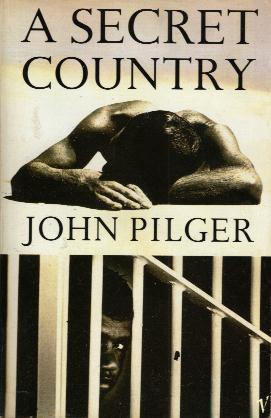
Return to a secret country by John Pilger

In his latest column for the New Statesman, John Pilger marks the 20th anniversary of the publication of A Secret Country, his best-selling history of Australia, with a description of Aboriginal Australia and its relationship with white authority following Prime Minister Kevin Rudd's apology to the "stolen generations" last year.
I remember the boys dressed in army surplus, the girls in hessian, their silhouettes framed in beach shanties, staring across an abyss. You were not meant to talk about them. They were not counted in the census, unlike the sheep, and anyway were dirty and feckless and dying off.
You were not meant to disturb the surface of our great southern idyll, sun-kissed and God-blessed, in circumstances that might raise questions of race. At high school, I studied a celebrated historian, Russel Ward, who wrote: “We are civilized and they are not.” They were the first Australians. At least he mentioned them. Other text books simply left them out.
Today, almost everything has changed and has not changed. For many Aboriginal people, who value healing, Prime Minister Kevin Rudd’s apology last year was important. They and their white allies had worked tirelessly for the mere word to be uttered. The resistance was formidable; white supremacist politicians, journalists and academics damned the “black armband version of our history”. And when Rudd finally said it, the Sydney Morning Herald described the apology as “a piece of political wreckage” that “the Rudd government has moved quickly to clear away... in a way that responds to some of its supporters’ emotional needs”.
There is to be no compensation for those thousands of Aborigines wrenched from their families as children, known as the stolen generation. The previous, openly racist government’s “intervention” into Aboriginal lands in the Northern Territory is being consolidated. In 2007, on the pretext that Aboriginal children were being sexually abused in “unthinkable numbers”, the government of John Howard suspended the Racial Discrimination Act and sent the army and “business managers” to take over black communities.
Within a year, barely reported statistics revealed how bogus it all was. Out of 7433 Aboriginal children examined by doctors, a maximum of four possible cases of sexual abuse were identified. The Australian Crimes Commission found no evidence of paedophile rings. What they found they already knew: poverty and sickness on the scale of Africa and India.
Since Rudd’s apology, Aboriginal poverty indicators have gone backwards. His “Closing the Gap” programme is a grim joke, having produced not a single new housing project. An undeclared agenda is straight from Australia’s colonial past: a land grab combined with an almost prurient need to control, harass and blame a people who have refused to die off, whose genius is their understanding of an ancient land that still perplexes and threatens white authority. Whenever Canberra’s politicians want to look “tough” they give the Aborigines a good kicking: it is a ritual as sacred as Don Bradman worship or Anzac Day.
The indigenous affairs minister, Jenny Macklin, has decreed that unless certain communities hand over their precious freehold leases they will be denied basic services. The Northern Territory contains abundant mineral wealth, such as uranium, and has long been eyed by multinationals as a lucrative radioactive waste dump. The blacks are in the way, yet again: so it is time for the usual feigned innocence. Rudd has said his government “doesn’t have a clear idea of what’s happening on the ground” in Aboriginal Australia. What? The reports of learned studies pour forth as if the sorcerer’s apprentice is loose. One example: the rate of incarceration of black Australians is five times that of South Africa during the last years of apartheid. The state of Western Australia imprisons Aboriginal men at eight times the apartheid figure, an Aussie world record.
On 16 November, a 12-year-old Aboriginal boy appeared in court charged with receiving a Freddo Frog chocolate bar from a friend who had allegedly taken it from a supermarket. The supermarket did not seek prosecution. Only the international headlines forced the police to drop the case. Two thirds of Aboriginal children who have contact with the police are jailed; two thirds of white children are cautioned. A young Aboriginal man was jailed for a year for stealing £12 worth of biscuits and soft drink.
In my lifetime, Australia has become one of the most culturally diverse places on earth, and it has happened peacefully, by and large. This proud achievement fades when you drive into a country town and pass the funerals of the native people, many of them young, who take their own lives. The whispering in Antipodean hearts is race. The navy is sent against leaking boats filled with desperate refugees, Tamils, Iraqis and Afghans, and if they cannot be dumped behind razor wire somewhere in Indonesia, they are isolated on Christmas Island which, for the purpose, has been “excised” from the Australian map by a legal sleight of hand. How clever.
While I have been in Australia, Irene Khan, Amnesty’s secretary general, an experienced witness of poverty and discrimination, has been travelling through the vast outback region known as Utopia. The roads are dirt; water trickles from a single standpipe in many communities. She saw children, their eyes streaming and coughs hacking. She met Elsie, who sleeps on a mattress in the desert, yet pays rent to the government. Shocking, she says.
There is currently a liberal clarion call in Australia for a Bill of Rights, and the republican movement is stirring again. These debates are meaningless until white Australia summons the moral and political imagination to offer its first people a genuine treaty, as well as universal land rights and a proper share of the country’s resources. And respect. Only then will this fortunate society earn the respect it so often craves by other means.
On 4 November 2009, John Pilger received the Sydney Peace Prize, Australia’s international human rights award. A Secret Country, his best-selling history of Australia published 20 years ago, remains in print (Vintage Books).
Thursday, November 27, 2008
Green Left Weekly Editorial : Rudd’s first year — style over substance
The first 12 months of Kevin Rudd’s federal Labor government have proved to be a continuation of the conservative, pro-war and anti-environmental politics of the Howard years.The major difference between the two governments has been a difference in style rather than substance. The previous government of John Howard stands condemned for refusing to recognise the threat of climate change or take any steps to limit Australia’s greenhouse emissions. Under Rudd, dealing with climate change is a stated government priority. But Rudd’s actual policies are dangerously inadequate to meet the climate emergency we face.
From a purely public relations standpoint, Rudd’s symbolic gestures on climate change appear successful. He immediately signed the Kyoto agreement. He announced his support for government investment in renewable energy. He formed a new ministry for climate change under Penny Wong. These relatively painless measures raised hopes that the new government took climate change seriously. But the reality has proved to be very different. No widespread shift to renewable energy use is underway, or has even been conceived. No moves to rapidly expand public transport have been made.
No legislation mandating drastic improvements in energy efficiency for industry or agriculture has been drafted. The priority has been given to discredited market-driven emissions schemes and non-existent technologies like so-called clean coal. Emission reduction targets have been set at hazardously low levels in accordance with what big business will accept. The latest alarming climate science has been studiously ignored. * * * * * * Like the articles? Reading Green Left Weekly online is free, but producing it isn’t. To support the independent media and help GLW reach its $250,000 fighting fund target, donate now. * * * * * * Soothing rhetoric aside, Rudd’s climate agenda mirrors that of straight-talking Howard: business as usual will prevail. Damian Lawson and David Spratt pinpoint the essence of the ALP’s approach in the November Rolling Stone: “Kevin Rudd and Penny Wong have adopted a traditional Labor approach to the climate problem: something for the environment lobby and something for business. “But the problem is that solving the climate crisis cannot be treated like a wage deal, with the demands of each side balanced somewhere in the middle. It is not possible to negotiate with the laws of physics and chemistry. The planet cannot be bought off. There are absolute limits that should not be crossed, and doing something, but not enough, will still lead to disaster.” Rudd’s eloquent apology to Australian Aborigines moved many who longed for a decisive shift away from the racism of the Howard years. Not only did Rudd deliver a long-overdue recognition to the Stolen Generations, but he promised to “embrace the possibility of new solutions to enduring problems where old approaches have failed”. Yet no new solutions — solutions that involve and empower Aboriginal people — have been realised. The racist intervention into the Northern Territory initiated under Howard has continued. The Rudd government is intent on extending welfare quarantining and the suspension of services to “unviable” communities to Aboriginal people in other states. Aboriginal land rights and Aboriginal control over their own affairs have always been especially opposed by the mining and pastoral industries — two powerful players in Australia’s unsustainable economy. The NT intervention was conceived under Howard to undermine the past gains of the Aboriginal rights movement in these areas while simultaneously shifting blame for ongoing poverty onto Aboriginal people themselves. Rudd’s continuation of the intervention, albeit with minor adjustments, signals that the ALP is willing to finish the job that Howard started.
The same can be said for the Rudd government’s record on workers’ rights. The union-led campaign against the Howard government’s anti-union Work Choices laws was the biggest single factor that led to the ALP election victory in November 2007. In the lead-up to the election Rudd exploited this public anger, promising to “rip up” Work Choices and protect the rights of Australian workers. Twelve months later, the key parts of Howard’s undemocratic Work Choices remain intact. The Australian Building and Construction Commission is still empowered to carry out its witch-hunt against the building industry unions. Meanwhile the Rudd government, with the help of the Australian Council of Trade Unions, is preparing to sell a rotten compromise to the union movement. Instead of Work Choices, Rudd will deliver Australian workers “Work Choices Lite”.
Australian government support for the bogus “war on terror” and the brutal wars in Iraq and especially Afghanistan have also continued under the Rudd government. Rudd, like Howard before him, has blood on his hands. The similarity between the two major parties when in power is no accident or mistake. Both are committed to defending the profit system at the expense of people and the planet. Temporarily, Rudd has succeeded in deflecting much of the public anger at these policies through symbolic actions. But as capitalism descends into a deep economic and environmental crisis, Rudd’s extended “honeymoon” is certain to come up against the harsh reality. Working people will increasingly demand secure employment, maintenance of living standards and a safe climate for their grandchildren. These are things that the Rudd government cannot deliver without breaking its loyalty to big business.
Style cannot substitute for substance forever.
From: Comment & Analysis, Green Left Weekly issue #776 26 November 2008.
Monday, October 27, 2008
Under cover of racist myth, a new land grab in Australia by John Pilger

Tuesday, October 14, 2008
The people's sporting star who had 'the grace' by John Pilger
In his latest column for the New Statesman, John Pilger celebrates the life of Sep Prosser, one of Australia's great swimmers and swimming coaches, whose celebrity was based on an ingredient now missing from so much sport: grace.