John/Togs Tognolini

John/Togs Tognolini
March for Humanity August 3 2025. On the Sydney Harbour Bridge with 300,000 other people protesting against Israel's Genocide against the Palestinians in Gaza.

Blog Archive

Popular Posts

Pageviews last month

Showing posts with label Music. Show all posts

Saturday, January 17, 2009

Joe Strummer Tribute- COMMANDANTE JOE by Attila the Stockbroker


I guess in quite a lot of ways I grew up just like you
A bolshy kid who didn't think the way they told him to
You kicked over the statues, a roots rock rebel star
Who knew that punk was more than just the sound of a guitar
And I'll always remember that night at the Rainbow
When you wrote a soundtrack for my life, Commandante Joe.

So many bands back then were like too many bands today
A bunch of blokes who made a noise with bugger all to say
The Clash were always out in front, you put the rest to shame
Your words were calls to action, your music was a flame
You were our common Dante, and you raised an inferno
And you wrote a soundtrack for my life, Commandante Joe.

Reggae in the Palais
Midnight till six!
Rockin' Reds in Brockwell Park!
Sten guns in Knightsbridge!
Up and down the Westway
In and out the lights!
Clash City Rockers!
Know Your Rights!
I guess in quite a lot of ways I grew up just like you
A bolshy kid who didn't think the way they told him to
Like you I always knew that words and music held the key
As you did for so many, you showed the way to me
Although I never met you I'm so sad to see you go
'Cos you wrote a soundtrack for my life, Commandante Joe.

ATTILA THE STOCKBROKER1/1/2003
Lyrics to a song, performed by Barnstormer, in memory of Joe Strummer 1952-2002


Tuesday, December 18, 2007

Archie Roach is back by John Tognolini

Journey
Music from Archie Roach
Liberation Music, 2007, $30

“I thought writing the song‘Took the Children Away’ was in part, a way of telling people that taking children from their families was not necessarily the best or so-called solution concerning the child or their family’s well being. I was wrong. We thought the Bringing Them Home report would see measures taken to ensure it should never happen again. We were wrong. We thought the Deaths in Custody [Royal Commission] would prevent such things happening. We were wrong. The songs of Journey are a reaffirmation of identity, country, beliefs and spirit and how no one has listened to our recommendations on stolen kids or people dying in jails. So it continues, but we are still watching and definitely taking note.” Archie Roach, 2007.

A couple of years ago, I was reading the debate section of the BBC History magazine and the topic was the return of Aboriginal remains from Britain’s universities and museums to Australia. I was sickened by the obscene case being put forward to keep these Aboriginal skeletons in the collections of British and other European universities and museums. When Roach introduced his song “Travellin’ Bones” on this topic, at his recent performance in Katoomba’s Triselies nightclub, to a packed house of over 140 people, he told of the story of the remains of a little girl that were brought back to Australia and how she had a bullet hole in her skull from over 100 years ago.

Many of the songs on Journey were inspired by a journey that Roach took with English actor Peter Postlethwaite (In the Name of the Father, Brassed Off, Baz Lurhman’s Romeo & Juliet) and Indigenous leader and Yawuru man, Patrick Dodson. Journey has been described as an eternal moment of dreaming. Reflecting songs of pain, loss, racism, redemption and hope. Roach described it as a marriage of Aboriginal and Western philosophy from the heart and mind. He is an extraordinary writer and singer. Journey is a companion piece to the recently released Liyarn Ngarn DVD, a compelling tale of racism and a plea for a new future in black/white relations in Australia.

Journey was produced by Shane Howard (of Goanna) and engineered and co-produced by Nash Chambers. It was a long time in the creation and preparation and a short time in the recording. Recorded live in Melbourne’s Sing Sing studios after a journey that took Roach from the spiritual Ngurrarra paintings, south of Fitzroy Crossing, to the jails of Roebourne and Fremantle, where Indigenous people had died in custody. It continued through the desert country of central Australia and the inevitable connection back to Roach’s home country of the Gunditjmara/Kirrae Whurrong of south-west Victoria.

I’ve only seen Roach play live once before at the Building Bridges Concert at Bondi Pavilion nearly twenty years ago. I and other BLF scaffolders volunteered our labour to put up the stage for this concert, on the eve of the massive Aboriginal Anti-Bicentennial Invasion Day Protest on January 26, 1988. Roach performed “Charcoal Lane” and I thought what a terrific voice and a moving song. Roach was joined that afternoon by Paul Kelly who joined him again on Journey, performing the song “John Pat”.

John Pat was a young Aboriginal man who was strangled to death in Roebourne jail in West Australia in 1987. His death, along with many others, led to the Royal Commission into Aboriginal Deaths in Custody being convened in 1987. This song is from a poem by a West Australian Aboriginal poet Jack Davis. Roach played it to him before he passed away in Fremantle hospital.

Also featuring on the album are Ruby Hunter, Bart Willoughby, Amy Saunders (formerly of Tiddas), David Birdie, Mark Punch, Troy Cassar-Daly, Ewen Baker, Helen Mounfort, Jarad Hearman, Shane Howard, Dave Arden and Amos Roach.

Roach has seen a lot, some would say too much hurt, but still these hallowed songs reach out to bridge the divide between black and white and challenge Australia’s culture of racism. Roach Roach turns suffering into hope and art with his music. His unique voice is in the league of Ray Charles, John Lee Hooker or George Jones. As an elder statesman of Aboriginal music, Roach takes us on a journey of epic dimensions but the music and the message are absolutely clear and uncomplicated.

I encourage you not just to buy his album but also to see Roach perform. I helped organise his Katoomba performance where he was joined by Shane Howard, Dave Arden and Amos Roach. For tour dates and venues check out these links and

[This article was first published in the New South Wales Teachers Federation journal, Education November 2007]

From: Cultural Dissent, Green Left Weekly issue #735 12 December 2007.

Saturday, November 24, 2007

Archie Roach Has Returned by John/Togs Tognolini

Archie Roach

Review of Journey Album 2007 Liberation $30

"I thought writing the song Took The Children Away was in part, a way
of telling people that taking children from their families was not
necessarily the best or so-called solution concerning the child or
their family's well being. I was wrong. We thought the Bringing Them
Home report would see measures taken to ensure it should never happen
again. We were wrong. We thought the Deaths in Custody would prevent
such things happening. We were wrong. The songs of Journey are a
reaffirmation of identity, country, beliefs and spirit and how no one
has listened to our recommendations on stolen kids or people dying in
jails. So it continues, but we are still watching and definitely
taking note.''

Archie Roach 2007

A couple of years ago, I was reading the debate section of the BBC
History magazine and the topic was the return of Aboriginal remains
from Britain's universities and museums to Australia. I was sickened
by the obscene case being put forward to keep these Aboriginal
skeletons in the collections of the British and other European
universities and museums. When Archie Roach introduced his song Travellin'
Bones on this topic, at his recent performance in Katoomba's Triselies
nightclub, to a packed house of over 140 people. He told of the story
of the remains of a little girl who was bought back to Australia and
how she had a bullet hole in her skull from over a hundred years ago.

Many of the songs on Journey were inspired by a journey that Archie
took with English actor Peter Postlethwaite (In The Name of The
Father, Brassed Off, Baz Lurhman's Romeo & Juliet) and Indigenous
leader and Yawuru man, Patrick Dodson. Journey has been described as
an eternal moment of dreaming. Reflecting songs of pain, loss, racism,
redemption and hope. Archie described it as a marriage of Aboriginal
and Western philosophy from the heart and mind. He is an extraordinary
writer and singer. Journey is a companion piece to the recently
released Liyarn Ngarn DVD, a compelling tale of racism and a plea for
a new future in black/white relations in Australia.

Journey was produced by Shane Howard (of Goanna) and engineered and
co-produced by Nash Chambers, the new album Journey was a long time in
the creation and preparation and a short time in the recording.
Recorded live in Melbourne's Sing Sing studios after a journey that
took Archie from the spiritual Ngurrarra paintings, south of Fitzroy
Crossing, to the deaths in custody in the jails of Roebourne and
Fremantle. It continued through the desert country of Central
Australia and the inevitable connection back to Archie's home country
of the Gunditjmara/Kirrae Whurrong of South West Victoria.

I've only seen Archie play live once before at the Building Bridges
Concert at Bondi Pavilion nearly twenty years ago. I and other BLF
scaffolders volunteered our labour to put up the stage for this
concert, on the eve of the massive Aboriginal Anti-Bicentennial
Invasion Day Protest 26 January 1988. Archie performed Charcoal Lane
and I thought what a terrific voice and a moving song. Archie was
joined that afternoon by Paul Kelly who joins him again on the Journey
performing the song John Pat. John Pat was a young Aboriginal man who was
strangled to death in Roebourne jail in West Australia in 1987 and his
death along with many others led to the Aboriginal Deaths in Custody
Royal Commission. This song is from a poem by a West Australian
Aboriginal poet Jack Davis. Archie played it to him before he passed
away in Fremantle hospital.

Also on the album are Ruby Hunter, Bart Willoughby, Amy Saunders
(formerly of Tiddas), David Birdie, Mark Punch, Troy Cassar Daly, Ewen
Baker, Helen Mounfort, Jarad Hearman, Shane Howard, Dave Arden and
Amos Roach.

Archie Roach has seen a lot, some would say too much hurt, but still
these hallowed songs reach out to bridge the divide between black and
white and challenge Australia's culture of racism. Archie Roach turns
suffering into hope and art with his music. His unique voice is in the
league of Ray Charles, John Lee Hooker or George Jones. He is an elder
statesman of Aboriginal music, Archie takes us on a journey of epic
dimensions but the music and the message are absolutely clear and
uncomplicated.

I encourage you not just to buy his album but also to see him perform.
I helped organise his Katoomba performance where he was joined by
Shane Howard, Dave Arden and Amos Roach. For tour dates and venues
check out these links www.archieroach.com.au
www.myspace.com/archieroach

This article was first published in the New South Wales Teachers Federation journal, Education November 2007

Saturday, April 21, 2007

REVIEW-Tribute to a great fighter by Carla Gorton

Cannot Buy My Soul: The songs of Kev Carmody
Various artists
Virgin, $24.99


For 200 years we’ve been beaten down

Too long on the dole

My dignity I’m losing here and mentally I’m old

There’s a system here that nails us, ain’t we left out in the cold

They took our life and liberty friend but

they couldn’t buy our soul.


Joe Hill died, Che Guevara fought and Pemulwuy lay down dead

If a person speaks out critically here you can get loaded down with lead

How long can the majority wait for their story to unfold

They took their life and liberty friend but

they could not buy their soul.

Kev Carmody

Cannot Buy My Soul is a tribute to Kev Carmody’s outstanding song writing talents. Paul Kelly, who has collaborated with Carmody on many projects, gathered together the John Butler Trio, Bernard Fanning, Missy Higgins, Augie March, The Waifs, The Herd, Archie Roach and many more to record this album. Along with this is a bonus disc of the original recordings by Carmody.

I loved the tribute album, but it was the disc of originals that really brought that strong emotional response you feel when you listen to music that really moves you.

And that is what Carmody has made since he released his debut album Pillars of Society in 1989 — music that moves people and songwriting so laden with stories that few can match it. “Droving Woman”, delivered on the album by Augie March, Missy Higgins and Paul Kelly, which plays for eight and a half minutes, is one example, but there are many more, including tracks not selected for this album like “Tom Shane” from the Eulogy album. Hopefully, this album will lead people to Carmody’s other albums and to discover the power of music with a political heart.

Indigenous activists and their supporters have been out on the streets again recently to fight for justice around the issues of Aboriginal deaths at the hands of police. Carmody’s music traces the history of these campaigns.

“River of Tears”, performed by The Drones, tells the story of David Gundy, a 32-year-old Aboriginal man who died after being shot by police when he was woken from his sleep during an unlawful raid on his home in Marrickville on April 27, 1989. The police were in fact looking for another man. Gundy was an Aboriginal man in the wrong place at the wrong time. The police had no legal right to be in his home, much less to point a loaded and cocked shotgun at him. A coronial inquest found that Gundy had died accidentally and an internal police investigation found that complaints about the police involved could not be sustained.

“The Young Dancer is Dead”, performed by The Last Kinection, highlights the fate of 18-year-old Daniel Yock, who in November 1993 was picked up from a street in Brisbane and taken in a paddy wagon to the Brisbane watchhouse. He was dead on arrival. In April 1994, the Criminal Justice Commission in Queensland found the six police officers who arrested Daniel Yock were not responsible for his death.

The John Butler Trio, who performed with Carmody at the Make Poverty History concert in Melbourne on November 17, present a great version of “Thou Shalt Not Steal”. Bernard Fanning puts his stamp on “Elly”. Troy Cassar-Daley, performing “On the Wire”, and Archie Roach, singing the title song, are outstanding. Sara Storer’s version of “Moonstruck” made me appreciate the beauty of this song all over again. “Darkside” somehow seemed to have been written especially for Tex Perkins to perform.

One of the highlights of the album for me is The Herd’s version of “Comrade Jesus Christ”. As Shannon Kennedy from The Herd explained on the February 12 episode of Message Stick on SBS, “The context that Kev’s put the lyrics in, it’s not about religion or about Christianity, I think it’s more about being an activist.”

This is an album for activists. It is also an album for musicians, and those who love a range of musical styles. And it is an album with soul. Despite the fact that Carmody’s performing has been hindered by arthritis and physical pain of recent years, brought on by many years of labouring work in his youth, hand cutting cane and carrying wheat bags (that’s another yarn all of its own), here’s hoping that we can look forward to future releases and collaborations down the track. Some of Carmody’s recent projects have included the 40th anniversary celebrations of the Wave Hill walk off at Kalkaringi and the Nganampa Music Project with musicians from the Anangu Pitjantjatjara Yankunytiatiara Lands.


Sunday, January 28, 2007

Mark Seymour: 'We must protect our democracy' by Miriam Gravino

Green Left Weekly 18 January 2007


Mark Seymour (left), Martin Kingham and Dona Jackson launching the musical We Built this City, which commemorates the 8-hour-day victory.photo by Bindi Cole/Melbourne Workers Theatre
One-time Hunter & Collector, and now solo performer, MARK SEYMOUR has often taken part in political rallies, as well as performed on the stages of Australia’s premier rock venues. At times his music and ideological stance have seemed as one. Recently he spoke to Green Left Weekly’s MIRIAM GRAVINO.

As one of Australia’s most highly regarded songwriters, do you feel a responsibility to comment on political issues of the day?

I feel compelled to comment on Australia’s involvement in the Iraq war for the simple reason that the invasion wasn’t necessary, and if John Howard had made an honourable choice at the beginning of 2003, my country would not now be perceived as supporting an incompetent and unjust invasion which has led to the death and suffering of thousands of innocent people.

The sheer scale of the catastrophe is a telling reminder to us all that we cannot place unconditional trust in the judgement of our leaders, regardless of the fact that we live in a democratic country. The outcome of Howard’s decision in this case is utterly immoral, and he stands condemned for making it.

Has activism and consciousness-raising died a death in rock music?

We should not judge too quickly the apparent lack of political comment from songwriters today. In the past, artists were buoyed by the momentum generated by the Vietnam War. Its impact was felt for many years after we’d disengaged.

The draught and the loss of our own soldiers’ lives gave far greater weight to the argument that the Vietnam War was wrong than the debate surrounding Iraq. And we must accept that until our own begin to fall in battle it is much harder for young people to relate to the suffering and carnage taking place in a foreign country unless they feel the very real threat of getting caught up in it directly, as many of our boys did in the late ’60s because of national service.

Do your anti-war sentiments and your stance on social justice stem from your upbringing?

I missed out on the draft by one year. The Vietnam War was a generational issue. My parents had lived through World War II and although they were fiercely opposed to national service, they struggled to accept that the anti-war movement was not being manipulated by extremists.

In the end it was a generational conflict. At the time I was finishing high school and facing the decision as to whether I would register and refuse to go, or simply avoid the draft altogether. In either case I couldn’t have claimed to be a conscientious objector, as I believe that warfare is justified under certain circumstances. The consequences of my actions, had I been forced to take them, would have changed my life forever. Needless to say, I was very young as all military recruits are.

Why do you think the Australian government so slavishly endorses US policy? You are very specific about this on your website.

Australia’s endorsement of US foreign policy is entirely a question of interpretation. We happen to have a government which lacks a globally based foreign policy of its own. Foreign policy should be based on a cut and dried appraisal of our national geo-political interest. Diplomacy and military defence must share the load. Our decision to go into Iraq alongside the US made no sense in either case.

I have no problem with the US alliance as such, but in this case I don’t think it was relevant. I believe we went there because of the personal relationship between US President George Bush and Howard. I don’t believe the Bush administration’s decision to invade Iraq was a real test of what that alliance means.

Is there a connection between the government’s re-writing of industrial relations legislation and its championing of globalisation?

There is maybe a relationship between the IR legislation and globalisation. But it doesn’t matter. What matters is the survival of collective bargaining as a means by which employees can negotiate and guarantee fair working conditions and fair pay. There is nothing wrong with collective bargaining. It guarantees a safe and motivated workforce.

The IR laws are a calculated attempt to marginalise, once and for all, the trade union movement. Globalisation is the icing on the cake, so to speak. Work Choices is quite simply about reducing the cost of labour. It’s always about the workplace. Always, always!

You’ve spoken out and played at various rallies. Would it bother you if people absorbed your political message and neglected your music?

I’m happy to keep playing music. Politics is about being smart about your country and its leaders. By expressing my opinion occasionally I simply want others to think. They don’t have to agree. It’s really important to be seen to be thinking. We must protect our democracy. It’s a precious thing.

[Visit http://www.markseymour.com.au. Mark Seymour will play at Oceanus Restaurant, City Beach, WA on January 25.]

From: Cultural Dissent, Green Left Weekly issue #695 24 January 2007.

Friday, December 29, 2006

Father of Funk, The life and afterlife of James Brown by Jesse Walker


Reason December 28, 2006
In 1968 the poet and critic Amiri Baraka declared James Brown "our number one black poet." He wasn't the only writer who felt that way. Larry Neal, one of Baraka's confederates in the radical Black Arts Movement, recalled later that Brown was a hero to Neal's circle of literary intellectuals. "If the poets could do that," he remembered, "we could just take over America. Suppose James Brown had consciousness. We used to have big arguments like that. It was like saying, 'Suppose James Brown read Fanon.'"
If Brown ever did read Frantz Fanon, an Algerian leftist revered by revolutionaries in the '60s, he kept quiet about it. But the singer did have a place in the Black Power pantheon, one far more interesting and inspiring than anything Fanon ever wrote. At once rural and urban, iconoclastic and conservative, sacred and profane, both the man and his music evoked a radically transformed world while staying rooted in black American traditions.
After an early stint in prison for armed robbery, Brown turned to music, getting his professional start with a group called the Gospel Starlighters. It didn't take long for them to drop their religious repertoire and redub themselves the Famous Flames. Their first hits were recorded in the late '50s, as a style called southern soul was starting to coalesce.
This was a secular sound rooted in the music of the black church. You can divide it into two broad categories: slow and fast. On the slow side were the ballads, some of which were simply gospel without the references to the Lord, and some of which were ably described by the British critic Barney Hoskyns, in Say it One Time for the Brokenhearted, as "a black gospel foreground, with all the vocal improvisation and intensity that implies, superimposed on a white country background." The uptempo records were gritty, earthy, and sharply syncopated, with piercing, percussive horns; they felt a bit like the old jump blues of the '40s and a bit like another sort of church music -- the kind where everybody stomps their feet and the Holy Ghost starts to manifest Itself in the pews.
James Brown sang in both styles. If you don't think you hear anything country in his ballads, listen harder: He reportedly recorded but never released an entire album of country covers, and in 1979 he played the Grand Ole Opry. The keyboardist in Opry host Porter Wagoner's band had spent two years playing with Brown, and after Wagoner saw Brown in concert he invited the godfather of soul to come on his show. According to Hoskyns, Brown "performed a medley of 'Your Cheatin' Heart', 'Georgia on My Mind' and 'Tennessee Waltz', then followed with some funk." Some Opry stars protested his presence, but Wagoner later declared that the set "went over real big" with the audience. Brown less enthusiastically said that he "got as much praise as a white man who goes into a black church and puts $100 in the collection plate."
Good as his ballads were, as the '60s wore on Brown was increasingly identified with the uptempo side of soul. As every instrument in his ensemble, from the guitar to the human voice, became part of the rhythm section, Brown and his band created a whole new form of music, called funk. The melodies faded, the increasingly complex rhythms moved to the foreground, and the songs grew longer, as the rhythms became a launching pad for rich improvisations rooted in jazz (and, as other artists adopted Brown's innovations, in Latin rock and Hendrix-style psychedelia). The lyrics, befitting the genre's gospel origins, were ecstatic chants and screams; they carried echoes of both sex and sermons.
In the '60s and '70s Brown spoke out for black entrepreneurship and for strong black communities, for "the need for Afro-Americans to own things if we were ever going to have any real equality." His views soon crept into his music as well. After a decade of crossing over from the R&B world to the pop charts, he lost a large chunk of his white audience in 1968, with "Say It Loud, I'm Black and I'm Proud." Over a bare-boned rhythm, Brown shouted:
I worked on a job with my feet and my hands
But all the work I did was for the other man
Now we demand a chance to do things for ourself
We're tired of beatin' our head against the wall and workin' for someone else
It was incendiary stuff, and it attracted black rebels even as white radio programmers backed away. It isn't hard to imagine why Neal and Baraka would project themselves onto the pop star, fantasizing about a Brown with more "consciousness."
It was harder to imagine Brown reading Fanon four year later, when the musician called for the reelection of Richard Nixon. But the same year Brown sang "Say It Loud, I'm Black and I'm Proud," the future president had pointed out that "much of black militant talk these days is actually in terms far closer to the doctrines of free enterprise than to those of the welfarist thirties." Nixon went on to endorse "black power, in the best, the constructive sense of that often misapplied term....It's no longer enough that white-owned enterprises employ greater number of Negroes, whether as laborers or as middle-management personnel. This is needed, yes -- but it has to be accompanied by an expansion of black ownership, of black capitalism."
That might sound like a plan to loosen the strings that held back black businesses, for slashing at the licensing laws and other restraints that kept ghetto enterprises underground. Instead the president announced a black capitalism initiative that amounted to yet more goodies from the government: new contracts, new loans, new red tape. Nixon's black capitalism, like Nixon's white capitalism, had more to do with patronage than with free enterprise. The point wasn't black power; it was quelling unrest and buying votes.
Still, when Robert J. Brown, a special assistant to the president, visited a radio station owned by James Brown in 1971, the singer was drawn to what the White House's envoy had to say. He liked the fact that federal funds were flowing to black businesses and black colleges (though he never took any government grants himself, and in fact was hassled regularly by the IRS). He also managed to convince himself that the president would make Martin Luther King's birthday a holiday, a change that wouldn't actually come until the Reagan years. And since Nixon was sure to win in a landslide anyway, he thought an endorsement might earn him some influence in the administration. "A situation like that puts somebody who's sort of a spokesman in a dilemma," Brown recalled in his 1986 memoir The Godfather of Soul, written with Bruce Tucker. "You can either try to get inside and have some influence, or you can stay outside and be pure and powerless. Either way you're going to get criticized, especially if you're a black spokesman." In the last month of the campaign, Brown announced his support for Nixon.
That didn't go over well with his fans, and protests dogged his concerts for a while. In his memoir, Brown suggested his decision "cost me a lot of my black audience, just like 'Black and Proud' had cost me a lot of my white audience." Black power is a two-edged sword.
Brown had some more hits on the R&B charts after that, some of them pretty big. But by the end of the decade, he was struggling to stay relevant, adapting to trends rather than setting them; one album billed him as The Original Disco Man, which is a bit like Duke Ellington passing himself off as the father of smooth jazz. He charted occasionally in the '80s, but by then he was basically an oldies act.
But at the same time, he was something more. As his own creative energies started to slide, young producers and rappers started slicing, dicing, and remixing his records into new pieces of music. In the mash-up era, this happens to virtually every pop star, but James Brown has been sampled more than any other artist. He didn't just influence hip hop. He became a basic building block of the genre. Some rappers borrowed entire Brown songs, adding little to the mix but some uninspired rhymes; others used little shards of his music to build larger groove collages.
In his 1985 novel Schismatrix, the science-fiction writer Bruce Sterling described people who didn't die -- not officially, anyway -- but "faded" instead, their corporal existence replaced by a ghostly "programmed web of speeches, announcements, taped appearances, and random telephone calls." James Brown certainly seemed to be fading for the last three decades of his life. Besides the decline in his output, his personal life fell apart. He was credibly accused of beating one of his wives. After a high-speed car chase he was sentenced to six years in prison, in what the critic Dave Marsh called "perhaps the longest sentence ever given in the United States for a traffic charge." He served two years before being paroled.
But like the faded characters in Sterling's novel, his programmed web of rhythms and shouts is all around us. If you want to fuse Brown's music to the words of Frantz Fanon -- or Richard Nixon, or anyone else -- it's there, just waiting to be deployed. James Brown died on Christmas day, 2006, but he didn't just leave us a great body of work. He left us the tools to make more music long after he's gone.
Jesse Walker is managing editor of reason.

Wednesday, December 27, 2006

No One Else Came Close, James Brown: Please Don't Go By PETER STONE BROWN


CounterPunch December 26, 2006


Late last night, or more accurately early this morning doing my final email check, I noticed the headline: "James Brown hospitalized with pneumonia." I immediately had a sinking feeling, but reading the article it didn't seem all that serious. As it turns out, he was already gone when I was reading it.
The first thing I remember about James Brown was the cape routine during "Please Please Please" which closed all his shows. I saw it on television several times during the sixties and in concert much later on and it was great every time. The best example is probably in the video of the TAMI show. Brown's announcer Danny Ray puts a cape on him as the song ends, Brown starts moving off the stage and just before he's about to leave rips off the cape and runs back to the microphone. Ray appears with another cape and it happens all over again. This would happen about four times before he finally left the stage for good. Years later I had the chance to ask Brown about this routine and he said:
It came by accident. I was doin' real well and a fellow threw a towel around my shoulder and I threw it off and ran back and it kind of got to the people, so then we decided we'd get robes and it kept gettin' better and better and it become a legendary part of the act and it's kind of hard to quit. At one point I got kind of tired and wouldn't do it, like at one point I quite doin' "Please Please." That was kind of a mistake. But you livin' your life, it's a trainin' ground. And you find out the strong things that you need to do, so you keep on doin' it.
James Brown always stood apart. He was the most flamboyant, the most outrageous, the funkiest, the baddest. He had the best band, the best moves, the best clothes, the best hair. And the best music. There was something about the rhythm, about the way he used horns, the way the guitar almost creeped in, and the way he screamed on top of it all, it was just downright dangerous. He wasn't called "Soul Brother Number 1" or "the hardest working man in show business" for nothing (even if he probably came up with the names). He was both. This was someone who could easily start a riot and stop them.
I probably heard most of his music in somebody's car riding around North Jersey with the Am radio tuned to WNJR from Newark. But back then even Top 40 radio mixed it up so you could hear James Brown doing "I Got You," or "Papa's Got A Brand New Bag," or "It's A Man's Man's Man's World" followed by Frank Sinatra doing "That's Life," or the Stones of the The Beatles.
I still remember the first time I saw him do "Man's World" on TV, lip synching of course. Murray the K has a TV special, Murray the K at Shea Baby, and Brown was the closer. Of all Murray's TV specials this was one of the more preposterous since there was no audience, just all these stars miming their hits to an empty stadium. Brown of course closed the show, arriving by helicopter at the pitcher's mound, leaping out and running around the stands pretending to sing. The performance was still amazing.
Fast forward to sometime in 1979 or early 1980. James Brown is actually going to play a rock club in the Jersey suburbs Cherry Hill, New Jersey, 15 minutes from downtown Philly. Emerald City had been the famed night club, The Latin Casino, where Sinatra, Ray Charles and others would play. It was also where Jackie Wilson suffered the on-stage heart attack that put him into a coma. The Latin had closed and been turned into a disco that failed, when some young entrepreneurs from Electric Factory concerts decided to turn it into a rock club with a all the disco trappings, sunken couches, space-age looking bars, strobe lights, left intact. The stage was low and it was easy to get right up front. I was a disc jockey at the time, volunteering on the University of Pennsylvania station, WXPN and had arranged to interview James Brown. Arriving at the club I was told, "You have the speak to the Reverend." "The Reverend" turned out to be Al Sharpton who wasn't too well known at the time. The interview turned out to be a press conference with three or four other reporters taking part. I've interviewed many musicians and Brown always stood out as the most professional and also the slickest in how he handled questions. At the time, he'd recently finished filming The Blues Brothers and career-wise he was finding more success in Europe than in the U.S.
I'll never forget this exchange between Brown and an unidentified reporter:
James Brown: When I walk out on-stage here, it's about ten percent of the reception that I get in Italy or Israel or Africa or Germany, France, Australia, like I'm 100 percent bigger there than I am here.
Reporter: Is that because you haven't been there that much and people are so much more accustomed to you here?
JB: Uh, they are taught music appreciation in depth.
The show that night was beyond amazing, the only strange part being when they stopped the proceedings so Al Sharpton could present Brown with an award. The show I'll always remember though took place in August of 1985 in North Philly at the Robin Hood Dell. The Dell is an outside venue, that once was summer home to the Philadelphia Orchestra until they built a new "Dell" on the other side of the river which was renamed the Mann Music Center. A James Brown concert at its best was more like an experience than a concert. It was part medicine show, part revival meeting and soaring energy throughout. The show starts with the band, led by saxophonist Maceo Parker, who goes out into the crowd while the guitarist exhorts the crowd to shout "Maceo, Maceo" over and over. As I wrote back then in a review for a local weekly, "The introduction alone is almost worth the price of admission. After a horn fanfare, the guitarist announces Brown's endless string of hits with the band punctuating each one dramatically. Then he gets the audience to chant James Brown, James Brown, while he shouts Jeeeeames Browwn," so when Brown finally takes the stage the crowd is fully charged."
Nobody is still during a James Brown show. The band is always dancing and the horn players when not playing keep their instruments in motion. Brown never stops for a second. His favorite trick was to shoot the microphone stand out towards the crowd while he does a split, spins around and gets back up in time to pull the stand back. This happens countless times during the night. There was no band tighter. Booker T & The MGs may have been equals, but they weren't tighter. The stops this band pulled off left you breathless. Every few songs they'd tease the crowd with the intro to "Man's World," but being the show stopper, it was always saved till near the end. Again in the middle, the show was stopped so Al Sharpton could present Brown with an award, but when the music picked up, with announcer Danny Ray leading the James Brown chant, telling the crowd to shout so loud that Bruce Springsteen (playing Philly the same night) can hear you. the energy level rose even higher. There was no doubt in my mind that James Brown could provide more excitement by moving his knee than Bruce Springsteen could generate in three hours. The audience that night at Robin Hood Dell was at frenzy level.
Three years later Brown played the Valley Forge Music Fair with Wilson Pickett opening. Valley Forge was a theater in the round with a revolving stage. The show started in the usual way with the usual fanfare with Brown opening with "Living In America." He was barely into the song when he stopped it, growling, "This is a fucking circus, stop this thing from rotating." He then went into an incoherent rap about performing for the troops in Vietnam before finally starting the show again which went way overtime. The house lights were on and Brown's obviously pissed off road manager was fuming on-stage while Brown ran round the stage playing the organ, then the drums before finally leaving the stage 30 minutes later than he should have. A couple of months later came the famous interstate car chase which resulted in Brown going to prison for a couple of years.
I saw him when he was released, this time at the Mann Music Center. The all important energy level, the thing that made his shows stand out from every other show, where it seemed like he could stretch time, suddenly cut if off, then wrap it around his little finger, which bonded performer and audience as one was noticeably missing. The most memorable thing about the night was a completely insane stretch limo parked near the stage door that had a hot tub on top of the trunk.
That was the last time I saw him, but in the end what counted was I did see him and while maybe not at his peak, he was still beyond astounding and in terms of sheer energy, dynamics and pure showmanship, no one else came close.
Peter Stone Brown is a musician, songwriter, and writer. He can be reached through his website or at: psb51@verizon.net

Thursday, October 12, 2006

Quotes from Johnny Cash (1932-2003)


After about three lessons the voice teacher said, "Don't take voice lessons. Do it your way."


How well I have learned that there is no fence to sit on between heaven and hell. There is a deep, wide gulf, a chasm, and in that chasm is no place for any man.

I start a lot more songs than I finish, because I realize when I get into them, they're no good. I don't throw them away, I just put them away, store them, get them out of sight.

I think the first time I knew what I wanted to do with my life was when I was about four years old. I was listening to an old Victrola, playing a railroad song. The song was called, "Hobo Bill's Last Ride." And I thought it was the most wonderful, amazing thing that I'd ever seen.

If you can hold your listener, hold their attention, and you're sure you know what you're doing, and know that you're communicating - You know, performance is communicating. You've got to communicate. You've got a song you're singing from your gut, you want that audience to feel it in their gut.

It's like a novelist writing far out things. If it makes a point and makes sense, then people like to read that. But if it's off in left field and goes over the edge, you lose it. The same with musical talent, I think.

My father was a man of love. He always loved me to death. He worked hard in the fields, but my father never hit me. Never. I don't ever remember a really cross, unkind word from my father.

So, I learn from my mistakes. It's a very painful way to learn, but without pain, the old saying is, there's no gain. I found that to be true in my life. You miss a lot of opportunities by making mistakes, but that's part of it: knowing that you're not shut out forever, and that there's a goal you still can reach.

That was the big thing when I was growing up, singing on the radio. The extent of my dream was to sing on the radio station in Memphis. Even when I got out of the Air Force in 1954, I came right back to Memphis and started knocking on doors at the radio station.

The beast in me is caged by frail and fragile bars.

You build on failure. You use it as a stepping stone. Close the door on the past. You don't try to forget the mistakes, but you don't dwell on it. You don't let it have any of your energy, or any of your time, or any of your space.

You've got to know your limitations. I don't know what your limitations are. I found out what mine were when I was twelve. I found out that there weren't too many limitations, if I did it my way.

"Man In Black" by Johnny Cash

Well, you wonder why I always dress in black,
Why you never see bright colors on my back,
And why does my appearance seem to have a somber tone.
Well, there's a reason for the things that I have on.

I wear the black for the poor and the beaten down,
Livin' in the hopeless, hungry side of town,
I wear it for the prisoner who has long paid for his crime,
But is there because he's a victim of the times.

I wear the black for those who never read,
Or listened to the words that Jesus said,
About the road to happiness through love and charity,
Why, you'd think He's talking straight to you and me.

Well, we're doin' mighty fine, I do suppose,
In our streak of lightnin' cars and fancy clothes,
But just so we're reminded of the ones who are held back,
Up front there ought 'a be a Man In Black.

I wear it for the sick and lonely old,
For the reckless ones whose bad trip left them cold,
I wear the black in mournin' for the lives that could have been,
Each week we lose a hundred fine young men.

And, I wear it for the thousands who have died,
Believen' that the Lord was on their side,
I wear it for another hundred thousand who have died,
Believen' that we all were on their side.

Well, there's things that never will be right I know,
And things need changin' everywhere you go,
But 'til we start to make a move to make a few things right,
You'll never see me wear a suit of white.

Ah, I'd love to wear a rainbow every day,
And tell the world that everything's OK,
But I'll try to carry off a little darkness on my back,
'Till things are brighter, I'm the Man In Black

Sunday, October 01, 2006

Kev Carmody: back to the earth


Accompanied by Neil Murray, Dave Steel, Andrew O'Phee, and Bart Willoughby and Murray Cook from Mixed Relations, Aboriginal musician KEV CARMODY launched his new album, Eulogy (for a black person), before a full house at Sydney's Rose Shamrock and Thistle hotel on November 21. During a break, Carmody spoke to Green Left Weekly's JOHN TOGNOLINI.

“I'm getting a bit old, and everyone has got to die”, Carmody began, and that's a lot of what the new album is about. “It's that whole sense of rebirth, that no energy is dissipated. Christians call it soul. I just say you go back to the earth, that's it.

“It's not about worshipping the land or anything like that, it's about understanding that the land is so much a part of us. European people, especially the colonists, thought that they could conquer the land, that they could push it around and make it do what they wanted. Now we've got one of the driest droughts they've ever seen in southern Queensland.

“They find that they can't squeeze the land, because eventually it'll squeeze you. But they have no respect for it, no understanding of what I was told as a young fellow, that you're just this tiny part of the whole scheme of things.

“Eulogy means in praise of. The earth doesn't need us, we need it. There's a lot of ecologists going down different paths, but there's no real spiritual affinity with the land. They see it in some ways as something to walk through at weekends and have a place where your kids can go. There's something more, over and above, that needs to be redefined and put back into the wider culture. We Murris certainly had that appreciation.”

Besides its spiritual dimension, Kev Carmody's music is also about struggle. In one of his earlier songs, “You Can't Buy a Soul”, he writes, “Joe Hill died, Che Guevara fought and Pemulwuy lay down dead. If a person speaks out critically you can get loaded with lead.”

“That's a statement I did years ago for protests up home”, he says. “It means you can't kill the spirit of a people if the principles are right and based on proper law not corporate law. Most of the laws in this land are based on property, and just saying you can kill people, execute them, torture them, lock them up it makes no difference. But the truth will come out eventually.”

Kev came originally from western Queensland, “cattle country, 300 miles west of Brisbane. Dad was a drover all his life. We went right up to Charleville and St George to make a living. It was one of the few jobs Murri people could get those days.”

He also spent a lot of his life in metal workshops. “I did a bloody long time in steel sheds. Technology came to the back country out there with combine harvesters. I used to cut cane, then cane harvesters came in and bulk handling of grain. No more bag napping and sewing. That forced a shifting to the fringes of the towns.

“I swept the floor of a welding shed for nine months and taught myself to weld during the lunch breaks and then got onto the night shift welding. I spent seven years in welding sheds.

“I was always in unions. The shearers' union was a good one. You had your contract signed before you started, with all your conditions, and you stuck to them. Some of the other unions were a bit funny, I found. Too big, I think. Shearing sheds were the first placed I got unionised, and that taught me a whole of a lot.”

For Aborigines, living in Bjelke-Petersen's Queensland “was like having terminal piles”. Even so, for a while after the fall of the National Party government, Kev says he almost started to have faith in “colonial law”. A few of the cabinet ministers “got convicted and received little tiny sentences”. But the outcome of the Joh trial put things back in perspective. “He's gone, but we've got pretty well the same sort of mentality there. It's just a different window dressing but the same sort of shop.

“It makes you disillusioned with the concept of representative democracy, because all you have to do is control the parliament. There's only about 400 people who've got control. Read the definition of democracy: tolerance of minorities, government by all the people and absence of hereditary class distinction. Well, that's a big concept of democracy. I've never seen it, not yet, except in black culture. Real government should be down the bottom of the pyramid with the community controlling the top, not the top controlling the bottom.”

Some North American musicians had a big influence on Carmody. Woody Guthrie, “we heard him in the '50s, Huddy Ledbetter, early Jimmie Rogers and Blind Willie McTell, those sort of blues singers. We fitted them in with our sort of music because we had a lot music going around the campfires too.

“We first listened to their chord structures and melodies in our droving camps, because there was always some sort of music happening. You can just take a Hank Williams tune and use it as oral history. Everybody would know the tune and the older people would put words to it about something that happened. Because a lot of my relations couldn't read and write, that's why the music was so much a part of the culture.”
1990

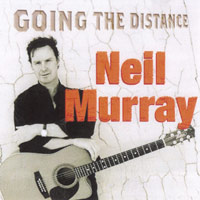
Kev Carmody & Neil Murray on Racism


Green Left Weekly'
s JOHN TOGNOLINI interviewed singer-songwriters KEV CARMODY and NEIL MURRAY about their views on the Olympics, the stolen generations, native title, reconciliation and racism.

Togs: It's only a few years since Sydney won the Olympics. Remember when they were saying this would be the multicultural, non-racist Olympics? Now there's been this open racism in the past 18 months.

Neil: I love sport and athletics. I like to see Australia do well, but the Olympics is like the bloody casino in Melbourne. It's like the Grand Prix. It's easy to get these big circus events ahead of real social, environmental or cultural reforms. The energy is not being put into really important things.

Kev: The fundamental questions are not being addressed.

Neil: You just can't go on ignoring the terrible bloody crimes that have happened in this country. Some people assume that Aboriginal people are going to stop progress. That is not the case at all. There's plenty of Aboriginal groups that have got pastoral stations.

They want their economic independence. All they want is their rights to be recognised and to be equal partners at the negotiating table, to be able to speak for themselves and decide what to do with their land. As Pat Dodson was trying to say, they're really not about kicking pastoralists off. They want their rights preserved.

There wouldn't have been a pastoral industry in this country without Aboriginal labour. They provided the cheap labour -- virtually slave labour, just living on rations -- to get the hard work done to get these properties established.

Kev: The “brave explorers” wouldn't have gotten 100 kilometres away from the nearest town without the blackfellas.

Togs: The 10-point plan that Howard has put forward is really the second dispossession of Aboriginal people.

Kev: What they're trying to do is to legitimise Aborigines' insecurity as far as land tenure goes. Pastoralists were granted leases for pastoral purposes, but they've done more than that.

Neil: They're actually going for a land grab now. They want more rights than they're supposed to have. They're the greedy bunch.

Kev: The way the country where I was raised has been vandalised is just phenomenal. Whole water systems 3000 or 4000 kilometres long have been killed. It's just dead, dead water from here to over the Queensland border.

Let's get back to the rise of racism in the last 18 months or so. Xenophobia -- the dictionary definition is the morbid fear of other races -- is still entrenched in this country. Some people feel isolated and alienated because they're a European-based society between Africa, South America and Asia. There's that insecurity. They've treated the land the same way they've treated the indigenous people.

Togs: Is Australia a new pariah? Is there going to be a boycott of the Olympic games?

Neil: There could well be boycotts the way things are heading. I remain an optimist. I think sanity will prevail and the pressure from the international arena will hold sway. The bigots are not going to last.

I mean, the spokesperson for this movement [Pauline Hanson] can't put two words together. She's totally out of her depth and isn't quite aware of the ramifications of what is happening around her.

Kev: I think she was quite startled at the response down in Tasmania. She doesn't realise what she's in or what she represents to the majority of people. She's quite insulated, isolated and secure when she's talking to those tiny bigoted groups, and once she gets outside in the open forum, it's a different kettle of fish.

Togs: What do you think of the federal government's attitude to the report on the stolen children, particularly since you, Kev, and your brother Laurie were taken away from your parents in the 1950s?

Kev: I always say we were lucky because we were put in the orphanage when I was about 10. We knew we had parents. We knew we had uncles, aunties, grandfathers, grandmothers.

It was the tiny little babies that were taken away, the young ones that didn't have a concept of having a community around them. That's the real tragedy. But the positive part is we, as a collection of indigenous nations in this country, have come through that and had resilience and dignity because of our association with our community, culture and the land.

Togs: How do you see institutionalised racism? It's ironic that we are talking about 30 years of Australian citizenship for the world's oldest people.

Kev: It's institutionalised ignorance.

Neil: That's what racism is. Basically, it's ignorance. Ignorance breeds racist attitudes.

Kev: But it was institutionalised through the education system, and through the churches. The education system, when I first came into it, had no history of us at all as a people. You could sit up there listening to a history class in primary school and we weren't even there.

So it was institutionalised right from the word go, officially by governments, and it's for us to reclaim that history back and put the agenda right.

Neil: Now the truth has to come out no matter how bad it is. The truth is always liberating. If you recall the Port Arthur massacre last year, that was a shocking tragedy. The grief was palpable on a national level, but people should remember that wasn't the biggest massacre in Australia's history.

There were many Aboriginal groups that were slaughtered like that, innocent victims of brutal slaughter, and people should remember that grief and shock they felt were felt by Aboriginal people in a lot of different places, and that goes on. That is still there. There has never been any recognition of that.
August 1997

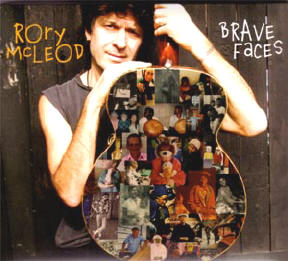
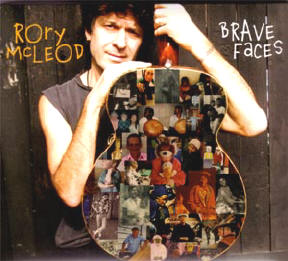
Rory McLeod


The politics of entertainment

Rory McLeod, currently touring Australia, entertains not only with his skills as a guitarist, harmonica player, tap dancer, spoon player and vocalist but also with the stories told in his songs, many of which he writes himself. He has performed in many places outside the normal entertainment venues, such as on picket lines during the British miners' strike, at the London public meeting for Sinn Fein's Gerry Adams and at Sydney's Long Bay jail supporting Tim Anderson. He is interviewed here by JOHN TOGNOLINI.

Togs: What are your songs based on?

Rory; I find that I have to respond very carefully to images through the media. A lot of people feel impotent from watching television. I like to make people feel a bit stronger, so I write and sing from direct experience.

Togs: You've done historical research in your music, such as the three-year school strike in East Anglia in 1911.

Rory: That was about two teachers, husband and wife, one the son of a farm labourer. The parents they met were mostly farm labourers, so they got them organised, such as electing themselves onto the local council.

The local vicar was a bigot; the church owned the land. When the labourers started fighting for wages and conditions, the church and the big farmers tried to expel the two teachers. They were eventually framed and tarred and feathered. The school kids went on strike in support of their teachers, with their parents backing them up, and it ended up being a running battle for nearly four years.

I heard about it and went down there and researched it, checking out the records and wrote a ballad about it.

Togs: You wrote song about school and growing up, Pauline's song.

Rory: It's a song about a girl I went to school with. We had a lot of trouble at school because all the school governors were Tory businessmen. That's why the school strike interested me a lot. I got expelled from school for so-called disobedience. The song's somewhat autobiographical; there's me in that song as well Pauline.

Togs: Does your personal experience enter your political songs as well, for example “Criminals of Hunger”?

Rory: That was a lot to do with me travelling at the time, being away from London and trying to keep in touch with things that were happening there and what was happening in Central America, where I was. This is where I heard about the riots back home in Brixton.

Some of the song I'd written down beforehand. It's basically a story of internationalism, of the fate we share with other people, that we've all got the same battle and share the same fate. I suppose it's quite a long song, but I was trying to say a lot as well.

Togs: You did a song about a Turkish political activist who committed suicide when faced with deportation from Germany back to Turkey.

Rory: I lived in Hamburg some years ago. There were a lot of Turkish folks that lived in the area I lived in. There's a lot of racism against Turks. They do all the shit jobs, like moving chemical waste.

It's a song about Kemal Altun, who jumped out of a window seven floors up in the police station rather than be sent back to imprisonment and torture in Turkey. I have friends in London who are in exile from Turkey, one whose father is in prison. He was in my mind when I wrote it. So it was a song for him as well and really for all Turks.

Togs: What got you involved in the project around Woody Guthrie, Woody Lives, with other musicians in Britain?

Rory: Most of the people involved were Northerners or had connections with the North, Scotland. In Scotland there's a lot more tradition for country music and cross-Atlantic fertilisation than there is in the south or in London, and it was something we all wanted to do.

A lot of Woody's song are still relevant. His deportees song is still going on: in Jersey, an island which is a bank/tax haven for rich people, they use Portuguese as labourers and send them back before they can get residential visas.

Woody's songs still mean a lot 50 years after they written. So we got together to keep the songs alive and do them our own way, Dick Gaughan and Rab Noates. It was a lot about showing respect to Woody and connecting the roots of folk or protest music.

Togs: You're able to make a living out of your music. How have you been able to survive?

Rory: I make people feel good through entertainment, which is something I don't hide. I don't just sing political songs all night, because there are ways of reaching out to people and not alienating them. I haven't always relied on record companies and have survived without them. I've had to do other jobs too, farming work and my time in the circus, painting, cooking and labouring jobs.

I've always stood by my own music. People have come back to acoustic or folk -- Michelle Shocked, Billy Bragg and the Pogues are a reflection of that.

The folk scene is coming up to date, with songs being taken out of museums and more people making a more popular culture. But I've got lots of friends who are great musicians who don't get work, so it's not an easy thing to get by.

Green Left Weeekly January

1992

RORY McLEOD is currently on his fourth visit to Australia, promoting his new album, Travelling Home. In his last visit in 1990-91, he played outside Long Bay jail at a concert protesting against the frame-up of Tim Anderson and at one of the rallies against the Gulf War in Sydney. He was interviewed for Green Left by JOHN TOGNOLINI.

Togs: You went back to England through the United States, playing at some festivals.

Rory: There was the Festival of the Eagle in Texas. Floyd Westerman was there; he's a native American actor who sang a great song about missionaries trying to change people's religions and a great song about anthropologists who come with their pens and leave when they dry out.

Togs: You travelled around Australia with Kev Carmody in some pretty remote areas. What response did you and Kev get to the Woody Guthrie songs you played?

Rory: Sometimes we got responses to different songs. The most response I got was singing “The Witches Burning Time” which is about the dark ages. Roy Bailey sings it, and it resonates today with the land being burned and ecologically destroyed.

Kev played some didge, I played trombone and we accompanied each other. We enjoyed each other's company. It wasn't just the gigs, but meeting after them: you're in an area, you want to find out what's happening.

Togs: You've travelled and toured basically non-stop for the past two years. What was it like to be back in London?

Rory: I want to stay local. When you're away a lot, you feel a bit like a deserter. There's things going on at home. There comes a time when you realise, I'd be doing more if I was staying there, rather than travelling.

Unemployment's grown, people are being repossessed who took up Margaret Thatcher's idea of buying their own homes [council/housing commission dwellings]. They can't pay their mortgage, so they're being made homeless.

There's socialists in the Labour Party, but they're not in the leadership. In my eyes the Labour Party is becoming more American in a political way. They're going more towards the right. They're not as bad or as right wing as the Australian Labor Party.

This thing that's happening in Europe, with the attacks on refugee hostels by the right wing: these attacks are more organised than we are led to believe.

The whole of Europe wants to tighten those [asylum] laws. There was an asylum bill passed in Britain which seems to be part of the business club they're building up around the Maastricht Treaty. They don't want people coming from poorer countries. Basically they don't want black or Asian people coming in: it's a racist law.

Togs: You've always been independent with the production of your music. Can you explain the production of your latest album Travelling Home?

Rory: I produced it myself. It's a kind of vision I've had; it is doing a painting and having the money to afford the canvas. I work with a company, Cooking Vinyl, and give them the tapes, and they manufacture them, do the artwork, type up the lyrics. It's very tiring and stressful, but I've always wanted to do it. It's my way of having some artistic control.

Your songs are sometimes compared to a camera. Do you feel your songs describe historical events?

We've been making up some songs for a radio documentary about the fruit market in the East End of London. Some of the old fellas are still alive who used to haul carts with horses. The documentary is basically them telling stories of what it was like. It's oral history. We are going to be editing their stories together with songs I've made up. That's what songs do: keep a memory alive.

Here's a song about a farming woman whose sons went off to fight in Vietnam for freedom; she's there at home fighting the oil company who wants to mine her land. I'm trying to tell the history from working people's point of view.

Green Left Weekly June 1994