John/Togs Tognolini

John/Togs Tognolini
On the Sydney Harbour Bridge with 300,000 other people protesting against Israel's Genocide against the Palestinians in Gaza.

A retired Teacher returning to Journalism, Documentary Making, Writing, Acting & Music.

My photo
I’ve been a political activist for over fifty years in the Union and Socialist Movement. I’m a member of NSW Socialists. I've retired as High School Teacher and returning to Journalism & Documentary Making.. My educational qualifications are; Honours Degree in Communications, University of Technology, Sydney, 1994, Diploma of Education Secondary University of Western Sydney, 2000.

Blog Archive

Popular Posts

Pageviews last month

Showing posts with label New Romans United States. Show all posts

Sunday, December 23, 2007

Politics and Profits: How the Oil Cartel Gets Its Way By RALPH NADER

While many impoverished American families are shivering in the winter cold for lack of money to pay the oil baron their exorbitant price for home heating oil, ex-oil man, George W. Bush sleeps in a warm White House and relishes his defeat of the Congressional attempt to get rid of $15 billion in unconscionable tax breaks given those same profit-glutted oil companies like ExxonMobil when crude oil was half the price it is today.

This is the same George W. Bush who, calling himself a "compassionate conservative" in October 2000 made this promise to the American people: "First and foremost, we've got to make sure we fully fund the Low Income Home Energy Assistance Program (LIHEAP), which is a way to help low-income folks, particularly here in the East, pay for their high, high fuel bills."

So what did this serial promise-breaker propose this year? Mr. Bush wanted to cut the fuel aid program by $379 million! This entire assistance program is funded at about half of the $5 billion that state governors and lawmakers believe is essential to meet the needs of the six million people eligible to apply for such help this year.

Everyone in Washington knows that the big, coddled, subsidized oil industry has many politicians over a barrel. When it comes to oily Bush and Cheney though, the global melting industry has these two indentured servants marinated in oil.

Look at what ending regulation of natural gas prices has produced: prices up 50 percent since last year. Home heating oil prices are up 30 percent. Bush's own Energy Department estimates the rise of heating oil costs will impose an average increase of $375 for customers this winter. No way that supply and demand explains this gouge.

If a home dweller is too poor to order more than 100 gallons at a time, they get smacked with an extra surcharge of 60 to 70 cents per gallon for delivery.

Some states set aside some money. New York State will spend $25 million. Joe Kennedy and Citgo sell discounted heating oil, but that Venezuelan program is undergoing a reduction.

Efforts in Congress to impose a windfall-profits tax on the King Kong, record-profit-setting oil companies got nowhere.

Two years ago, efforts by Senator Charles Grassley (Rep. Iowa), then chairman of the Senate Finance Committee, begging the major oil giants to slice off a tiny portion of their profits for charitable contributions toward energy assistance for the poor did not receive even the courtesy of a response.

I've asked members of Congress, including the Black Caucus and the Hispanic Caucus in the House of Representatives to take up this cause vigorously and prominently on behalf of their constituents back home. Have you heard any high-visibility demand from these veteran lawmakers? I haven't.

Even Senator Grassley seems to have despaired.

Please note that ExxonMobil alone made $36 billion in profits last year. That's one company profiting over seven times the amount of dollars needed for energy assistance. Greed, arrogance, callousness and far too much unaccountable power exists in Big Oil and in its White House.

Enforcing the antitrust laws and prohibiting organized speculators at the Mercantile Exchange from determining the price of an essential product like petroleum will bring prices down. But there is no action in the White House. No demand from the Congress.

Veteran free lance reporter, Lance Tapley has been reporting for The Portland Phoenix newspaper on the price bilking of recipients of energy assistance programs. For thirty years, he writes, the oil dealers have been charging the Maine state housing authority, which administers the LIHEAP program, higher prices than they set for their payment-plan customers, despite the large bulk purchasing by this housing authority.

Tapley severely criticizes the failure of Governor John Baldacci for not standing up for poor Maine people at the same time he promotes large subsidies for business and sells off state-owned assets at bargain-basement prices to corporations.

Mr. Tapley writes: "The heating oil crisis could be a big test in 2008 for Baldacci and the State House Democrats. The picture will not be pretty if elderly poor people freeze in their trailers while rich Republicans and professional-class Democrats snuggle up in their McMansions or old Colonialsbut, with our Democrats, who needs Republicans?" (Contact Lance Tapley at ltapley@adelphia.net)

Some day, the tens of millions of poor people in America, most of them working poor, will be heard from. Until now, they have been exhausted, powerless, despairing, fearful and grasping for whatever crumbs fall off the table. History teaches us that such a subdued human condition does not continue indefinitely.

Call the White House switchboard (202-456-1414) and your member of Congress (Senate Information: 202-224-3121; House Information: 202-225-3121). Tell them not all these low-income Americans have been sent to oil rich Iraq. Many are here mourning their losses of and injuries to loved ones while they shiver in the cold.

Tell them to make those big oil CEOs making as much as $50,000 an hour to ante up.

Ralph Nader is the author of The Seventeen Traditions

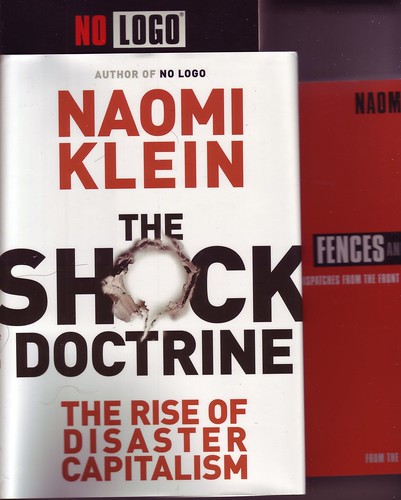
The Shock Doctrine in Action in New Orleans by Naomi Klein

Readers of The Shock Doctrine know that one of the most shameless examples of disaster capitalism has been the attempt to exploit the disastrous flooding of New Orleans to close down that city’s public housing projects, some of the only affordable units in the city. Most of the buildings sustained minimal flood damage, but they happen to occupy valuable land that make for perfect condo developments and hotels.

The final showdown over New Orleans public housing is playing out in dramatic fashion right now. The conflict is a classic example of the “triple shock” formula at the core of the doctrine.

First came the shock of the original disaster: the flood and the traumatic evacuation.
Next came the “economic shock therapy”: using the window of opportunity opened up by the first shock to push through a rapid-fire attack on the city’s public services and spaces, most notably it’s homes, schools and hospitals.
Now we see that as residents of New Orleans try to resist these attacks, they are being met with a third shock: the shock of the police baton and the Taser gun, used on the bodies of protestors outside New Orleans City Hall yesterday.
Democracy Now! has been covering this fight all week, with amazing reports from filmmakers Jacquie Soohen and Rick Rowley (Rick was arrested in the crackdown). Watch residents react to the bulldozing of their homes here.

And footage from yesterday’s police crackdown and Tasering of protestors inside and outside city hall here.

That last segment contains a terrific interview with Kali Akuno, executive director of the People’s Hurricane Relief Fund. Akuno puts the demolitions in the big picture, telling Amy Goodman:

This is just one particular piece of this whole program. Public hospitals are also being shut down and set to be demolished and destroyed in New Orleans. And they’ve systematically dismantled the public education system and beginning demolition on many of the schools in New Orleans–that’s on the agenda right now–and trying to totally turn that system over to a charter and a voucher system, to privatize and just really go forward with a major experiment, which was initially laid out by the Heritage Foundation and other neoconservative think tanks shortly after the storm. So this is just really the fulfillment of this program.

Akuno is referring to the Heritage Foundation’s infamous post-Katrina meeting with the Republican Study Group in which participants laid out their plans to turn New Orleans into a Petri dish for every policy they can’t ram through without a disaster. Read the minutes on my website.

For more context, here are couple of related excerpts from The Shock Doctrine: The Rise of Disaster Capitalism:

The news racing around the shelter [in Baton Rouge] that day was that Richard Baker, a prominent Republican Congressman from this city, had told a group of lobbyists, “We finally cleaned up public housing in New Orleans. We couldn’t do it, but God did.” Joseph Canizaro, one of New Orleans’ wealthiest developers, had just expressed a similar sentiment: “I think we have a clean sheet to start again. And with that clean sheet we have some very big opportunities.” All that week the Louisiana State Legislature in Baton Rouge had been crawling with corporate lobbyists helping to lock in those big opportunities: lower taxes, fewer regulations, cheaper workers and a “smaller, safer city”–which in practice meant plans to level the public housing projects and replace them with condos. Hearing all the talk of “fresh starts” and “clean sheets,” you could almost forget the toxic stew of rubble, chemical outflows and human remains just a few miles down the highway.

Over at the shelter, Jamar Perry, a young resident of New Orleans, could think of nothing else. “I really don’t see it as cleaning up the city. What I see is that a lot of people got killed uptown. People who shouldn’t have died.” He was speaking quietly, but an older man in line in front of us in the food line overheard and whipped around. “What is wrong with these people in Baton Rouge? This isn’t an opportunity. It’s a goddamned tragedy. Are they blind?”

A mother with two kids chimed in. “No, they’re not blind, they’re evil. They see just fine.”


At first I thought the Green Zone phenomenon was unique to the war in Iraq. Now, after years spent in other disaster zones, I realize that the Green Zone emerges everywhere that the disaster capitalism complex descends, with the same stark partitions between the included and the excluded, the protected and the damned.

It happened in New Orleans. After the flood, an already divided city turned into a battleground between gated green zones and raging red zones–the result not of water damage but of the “free-market solutions” embraced by the president. The Bush administration refused to allow emergency funds to pay public sector salaries, and the City of New Orleans, which lost its tax base, had to fire three thousand workers in the months after Katrina. Among them were sixteen of the city’s planning staff–with shades of “de Baathification,” laid off at the precise moment when New Orleans was in desperate need of planners. Instead, millions of public dollars went to outside consultants, many of whom were powerful real estate developers. And of course thousands of teachers were also fired, paving the way for the conversion of dozens of public schools into charter schools, just as Friedman had called for.

Almost two years after the storm, Charity Hospital was still closed. The court system was barely functioning, and the privatized electricity company, Entergy, had failed to get the whole city back online. After threatening to raise rates dramatically, the company managed to extract a controversial $200 million bailout from the federal government. The public transit system was gutted and lost almost half its workers. The vast majority of publicly owned housing projects stood boarded up and empty, with five thousand units slotted for demolition by the federal housing authority. Much as the tourism lobby in Asia had longed to be rid of the beachfront fishing villages, New Orleans’ powerful tourism lobby had been eyeing the housing projects, several of them on prime land close to the French Quarter, the city’s tourism magnet.

Endesha Juakali helped set up a protest camp outside one of the boarded-up projects, St. Bernard Public Housing, explaining that “they’ve had an agenda for St. Bernard a long time, but as long as people lived here, they couldn’t do it. So they used the disaster as a way of cleansing the neighbourhood when the neighbourhood is weakest. … This is a great location for bigger houses and condos. The only problem is you got all these poor black people sitting on it!”

Amid the schools, the homes, the hospitals, the transit system and the lack of clean water in many parts of town, New Orleans’ public sphere was not being rebuilt, it was being erased, with the storm used as the excuse. At an earlier stage of capitalist “creative destruction,” large swaths of the United States lost their manufacturing bases and degenerated into rust belts of shuttered factories and neglected neighbourhoods. Post-Katrina New Orleans may be providing the first Western-world image of a new kind of wasted urban landscape: the mould belt, destroyed by the deadly combination of weathered public infrastructure and extreme weather.

Since the publication of The Shock Doctrine, my research team has been putting dozens of original source documents online for readers to explore subjects in greater depth. The resource page on New Orleans has some real gems.

Naomi Klein is the author of many books, including her most recent, The Shock Doctrine: The Rise of Disaster Capitalism, which will be published in September.Visit Naomi’s website at www.naomiklein.org, or to learn more about her new book, visit www.shockdoctrine.com .

Published on Friday, December 21, 2007 by Huffington Post

Friday, December 21, 2007

Bomb After Bomb By HOWARD ZINN

This essay serves as the introduction to Bomb After Bomb: a Violent Cartography, a collection of drawings illustrating the history of bombing by elin o'Hara slavick. o'Hara slavick is a professor of art at the University of North Carolina. More of her visionary work can be viewed on her website. AC / JSC

Perhaps it is fitting that elin o'Hara slavick's extraordinary evocation of bombings by the United States government be preceded by some words from a bombardier who flew bombing missions for the U.S. Air Corps in the second World War. At least one of her drawings is based on a bombing I participated in near the very end of the war--the destruction of the French seaside resort of Royan, on the Atlantic coast.

As I look at her drawings, I become painfully aware of how ignorant I was, when I dropped those bombs on France and on cities in Germany, Hungary, Czechoslovakia, of the effects of those bombings on human beings. Not because she shows us bloody corpses, amputated limbs, skin shredded by napalm. She does not do that. But her drawings, in ways that I cannot comprehend, compel me to envision such scenes.

I am stunned by the thought that we, the "civilized" nations, have bombed cities and countrysides and islands for a hundred years. Yet, here in the United States, which is responsible for most of that, the public, as was true of me, does not understand--I mean really understand--what bombs do to people. That failure of imagination, I believe, iscritical to explaining why we still have wars, why we accept bombing as a common accompaniment to our foreign policies, without horror or disgust.

We in this country, unlike people in Europe or Japan or Africa or the Middle East, or the Caribbean, have not had the experience of being bombed. That is why, when the Twin Towers in New York exploded on September 11, there was such shock and disbelief. This turned quickly, under the impact of government propaganda, into a callous approval of bombing Afghanistan, and a failure to see that the corpses of Afghans were the counterparts of those in Manhattan.

We might think that at least those individuals in the U.S. Air Force who dropped bombs on civilian populations were aware of what terror they were inflicting, but as one of those I can testify that this is not so. Bombing from five miles high, I and my fellow crew members could not see what was happening on the ground. We could not hear screams or see blood, could not see torn bodies, crushed limbs. Is it any wonder we see fliers going out on mission after mission, apparently unmoved by thoughts of what they have wrought.

It was not until after the war, when I read John Hersey's interviews with Japanese survivors of Hiroshima, who described what they had endured, that I became aware, in excruciating detail, of what my bombs had done. I then looked further. I learned of the firebombing of Tokyo in March of 1945, in which perhaps a hundred thousand people died. I learned about the bombing of Dresden, and the creation of a firestorm which cost the lives of 80,000 to 100,000 residents of that city. I learned of the bombing of Hamburg and Frankfurt and other cities in Europe.

We know now that perhaps 600,000 civilians--men, women, and children-died in the bombings of Europe. And an equal number died in the bombings of Japan. What could possibly justify such carnage? Winning the war against Fascism? Yes, we "won". But what did we win? Was it a new world? Had we done away with Fascism in the world, with racism, with militarism, with hunger and disease? Despite the noble words of the United Nations charter about ending "the scourge of war" - had we done away with war?

Amchitka Island, Alaska, USA
1965 - 1971
elin o'Hara slavick

As horrifying as the loss of life was, the acceptance of justifications for the killing of innocent people continued after World War II. The United States bombed Korea, with at least a million civilian deaths, and then Vietnam, Cambodia, Laos, with another million or two million lives taken. "Communism" was the justification. But what did those millions of victims know of "communism" or "capitalism" or any of the abstractions which cover up mass murder?

We have had enough experience, with the Nuremberg trials of the Nazi leaders, with the bombings carried out by the Allies, with the torture stories coming out of Iraq, to know that ordinary people with ordinary consciences will allow their instincts for decency to be overcome by the compulsion to obey authority. It is time therefore, to educate the coming generation in disobedience to authority, to help them understand that institutions like governments and corporations are cold to anything but self-interest, that the interests of powerful entities run counter to the interests of most people.

This clash of interest between governments and citizens is camouflaged by phrases that pretend that everyone in the nation has a common interest, and so wars are waged and bombs dropped for "national security", "national defense", "and national interest".

Patriotism is defined as obedience to government, obscuring the difference between the government and the people. Thus, soldiers are led to believe that "we are fighting for our country" when in fact they are fighting for the government - an artificial entity different from the people of the country - and indeed are following policies dangerous to its own people.

Lebanon
1983 - 1984 and 2006
elin o'Hara slavick

My own reflections on my experiences as a bombardier, and my research on the wars of the United States have led me to certain conclusions about war and the dropping of bombs that accompany modern warfare.

One: The means of waging war (demolition bombs, cluster bombs, white phosphorus, nuclear weapons, napalm) have become so horrendous in their effects on human beings that no political end-- however laudable, the existence of no enemy -- however vicious, can justify war.

Two: The horrors of the means are certain, the achievement of the ends always uncertain.

Three: When you bomb a country ruled by a tyrant, you kill the victims of the tyrant.

Four: War poisons the soul of everyone who engages in it, so that the most ordinary of people become capable of terrible acts.

Five:Since the ratio of civilian deaths to military deaths in war has risen sharply with each subsequent war of the past century (10% civilian deaths in World War I,50% in World War II, 70% in Vietnam, 80-90% in Afghanistan and Iraq) and since a significant percentage of these civilians are children, then war is inevitably a war against children.

Six: We cannot claim that there is a moral distinction between a government which bombs and kills innocent people and a terrorist organization which does the same. The argument is made that deaths in the first case are accidental, while in the second case they are deliberate. However, it does not matter that the pilot dropping the bombs does not "intend" to kill innocent people -- that he does so is inevitable, for it is the nature of bombing to be indiscriminate. Even if the bombing equipment is so sophisticated that the pilot can target a house, a vehicle, there is never certainty about who is in the house or who is in the vehicle.

Seven: War, and the bombing that accompanies war, are the ultimate terrorism, for governments can command means of destruction on a far greater scale than any terrorist group.

These considerations lead me to conclude that if we care about human life, about justice, about the equal right of all children to exist, we must, in defiance of whatever we are told by those in authority, pledge ourselves to oppose all wars.

If the drawings of elin o'Hara slavick and the words that accompany them cause us to think about war, perhaps in ways we never did before, they will have made a powerful contribution towards a peaceful world.

Howard Zinn's most recent book is A Power Government's Cannot Suppress.

from CounterPunch

Thursday, December 20, 2007

Remember the Good Old Days, When the State Feared We-the-People? Privatizing War Abroad, Invading Privacy at Home By EVA LIDDELL

Although there may be an international outcry that the United States has over a hundred and sixty thousand private contractors who are up to no good in Iraq most Americans are greeting the news with a resigned shrug. Nothing this government does seems to surprise anybody anymore. George Bush isn't bothered by low approval ratings or the revelations of the crimes of his regime. He acts like he was just hoping some son-of-a-bitch wouldn't like it. And we the people seem to be that son-of-a-bitch.

Bush is a lucky man which could be one reason for his insouciance. Other presidents didn't have the luxury of ruling over a public whose social power is as weak as our present one. Lyndon Johnson didn't have Bush's luck. Richard Nixon didn't either.

Up to the Tet Offensive in 1968 Johnson had been conscripting forty thousand American boys a month. The pressures of the peace movement and internal opposition within the conscript army forced him to seek mercenaries from other countries. American taxpayers were unaware they were paying the salaries of over a hundred thousand mercenaries from the Philippines, Thailand and South Korea. The South Korean government whose economy ultimately benefited from Johnson's bribes supplied fifty thousand trained mercenaries who were in Vietnam with one job only. Kill Vietnamese. Johnson figured that by using professional killers it would decrease the direct participation of the American conscripts less willing to commit outright murder while still accomplishing his goals of fighting an unwinnable war.

While Richard Nixon promised people that he had a "secret plan to end the war" which got him the votes of even desperate Democrats bringing him a victorious election he wanted to escalate the war not stop it. But his use of mercenaries to fight it had an additional purpose. By 1969 domestic opposition had grown so intense that while both Johnson and Nixon had wanted to send an additional three hundred thousand American soldiers into battle in Vietnam they kept them in the States to be used for another conflict. They were convinced they would be needed to quell an internal rebellion on the level of a civil war right here at home. It is easy to forget that our society was once capable of intimidating our rulers to that extent. After Vietnam our rulers made sure the people would forget.

That was a long time ago. No need now for presidents to keep from the people that while our wars are privatized our own private lives are open to any scrutiny the State deems necessary strictly for our "own protection". The "national emergency" of 9/11 saw a wholesale sell-off of our strength as a society as we fled into the arms of a protective federal government. Maybe by the time 9/11 rolled out that's what we wanted.

The thing about the State is that it takes everything from the people and gives the people nothing in return. There's nothing like a war or a national crisis for the State to take even more power to itself. But where does this power come from? We are not the State. We are not the government. We are a society and at present the poorer for it because almost without noticing the State has usurped our social power and taken it all to itself.

We keep electing into office the same incompetent politicians year after year who promise to represent us but who serve only to enrich themselves while enlarging the apparatus of the State. And then we wonder why nothing ever changes.

Eva Liddell is a painter who lives in the Pacific Northwest. Her email is Eva.Liddell@gmail.com

from CounterPunch

Wednesday, December 19, 2007

The Constitution, the Media and Kucinich-Piano Wire Puppeteers By SEAN PENN

Sean Penn and friends helping rescue peole in New Orleans after Hurricane Katrinia


It’s been an odd week. For me, a particularly odd week. But that’s another story. So, wait a minute. Iran DOESN’T have nuclear weapon capability??? So, who are we gonna bomb? I want to bomb somebody!

Didn’t Senator Clinton just vote in essence to give President Bush the power to bomb Iran? If he had done it last week, would that have made her right? I mean, if she knew then what she knows now? Or am I getting that backward? Golly, I’m confused.

And what about President Bush? This week, Vladimir Putin, the man Mr. Bush said he “Looked into the eyes of and found to be very straightforward and trustworthy.” So much so, he was “able to get a sense of his soul.” Well that soulful fella has just successfully coalesced the most dangerous power base in Russia since the Cold War amid rumors that include allegations he ordered the assassinations of journalists and imprisonment of noted proponents of freedom (Oops).

Meanwhile, our President’s great enemy in Venezuela, Hugo Chavez, that “totalitarian,” “authoritarian,” “dictator,” that “mad man run amok,” somehow was unsuccessful in his bid for the constitutional reforms that would have allowed him to be repeatedly re-elected for life…Hmmm?

Odd week, you know? Really.

What happened to Chavez’s “strong-arming?” His “electoral corruption?” His alleged “gagging of the press?” How in the hell could he have lost? I’m sorry, did I miss something?

How is it that this “Commie bastard” with 80% of his citizens having elected him in the first place was unable to prevail? Could it be that we’ve been lied to about him? I mean, Pat Robertson’s not a liar, is he? His god wouldn’t let that happen, would he? And god-forbid, our god would let the right-wing pundits, left-wing corporates, or our own administration send us a bill of goods!?

Is it possible, I mean I know it’s silly, but is it just a little bit possible that President Chavez is in fact a defender of his people’s Constitution? That, that’s how his referendum could fail? And that that’s why he accepted it with such grace? A constitution which I have read several times. Quite a beautiful document, not dissimilar to our own. You might give it a read. Oh, I forgot – he’s a “drug runner.”

Let me share something with you. Late one night in Caracas, I met with a couple of fellas, mercenaries I think you call them. Goddamit, I keep doing that. I mean “contractors.” They were Brits, their specialty: drug interdiction. These two were no great fans of Chavez. They called him “radical” and expected him to fall to an assassin’s bullet within the year. Like him or not, he had the cash to win their acceptance of his employ. And working alongside the Venezuelan military, these two, based in Caracas, had played the mountainous and jungled border between Columbia and Venezuela. A zone rife with paramilitaries, FARC guerillas, and mer…scratch that, contractors. What I was told that evening in Caracas by these piano wire puppeteers was that they had never worked for a government whose investment in drug interdiction was so genuine. “Yeah,” said one of the Brits, “I gotta give the bastard Chavez that.”

But I was talking about the Constitution. Most importantly, our own. And what an odd week it has been. Our culture is engrained with a tradition that blurs the line between what is right, what is just and what is constitutional, with what is a scam. That tradition is the cult of personality. What can TV sell, what kind of crap will we buy. And at what point are we buying and selling our rights, our pride, our flag, our children, and succumbing to meaningless slogans that are ultimately pure titles for un-Americanism. How do we know what’s American and what is not? Because John Wayne tells us so? Because Sean Penn tells us so? Susan Sarandon? Bill O’Reilly? Michael Moore? Senator Bull? Or Senator Shit? Ann “my bowel expenditure” Coulter? No. It’s our Constitution. We don’t use it just to win. We depend on it because it’s the only “us” worth being. And because it’s our children’s inheritance from our shared forefathers and the traditions that really do speak best of our country.

So, here’s the question. We got Iowa coming up, we got New Hampshire right on its ass. Do we sell it for electability? If Hitler were the only candidate, would voting for him be most American? Jump on a plane with me. Okay, we’re over the Middle East now…Let’s land. Take a deep breath.

Imagine the bodies, burned and mutilated, the concussive sounds of gunfire and explosives defining the last horrifying moments of the dying and the dead. Imagine the millions of refugees fleeing through the deserts of Iraq, the babies crying, and the stench of death in the air. Yuck. Let’s get back on the plane and head home.

Now, imagine American servicemen dead or broken, returning from a broken military to a silent casket or a broken veteran’s administration, to broken lives and broken businesses, broken wives, unspoken husbands, and devastated children. And what for? What have we gained?

Al-Qaida recruitment is up. Terrorism is up. Quality of life is down in our country and around the world. While the rich continue to get richer and the poor, poorer and more numerous. And on the verge of recession, we are witnessing the dramatic disassembling of the middle class amidst a flood of foreclosures and unpayable debts. To Osama Bin Laden’s infinite delight, we have become a country of principle breakers rather than principle bearers.

We are torturers and we too often, imprison only the weak. When our own administration chooses its bewilderingly un-American agenda (For the entitled people? By the entitled people?) over the Constitution in defining American values, principles, and law, Bin Laden laughs at the weakened sheep that we and our representatives have become.

High crimes and misdemeanors? How about full-blown treason for the outing our own CIA operatives? How about full-blown treason for those who support this administration through media propaganda?

While I’m not a proponent of the Death Penalty, existing law provides that the likes of Cheney, Bush, Rumsfeld and Rice, if found guilty, could have hoods thrown over their heads, their hands bound, facing a 12-man rifle corps executing death by firing squad. And our cowardly democratically dominated House and Senate can barely find one voice willing to propose so much as an impeachment. That one voice of a true American. That one voice of Congressman Dennis Kucinich.

This is not going to be a sound bite. Not if I can help it. I’m torn. I’m torn between the conventional wisdom of what we all keep being told is electibility and the idealism that perhaps alone can live up to the challenges of our generation. Of the democrats running for President, only Congressman Dennis Kucinich’s candidacy is backed by a voting record of moral courage and a history of service to our country that has fully earned our support and our gratitude. And when I say support, I am not speaking to democrats alone, but rather to every American who would take the time on behalf of their children, our planet, and our soldiers to educate themselves on the Kucinich platform.

In the recent debate among Democrats in Las Vegas, the candidates, one after the other, placed security ahead of human rights. Benjamin Franklin once said “Any society that would give up a little liberty to gain a little security will deserve neither and lose both.” Then, there was good ole Patrick Henry. Remember him? “Give me liberty, or give me death.” These were the real tough bastards. The real John Wayne’s.

These are the traditions we should be serving. I found the debate infuriating, nearly an argument for fascism with few exceptions, key among them Dennis Kucinich. Of course as a strategic politician, Mrs. Clinton pulled out her set of Ginzu knives and dominated once again on “centrist” political strategy. In fending off attacks upon she, the front runner, she reminded the audience and her fellow candidates, “We are all Democrats.”

Wolf Blitzer asked each candidate if they would support the other should they themselves not be the nominee. One after another, the answer, yes. One exception: Dennis Kucinich, who with the minimal time allotted him, once again rose up beyond the sound bite and put principal ahead of party; argued policy rather than politeness. He has been the dominant voice of integrity on issues of trade, labor, education, environment, health, civil liberties, and the one endlessly determined voice of peace.

But is he too short? Does his haircut not appeal? Is he not loyal enough to a cowardly democratic platform? Does he not appeal to the cult of personality? And what if the answer is yes? What if Dennis Kucinich, the most deserving and noble of candidates, the most experienced in issues of policy and the least willing to play into the politics of personal power? What if we can’t elect a man simply on the basis of the best ideas, the most courage, and the most selfless service? What does it say about our country when we can’t rally the voices of the common good to support a man, like our troops, who would die for us, who would die for our constitution? Who, as mayor of Cleveland at the age of 31 stood up against contracts on his life. Three separate assassins whose intent was to kill him as he stood up for his constituency there.

Nonetheless, he carries on. He continues to serve.

I’ve been a supporter of Dennis Kucinich for several years. And I’ve been torn lately. I’ve been torn by the allure of “electability.” I began to invest some support in a very good man (one among Dennis’s opponents) who seems to be finding himself as a constitutional defender, but he’s not one yet. He is however, among those that we allow the media to distinguish as electable. But we’re talking about the Constitution here. We’re talking about our country. I have decided not to participate in proactive support on the basis of media distinctions. I have chosen to pledge my support to the singular, strongest and most proven representative of our constitutional mandate.

Dennis Kucinich offers us a very singular opportunity as we share this minute of time on earth. We, the people. It is for us to determine what is electable. And here’s how simple it is: If we, those of us who truly believe in the Constitution of the United States of America, all of us, vote for Dennis Kucinich, he will be elected. Could we call him electable then? If so, America will stand taller than ever.

Let’s remind our friends in the social circles of New York and the highbrow winner-friendly and monied major cities that support Mrs. Clinton, that this is not Bill Clinton. For all the misgivings I have about our former President, he raised up friends and opposition alike, his great gift as a motivator of interest and activism, of self-education and participation was, on its own merits, a unique gift. But don’t underestimate personal agendas, those that initiated NAFTA, betrayed Haitian refugees and gay rights in the military within a minute of his own election. Don’t underestimate that part of him when he gives his wife the face of his talent. Don’t underestimate the damage her poisonous ambition can do to this country. We can’t wait for the benefit of hindsight to service the benefit of Mrs. Clinton’s career.

Let’s raise up men and women of vision, of integrity, of belief in our principles. How exciting would that be to do? How good would that be for television? What if we turned this game around? Imagine watching on television, our country raising up a leader because he represents our Constitution.

Yes, good things can be good TV.

So, let’s give the Constitution another read, shall we? And then decide who its greatest defender would be. I suggest that Republicans, Independents, and Democrats alike will find that they know what’s really right in their hearts and minds.

Sean Penn's latest film is Into the Wild.

Friday, November 30, 2007

Klein: In War on Terror, Are You Next? by Shaunna Murphy


You shouldn’t be sure you’ll never end up in a damp, tiny cell in Guantanamo Bay, said best-selling author Naomi Klein to the NYU students and faculty gathered last night in Hemmerdinger Hall.

“We think we don’t fit the profile,” she said. “If we feel safe, we are banking on the racism of our government.”

Klein, author of current New York Times bestseller “The Shock Doctrine: The Rise of Disaster Capitalism,” visited the Silver Center last night to participate in the panel “Torture and Democracy,” along with Lisa Hajjar, chair of the law and society program at the University of California at Santa Barbara and author of “Courting Conflict: The Israeli Military Court System in the West Bank and Gaza.”

“We’re here to talk about the relationship between torture and democracy,” Klein said. “The thesis of the book is that the central claim of our time that the free market and democracy go hand in hand is a fairy tale.”

Klein made it clear that her definition of democracy is not a country that holds elections, but a nation that values human rights and civil liberties that are being stripped away by the use of torture as a “crude tool of coercion.” She finds that shock coupled with torture is being used to scare both individuals, largely in Guantanamo, and mass publics into submission.

“Torture is always public,” she said. “In order for you to be scared, you have to know it’s going on.”

Hajjar spoke of the relationship between torture and law, and agreed with Klein that the government’s acceptance of torture can break down entire nations.

“Torture produces false information, breaks a society and leads to mass imprisonment,” she said. “You torture people, they confess and you can say you caught a terrorist. Torture doesn’t produce truth; the ticking time bomb notion is ridiculous - ‘24′ notwithstanding.”

Though the common consensus across the panel was that the current situation in the United States is bleak, Klein offered some positive advice for improvement.

“Just like torture sends individuals into shock, events like Sept. 11 send whole societies into shock,” she said. “They lose their narrative. We need to start telling stories of why terror is happening.”

Shaunna Murphy is features editor. E-mail her at smurphy@nyunews.com.

Published on Thursday, November 29, 2007 by Washington Square News (New York)

Sunday, November 04, 2007

Rapture Rescue 911: Disaster Response for the Chosen by Naomi Klein

Naomi Klein

I used to worry that the United States was in the grip of extremists who sincerely believed that the Apocalypse was coming and that they and their friends would be airlifted to heavenly safety. I have since reconsidered. The country is indeed in the grip of extremists who are determined to act out the biblical climax–the saving of the chosen and the burning of the masses–but without any divine intervention. Heaven can wait. Thanks to the booming business of privatized disaster services, we’re getting the Rapture right here on earth.

Just look at what is happening in Southern California. Even as wildfires devoured whole swaths of the region, some homes in the heart of the inferno were left intact, as if saved by a higher power. But it wasn’t the hand of God; in several cases it was the handiwork of Firebreak Spray Systems. Firebreak is a special service offered to customers of insurance giant American International Group (AIG)–but only if they happen to live in the wealthiest ZIP codes in the country. Members of the company’s Private Client Group pay an average of $19,000 to have their homes sprayed with fire retardant. During the wildfires, the “mobile units”–racing around in red firetrucks–even extinguished fires for their clients.

One customer described a scene of modern-day Revelation. “Just picture it. Here you are in that raging wildfire. Smoke everywhere. Flames everywhere. Plumes of smoke coming up over the hills,” he told the Los Angeles Times. “Here’s a couple guys showing up in what looks like a firetruck who are experts trained in fighting wildfire and they’re there specifically to protect your home.”

And your home alone. “There were a few instances,” one of the private firefighters told Bloomberg News, “where we were spraying and the neighbor’s house went up like a candle.” With public fire departments cut to the bone, gone are the days of Rapid Response, when everyone was entitled to equal protection. Now, increasingly intense natural disasters will be met with the new model: Rapture Response.

During last year’s hurricane season, Florida homeowners were offered similarly high-priced salvation by HelpJet, a travel agency launched with promises to turn “a hurricane evacuation into a jet-setter vacation.” For an annual fee, a company concierge takes care of everything: transport to the air terminal, luxurious travel, bookings at five-star resorts. Most of all, HelpJet is an escape hatch from the kind of government failure on display during Katrina. “No standing in lines, no hassle with crowds, just a first class experience.”

HelpJet is about to get some serious competition from some much larger players. In northern Michigan, during the same week that the California fires raged, the rural community of Pellston was in the grip of an intense public debate. The village is about to become the headquarters for the first fully privatized national disaster response center. The plan is the brainchild of Sovereign Deed, a little-known start-up with links to the mercenary firm Triple Canopy. Like HelpJet, Sovereign Deed works on a “country-club type membership fee,” according to the company’s vice president, retired Brig. Gen. Richard Mills. In exchange for a one-time fee of $50,000 followed by annual dues of $15,000, members receive “comprehensive catastrophe response services” should their city be hit by a manmade disaster that can “cause severe threats to public health and/or well-being” (read: a terrorist attack), a disease outbreak or a natural disaster. Basic membership includes access to medicine, water and food, while those who pay for “premium tiered services” will be eligible for VIP rescue missions.

Like so many private disaster companies, Sovereign Deed is selling escape from climate change and the failed state–by touting the security clearance and connections its executives amassed while working for that same state. So Mills, speaking recently in Pellston, explained, “The reality of FEMA is that it has no infrastructure, and a lot of our National Guard is elsewhere.” Sovereign Deed, on the other hand, claims to have “direct access and special arrangements with several national and international information centers. These proprietary arrangements allow our Emergency Operations Center to…give our Members that critical head start in times of crisis.” In this secular version of the Rapture, God’s hand is unnecessary. Not when you have retired ex-CIA agents and ex-Special Forces lifting the chosen to safety–no need to pray, just pay. And who needs a celestial New Jerusalem when you can have Pellston, with its flexible local politicians and its surprisingly modern regional airport?

Sovereign Deed could soon find itself competing with Blackwater USA, whose CEO, Erik Prince, wrote recently of his plans to offer “full spectrum” services, including humanitarian aid in disasters. When fires broke out in San Diego County, near the proposed site of the controversial Blackwater West base, the company immediately seized the opportunity to make its case. Blackwater could have been the “tactical operation center for East County fires,” said company vice president Brian Bonfiglio. “Can you imagine how much of a benefit it would be if we were operational now?” To show off its capacity, Blackwater has been distributing badly needed food and blankets to people of Potrero, California. “This is something we’ve always done,” Bonfiglio said. “This is what we do.” Actually, what Blackwater does, as Iraqis have painfully learned, is not protect entire communities or countries but “protect the principal”–the principal being whoever has paid Blackwater for its guns and gear.

The same pay-to-be-saved logic governs this entire new sector of country club disaster management. There is, of course, another principle that could guide our collective responses in a disaster-prone world: the simple conviction that every life is of equal value.

For anyone out there who still believes in that wild idea, the time has urgently arrived to protect the principle.

Published on Friday, November 2, 2007 by The Nation

Naomi Klein is the author of many books, including her most recent, The Shock Doctrine: The Rise of Disaster Capitalism, which will be published in September.Visit Naomi’s website at nologo.org.

Sunday, October 21, 2007

Outsourcing Government by by Naomi Klein

Naomi Klein

‘We didn’t want to get stuck with a lemon.” That’s what Homeland Security Secretary Michael Chertoff said to a House committee last month. He was referring to the “virtual fence” planned for the U.S. borders with Mexico and Canada. If the entire project goes as badly as the 28-mile prototype, it could turn out to be one of the most expensive lemons in history, projected to cost $8 billion by 2011.


Boeing, the company that landed the contract — the largest ever awarded by the Department of Homeland Security — announced this week that it will finally test the fence after months of delay due to computer problems. Heavy rains have confused its remote-controlled cameras and radar, and the sensors can’t tell the difference between moving people, grazing cows or rustling bushes.


But this debacle points to more than faulty technology. It exposes the faulty logic of the Bush administration’s vision of a hollowed-out government run everywhere possible by private contractors.


According to this radical vision, contractors treat the state as an ATM, withdrawing massive contracts to perform core functions like securing borders and interrogating prisoners, and making deposits in the form of campaign contributions. As President Bush’s former budget director, Mitch Daniels, put it: “The general idea — that the business of government is not to provide services but to make sure that they are provided — seems self-evident to me.”
The flip side of the Daniels directive is that the public sector is rapidly losing the ability to fulfill its most basic responsibilities — and nowhere more so than in the Department of Homeland Security, which, as a Bush creation, has followed the ATM model since its inception.


For instance, when the controversial border project was launched, the department admitted that it had no idea how to secure the borders and, furthermore, didn’t think it was its job to figure it out. Homeland Security’s deputy secretary told a group of contractors that “this is an unusual invitation. … We’re asking you to come back and tell us how to do our business.”
Private companies would not only perform the work, they would identify what work needed to be done, write their own work orders, implement them and oversee them. All the department had to do was sign the checks.


And as one former top Homeland Security official put it: “If it doesn’t come from industry, we are not going to be able to get it.”


Put simply, if any given job can’t be outsourced, it can’t be done.


This philosophy, so central to the Bush years, explains statistics like this one: In 2003, the U.S. government handed out 3,512 contracts to companies to perform domestic security functions, from bomb detection to data mining. In the 22-month period ending in August 2006, the Homeland Security Department had issued more than 115,000 security-related contracts.
If government is now an ATM, perhaps the war on terror is best understood not as a war but as a sprawling new economy, one based on continued disaster and instability. In this economy, the Bush team doesn’t run the venture exactly; rather, it plays the role of deep-pocketed venture capitalist, always on the lookout for new security start-ups (overwhelmingly headed by former employees of the Pentagon and Homeland Security). Roger Novak, whose firm invests in homeland security companies, explains it like this: “Every fund is seeing how big the [government] trough is and asking, how do I get a piece of that action?”


The Boeing border contract is just one piece of that action. Another, of course, is the security contractor boom in Iraq, currently starring Blackwater USA.


Last month, when the Iraqi government accused Blackwater guards of massacring civilians in Baghdad, it became clear that the U.S. Embassy had no intention of severing ties with Blackwater because it could not function without it.


Perhaps that’s why that same bureau rushed to respond to the Iraqi government’s allegations in the September shooting with a “spot report” of its own: that Blackwater guards had come under attack and had responded accordingly. Days later, it emerged that an embassy contractor wrote the report — a contractor who worked for Blackwater. The administration then sent in the FBI to investigate the shootings. Yet it quickly emerged that the FBI investigators could well be guarded by Blackwater. The FBI announced that other arrangements would be made — but this was an exception.


And remember Hurricane Katrina, when contractors — including Blackwater — descended on New Orleans? FEMA was already so hollowed-out by then that it had to hire a contractor to help manage all the contractors. And with all the controversies, the Army recently decided it needed to update its manual for dealing with contractors — giving the job of drafting the new policy to one of its major contractors.


It still looks like a government — with impressive buildings, presidential news briefings, policy battles. But pull back the curtain and there is nobody home.


The Blackwater scandal could have provided an opportunity to question the wisdom of turning state security into a for-profit activity — but not in today’s Washington. Instead, rather than replacing its cowboy contractors with troops, the State Department says it will put video cameras on the vehicles they guard.


Video surveillance is one of the most lucrative sectors of the war-on-terror economy. This could even turn out to be great news for the top executives at Blackwater, who have launched a new private intelligence company billed as a “one-stop service able to meet all the intelligence, operational and security needs.” If the past is any indication, there is no reason why the men from Blackwater cannot be contracted to spy on Blackwater. Indeed, it would be the perfect expression of the hollow state that Bush built.


Published on Saturday, October 20, 2007 by the Los Angeles Times


Naomi Klein is the author of many books, including her most recent, The Shock Doctrine: The Rise of Disaster Capitalism, which will be published in September.Visit Naomi’s website at nologo.org.

Sunday, October 14, 2007

American Tears by Naomi Wolf

Naomi Wolf


I wish people would stop breaking into tears when they talk to me these days.

I am traveling across the country at the moment — Colorado to California — speaking to groups of Americans from all walks of life about the assault on liberty and the 10 steps now underway in America to a violently closed society.

The good news is that Americans are already awake: I thought there would be resistance to or disbelief at this message of gathering darkness — but I am finding crowds of people who don’t need me to tell them to worry; they are already scared, already alert to the danger and entirely prepared to hear what the big picture might look like. To my great relief, Americans are smart and brave and they are unflinching in their readiness to hear the worst and take action. And they love their country.

But I can’t stand the stories I am hearing. I can’t stand to open my email these days. And wherever I go, it seems, at least once a day, someone very strong starts to cry while they are speaking.

In Boulder, two days ago, a rosy-cheeked thirtysomething mother of two small children, in soft yoga velours, started to tear up when she said to me: “I want to take action but I am so scared. I look at my kids and I am scared. How do you deal with fear? Is it safer for them if I act or stay quiet? I don’t want to get on a list.” In D.C., before that, a beefy, handsome civil servant, a government department head — probably a Republican — confides in a lowered voice that he is scared to sign the new ID requirement for all government employees, that exposes all his most personal information to the State — but he is scared not to sign it: “If I don’t, I lose my job, my house. It’s like the German National ID card,” he said quietly. This morning in Denver I talked for almost an hour to a brave, much-decorated high-level military man who is not only on the watch list for his criticism of the administration — his family is now on the list. His elderly mother is on the list. His teenage son is on the list. He has flown many dangerous combat missions over the course of his military career, but his voice cracks when he talks about the possibility that he is exposing his children to harassment.

Jim Spencer, a former columnist for the Denver Post who has been critical of the Bush administration, told me today that I could use his name: he is on the watch list. An attorney contacts me to say that she told her colleagues at the Justice Department not to torture a detainee; she says she then faced a criminal investigation, a professional referral, saw her emails deleted — and now she is on the watch list. I was told last night that a leader of Code Pink, the anti-war women’s action group, was refused entry to Canada. I hear from a tech guy who works for the airlines — again, probably a Republican — that once you are on the list you never get off. Someone else says that his friend opened his luggage to find a letter from the TSA saying that they did not appreciate his reading material. Before I go into the security lines, I find myself editing my possessions. In New York’s LaGuardia, I reluctantly foudd myself putting a hardcover copy of Tara McKelvey’s excellent Monstering, an expose of CIA interrogation practices, in a garbage can before I get in the security line; it is based on classified information. This morning at my hotel, before going to the sirport, I threw away a very nice black T-shirt that said “We Will Not be Silenced” — with an Arabic translation — that someone had given me, along with a copy of poems written by detainees at Guantanamo.
In my America we are not scared to get in line at the airport. In my America, we will not be silenced.

More times than I can count, courageous and confident men who are telling me about speaking up, but who are risking what they see as the possible loss of job, home or the ability to pay for grown kids’ schooling, start to choke up. Yesterday a woman in one gathering started to cry simply while talking about the degradation of her beloved country.
And always the questions: what do we do?

It is clear from this inundation of personal stories of abuse and retribution against ordinary Americans that a network of criminal behavior and intention is catching up more and more mainstream citizens in its grasp. It is clear that this is not democracy as usual — or even the corruption of democracy as usual. It is clear that we will need more drastic action than emails to Congress.

The people I am hearing from are conservatives and independents as well as progressives. The cardinal rule of a closing or closed society is that your alignment with the regime offers no protection; in a true police state no one is safe.

I read the news in a state of something like walking shock: seven soldiers wrote op-eds critical of the war — in The New York Times; three are dead, one shot in the head. A female soldier who was about to become a whistleblower, possibly about abuses involving taxpayers’ money: shot in the head. Pat Tillman, who was contemplating coming forward in a critique of the war: shot in the head. Donald Vance, a contractor himself, who blew the whistle on irregularities involving arms sales in Iraq — taken hostage FROM the U.S. Embassy BY U.S. soldiers and kept without recourse to a lawyer in a U.S. held-prison, abused and terrified for weeks — and scared to talk once he got home. Another whistleblower in Iraq, as reported in Vanity Fair: held in a trailer all night by armed contractors before being ejected from the country.

Last week contractors, immune from the rule of law, butchered 17 Iraqi civilians in cold blood. Congress mildly objected — and contractors today butcher two more innocent civilian Iraqi ladies — in cold blood.

It is clear yet that violent retribution, torture or maybe worse, seems to go right up this chain of command? Is it clear yet that these people are capable of anything? Is it obvious yet that criminals are at the helm of the nation and need to be not only ousted but held accountable for their crimes?

Is it treason yet?

This is an open invitation to honorable patriots on the Right and in the center to join this movement to restore the rule of law and confront this horror: this is not conservatism, it is a series of crimes against the nation and against the very essence of America. Join us, we need you.

This movement must transcend partisan lines. The power of individual conscience is profound when people start to wake up.

Former Deputy Attorney General James Comey said No: he told colleague that they would be ashamed when the world learned about the Administration’s warrantless wiretapping. Comey said No: history will look at this torture and disgrace the torturers. A judge today ruled that the U.S. can’t just ship prisoners out of Guantanamo to be tortured at will — she said No. The Center for Constitutional Rights is about to file a civil lawsuit — against Blackwater: they are saying No.

In Germany, according to historian Richard Evans, in 1931-1932, if enough Germans of conscience had begun to say No — history would have had an entirely diferent outcome.
If we go any further down this road the tears will be those of conservatives as well as progressives. They will be American tears.

The time for weeping has to stop; the time for confronting must begin.

Published on Friday, October 12, 2007 by The Huffington Post

Naomi Wolf’s books include The Beauty Myth and Fire With Fire: The New Female Power and How It Will Change The 21st Century.

Sunday, August 12, 2007

Michael Moore exposes Bush's "Sicko" system by Lachlan Malloch


Sicko is Michael Moore’s long-awaited follow-up to his phenomenal 2004 documentary Fahrenheit 9/11, in which his cinematic guns blazed at the twin targets of US President George Bush’s illegitimate presidency and the US invasion of Iraq. The refusal of either villain to lie down and die, despite the heavy battering they took, prompted some commentators to speculate that Moore’s days were over and he’d shrunk into obscurity.

The custodians of the Academy Awards declined to bestow an Oscar on Fahrenheit. They’d learned their lesson after Moore famously used his Bowling for Columbine victory as a prestigious stage from which to denounce the US president and his “fictitious war”. Far from “going into hiding”, as some detractors might have hoped, Moore has been working on Sicko, a compelling and alarming examination of the disastrous US health-care system.

The project actually began in 1999, but the Columbine High School massacre and the US-led invasion of Iraq waylaid Moore for several years before he could see it through to completion. Lacking the ready-made drama of a high school massacre or the 9/11 terrorist attacks, the film seems to start somewhat shakily, and we’re unsure of where it’s going. But Moore’s trademark satire and archival revelations soon emerge, creating a profound and surprising film, leading us to question the fundamental principles on which an entire society functions.

Sicko is probably Moore’s most radical production to date and one which will make you hate Grey’s Anatomy with all its “glamorous” but totally phoney representations of health care in the US. The US health-care system — the word “care” seems far too generous after seeing this film — is so exclusive that 45 million US residents are today highly vulnerable, completely without medical insurance. “But this movie’s not about them,” says Moore. Rather, the film reveals how the private health insurance companies shatter so many lives among the “quarter billion Americans who do have insurance”.

The personal tragedies revealed here are saddening and maddening. The push to turn a private profit out of every person’s health management leads to 18,000 avoidable deaths annually in the US. Sicko’s revelation of such alarming statistics and case histories has raised the usual chorus of anti-Moore indignation following its release in the US. But, as before, Moore has managed to comprehensively rebut all his critics by publishing on his website supporting evidence from reputable sources for every one of the film’s claims. But then again, the careful presentation of a well-researched factual history has never been Mike Moore’s raison d’etre.

His films are hard-hitting, emotive polemics, using satire and stunts as clarion calls to his fellow US citizens to wake up and start talking about social change. We endure a distressing scene in which a hospital forcibly discharges an elderly woman who is clearly still in need of medical care. A taxi driver is instructed to shove her out into the street, disoriented and afraid outside a homeless shelter. “Who are we? Is this what we’ve become?”, Moore pleads. Having climbed over the other side of the fence of privilege in his own country, Moore sets off to see what happens abroad. The universal health-care systems that he discovers in Canada, France and Britain contrast with the grotesquely unequal US system.

Moore’s heart is in the right place here, but astute viewers might question the rosy glow that he brings to the modest remnants of Western social democracy. We’re only introduced to comfortable, middle-class professionals abroad. A young doctor in Britain tells us that his job in the public hospital system has made him well-off, but he would have to look elsewhere if he was the type of person who wanted medicine to make him obscenely rich. But even among this rosy glow we can discern some valuable political lessons.

A French doctor echoes the powerful motto of the recent film V for Vendetta when he tells us that what prevents the French government from getting away with introducing a US-style health system is their fear of the power of mass political protest. Moore does a gloss-job on the US Democratic Party, which is unfortunately altogether predictable from him. He revisits the early years of the Clinton presidency, during which first lady Hilary Rodham Clinton headed a health care reform task force. It’s a valuable lesson to see the way the giants of the health industry put up almost hysterical resistance to any suggestion of reform, but Moore’s unquestioning approach gives us the false impression that the Democrats wanted to usher in a grand new era of universal health care in the US. According to Barbara Ehrenreich, writing in the Nation, “the bottom line is that despite [right wing] charges of ‘socialised medicine’, Hilary Clinton’s plan would have maintained the nation’s largest private insurance companies’ death-grip on American health care”.

Indeed, as a declared candidate seeking the Democratic Party’s nomination for the 2008 presidential elections, Hilary Clinton now leads the field in terms of political donations from the health industry. For all his radicalism and bravado on behalf of the working class, Moore remains thoroughly tunnel-visioned on the question of party politics in the US. When questioned about the supposedly “controversial” nature of his work, Moore begged to differ: “These days, I get a lot of Republicans stopping me on the street and apologising to me. They now see that [Fahrenheit 9/11] was trying to warn them the Emperor has no clothes. At this point, I’m very squarely in the middle of the mainstream majority.”

But those Republicans won’t be so enamoured with the overriding message of Sicko, which is that the people of the US should take inspiration from alternative social systems abroad. The final stop on Moore’s worldwide tour of health care systems is an inspiring visit to revolutionary Cuba, where free health care is provided as a basic human right to every citizen at a fraction of the cost in other countries. It’s no exaggeration to say that the final part of Sicko showcases the moral power of socialism, by highlighting the progressive gains of the Cuban revolution.

That sort of conclusion sits strikingly outside the “mainstream majority” of US political opinion and is the most surprising aspect of the film Cuba is a small and relatively impoverished nation. Yet today it sends over 25,000 doctors annually to provide humanitarian medical aid in no less than 68 of the world’s neediest countries. Struggling under a US economic embargo for over 40 years, Cuba’s revolutionary system shames its rich and powerful neighbour with an infant mortality rate and life expectancy at birth equal to the US.

It would be spoiling the experience of seeing the film to reveal why Moore decides to go to Cuba, how he gets there and exactly what happens. Suffice to say Sicko’s Cuban finale manages to link together the “war on terror” with the struggle for social alternatives to the ravages of US capitalism. Moore also manages to pull off some unexpected, humbling diplomacy between the two supposed enemy nations. And there’s no-one else other than Michael Moore who can do all that in the one film, while making you laugh and cry at the same time.

From: Cultural Dissent, Green Left Weekly issue #720 8 August 2007.

Monday, July 02, 2007

An Awesome First Night for "Sicko", a letter from Michael Moore


Friends,

Thank you so much to the hundreds of thousands of you who went to see my movie last night and this afternoon. The studio tells me that we are on track to have the second largest opening weekend for a documentary in the history of the movies! ("Fahrenheit 9/11" was first.) Many theaters have been selling out. The Bush administration's investigation of this movie is certainly not keeping people away. Thanks for all the pictures you sent me of people packing in to see "Sicko!"
The movie is making impact big and small. I thought you would enjoy this story about a family that Aetna was forcing to pay a $65,000 hospital bill that the insurance company was supposed to cover!

The critics, too, have been more than kind. Can I show you what a few of them said?
"It's as uplifting and heart-rending a thing as you will see at the movies all year. And it speaks of Moore's enduring faith -- his angry, nettled, exasperated belief that 'despite all our differences, we sink or swim together.' " -- Amy Biancolli, Houston Chronicle

"The weight of evidence Moore marshals for taking the profit motive out of medicine is overwhelming. In a summer of dumb, shameless drivel, Moore delivers a movie of robust mind and heart. You'll laugh till it hurts." -- Peter Travers, Rolling Stone
"'Sicko' is a beyond brilliant, nonpartisan expose' on American politics that should be mandatory for every student in America. Some rich person -- like maybe Angelina Jolie -- should sponsor a program where DVDs are sent to families or free screenings are held at local churches." -- Caroline Kepnes, E!

There's a moment in "Sicko" when the former British MP, Tony Benn, says, "If we have the money to kill people (with war), we've got the money to help people." That line always gets the loudest applause in the theater. It is estimated that, before Bush's War is over, we will have spent two trillion dollars on it. Let me say this: I NEVER want to hear again from ANY politician that we "don't have the money" to fix our schools, to take care of the poor, to provide health care for every American. Clearly, the money IS there when we want to illegally invade another country and then prolong a disastrous occupation. From now on, we have to demand that our tax dollars be there for the things we need, not the things that make us one of the most detested countries on earth.

If you haven't seen "Sicko," go see it tonight. I want this film to have as much impact as it can. How well it does in terms of attendance this first weekend will determine how many other towns get to see it. It's all about the "first weekend box office" with the studios these days. If it does well in the 400 theaters it's in, they will put it in more theaters next weekend. And trust me, the White House and their friends in the pharmaceutical and health insurance industries know this, too. It's no surprise to me that an original master of "Sicko" was stolen and widely distributed on the internet before the film's release. I'm one of the few people in the movie business who doesn't believe in prosecuting teenagers who want to share music or films (although I make my movies to be seen on a big screen and that's how I hope people see them!). I called up Mr. Bush's FBI last week. I wanted to know if they had asked themselves the first question any cop would ask about this particularly unique theft:

"Who has a vested interest in destroying the first weekend of Michael Moore's new film by stealing his movie's master copy and placing it on the internet?"
Needless to say, they showed little interest in investigating who's behind this. That's ok. I realize what's at stake for them and I accept that this is a battle with serious consequences. The drug and insurance companies have dumped over a half billion dollars in the pockets of Congress and the White House in the last 10 years. This movie may end up being their worst nightmare.

But here's the good news: There's more of us than there are of them. So, it's up to the rest of you to help me help this movie have a great opening weekend. If over a half million people come out to see it by tomorrow night, the studio will take that to mean it should be in more cities and more theaters. Let's make that happen. And I promise you, if you go, you'll see a movie unlike any other you've seen this year. Last night, the industry polled the people coming out of "Sicko." 93% said they would "strongly recommend 'Sicko'" to their friends and family. The pollster said he'd never seen a number that high (the norm for most movies is about 45%). It was a heartening piece of news.

Thanks again and see ya tonight at the movies!
Yours,
Michael Moore
mmflint@aol.com

Tuesday, May 08, 2007

John Pilger: Washington’s War on Democracy by Pablo Navarrete

John Pilger

John Pilger is an award-winning journalist, author and documentary filmmaker, who began his career in 1958 in his homeland, Australia, before moving to London in the 1960s. He has been a foreign correspondent and a front-line war reporter, beginning with the Vietnam War in 1967. He is an impassioned critic of foreign military and economic adventures by Western governments.

“It is too easy”, Pilger says, “for Western journalists to see humanity in terms of its usefulness to ‘our’ interests and to follow government agendas that ordain good and bad tyrants, worthy and unworthy victims and present ‘our’ policies as always benign when the opposite is usually true. It’s the journalist’s job, first of all, to look in the mirror of his own society.”

Pilger also believes a journalist ought to be a guardian of the public memory and often quotes Milan Kundera: “The struggle of people against power is the struggle of memory against forgetting.”

In a career that has produced more than 55 television documentaries, Pilger’s first major film for the cinema, The War on Democracy, will be released in Britain on May 11. Pilger spent several weeks filming in Venezuela and The War on Democracy contains an exclusive interview with Venezuelan President Hugo Chavez.

***

Could you begin by telling us what your new film The War on Democracy is about?

I happened to watch [US President] George Bush’s second inauguration address in which he pledged to “bring democracy to the world”. He mentioned the words “democracy” and “liberty” 21 times. It was a very important speech because, unlike the purple prose of previous presidents (Ronald Reagan excluded), he left no doubt that he was stripping noble concepts like “democracy” and “liberty” of their true meaning — government, for, by and of the people.

I wanted to make a film that illuminated this disguised truth — that the United States has long waged a war on democracy behind a facade of propaganda designed to contort the intellect and morality of Americans and the rest of us. For many of your readers, this is known. However, for others in the West, the propaganda that has masked Washington’s ambitions has been entrenched, with its roots in the incessant celebration of World War II, the “good war”, then “victory” in the Cold War. For these people, the “goodness” of US power represents “us”. Thanks to Bush and his cabal, and to [British Prime Minister Tony] Blair, the scales have fallen from millions of eyes. I would like The War on Democracy to contribute something to this awakening.

The film is about the power of empire and of people. It was shot in Venezuela, Bolivia, Chile and the United States, and is set also in Guatemala and Nicaragua. It tells the story of “America’s backyard”, the dismissive term given to all of Latin America. It traces the struggle of indigenous people — first against the Spanish, then against European immigrants who reinforced the old elite.

Our filming was concentrated in the barrios where the continent’s “invisible people” live in hillside shanties that defy gravity. It tells, above all, a very positive story: that of the rise of popular social movements that have brought to power governments promising to stand up to those who control national wealth and to the imperial master. Venezuela has taken the lead, and a highlight of the film is a rare face-to-face interview with President Hugo Chavez whose own developing political consciousness, and sense of history (and good humour), are evident.

The film investigates the 2002 coup d’etat against Chavez and casts it in a contemporary context. It also describes the differences between Venezuela and Cuba, and the shift in economic and political power since Chavez was first elected. In Bolivia, the recent, tumultuous past is told through quite remarkable testimony from ordinary people, including those who fought against the piracy of their resources. In Chile, the film looks behind the mask of this apparently modern, prosperous “model” democracy and finds powerful, active ghosts.

In the United States, the testimony of those who ran the “backyard” echo those who run that other backyard, Iraq; sometimes they are the same people. Chris Martin (my fellow director) and I believe The War on Democracy is well timed. We hope people will see it as another way of seeing the world: as a metaphor for understanding a wider war on democracy and the universal struggle of ordinary people, from Venezuela to Vietnam, Palestine to Guatemala.

As you say, Latin America has often been described as the US’s backyard. How important is Latin America for the US in the global context?

Latin America’s strategic importance is often dismissed. That’s because it is so important. Read Greg Grandin’s recent, excellent history (I interview him in the film) in which he makes the case that Latin America has been Washington’s “workshop” for developing and honing and rewarding its imperial impulses elsewhere. For example, when the US “retreated” from South-East Asia, where did its “democracy builders” go to reclaim their “vision”? Latin America. The result was the murderous assaults on Nicaragua, El Salvador and Guatemala, and the darkness of “Operation Condor” in the southern cone. This was Ronald Reagan’s “war on terror”, which of course was a war of terror that provided basic training for those now running the Bush/Cheney “long war” in the Middle East and elsewhere.

Noam Chomsky recently said that after five centuries of European conquests, Latin America was reasserting its independence. Do you agree with this?

Yes, I agree. It’s humbling for someone coming from prosperous Europe to witness the poorest taking charge of their lives, with people rarely asking, as we in the West often ask, “What can I do?” They know what to do. In Cochabamba, Bolivia, the population barricaded their city until they began to take control of their water. In El Alto, perhaps the poorest city on the continent, people stood against a repressive regime until it fell. This is not to suggest that complete independence has been won. Venezuela’s economy, for example, is still very much a “neoliberal” economy that continues to reward those with capital. The changes made under Chavez are extraordinary — in grassroots democracy, health care, education and the sheer uplifting of people’s lives – but true equity and social justice and freedom from corruption remain distant goals. Venezuela’s well-off complain endlessly that their economic power has been diminished; it hasn’t; economic growth has never been higher, business has never been better. What the rich no longer own is the government. And when the majority own the economy, true independence will be in sight. That’s true everywhere.

US deputy secretary of state John Negroponte, recently called Venezuelan President Hugo Chavez “a threat to democracy” in Latin America. What are you views on this?

This is Orwellian, like “war is peace.” Negroponte, whose record of overseeing Washington’s terrorism in Central America is infamous, is right about Hugo Chavez in one respect. Chavez is a “threat” — he’s the threat of an example to others that independence from Washington is actually possible.

President Chavez talks about building “socialism of the 21st century” in Venezuela. To what extent do you think this project is different to the socialist experiences in the 20th century?

In the time I spent with Chavez, what struck me was how un-self-consciously he demonstrated his own developing political awareness. I was intrigued to watch a man who is as much an educator as a leader. He will arrive at a school or a water project where local people are gathered and under his arm will be half a dozen books — Orwell, Chomsky, Dickens, Victor Hugo. He’ll proceed to quote from them and relate them to the condition of his audience. What he’s clearly doing is building ordinary people’s confidence in themselves. At the same, he’s building his own political confidence and his understanding of the exercise of power.

I doubt that he began as a socialist when he won power in 1998 — which makes his political journey all the more interesting. Clearly, he was always a reformer who paid respect to his impoverished roots. Certainly, the Venezuelan economy today is not socialist; perhaps it’s on the way to becoming something like the social economy of Britain under the reforming Attlee Labour government. He is probably what Europeans used to be proud to call themselves: a social democrat. Look, this game of labels is pretty pointless; he is an original and he inspires; so let’s see where the Bolivarian project goes. True power for enduring change can only be sustained at the grassroots, and Chavez’s strength is that he has inspired ordinary people to believe in alternatives to the old venal order. We have nothing like this spirit in Britain, where more and more people can’t be bothered to vote any more. It’s a lesson of hope, at the very least.

[The War on Democracy will be released in British cinemas on June 15. It will be released in Australia in September 2007. For more information visit http://www.johnpilger.com or http://www.warondemocracy.net. Reprinted from Venezuelanalysis.com.]

Tuesday, April 24, 2007

How to Stop the Next Campus Shootings, Bring Back the Posse By ALEXANDER COCKBURN

Since there undoubtedly will be a next time, probably in the not so distant future, what useful counsel on preventive measures can we offer students and faculty and campus police forces across America?

ALEXANDER COCKBURN

There have been the usual howls from the anti-gun lobby, but it's all hot air. America is not about to dump the Second Amendment to the US Constitution giving people the right--albeit an increasingly circumscribed one -- to bear arms.

A better idea would be for appropriately screened teachers and maybe student monitors to carry weapons. A quarter of a century ago students doing military ROTC training regularly carried rifles around campus. US Supreme Court Justice Antonin Scalia recently recalled regularly traveling on the New York subway system as a student with his rife. Perhaps there should be guns in wall cases, behind glass, at strategic points around campuses, like those fire axes, usually with menacing signs about improper use.

Five years ago Peter Odighizuwa a 43 years old Nigerian student killed three faculty members at Appalachian Law School Dean with a semi-automatic handgun, but before he could wreak further carnage two students fetched weapons from their cars, challenged the murderer with guns levelled ,and disarmed him.

When the mass murder session began in the engineering building the police cowered behind their cruisers till Cho Seung-Hui finished off the last batch of his 32 victims, then killed himself. Then the police bravely rushed in, started sticking their guns in the faces of the traumatized students, screaming at them to freeze or be shot. Similar timidity was on display in Columbine, where Harris and Klebold killed students in the library over a period of 15 minutes and then committed suicide. The police finally mustered up the nerve to enter the library over two hours later.

Years ago campus police were greeted as a welcome alternative to regular cops hassling students and creating trouble.. But now they mostly are regular cops, hassling students, dishing out speeding tickets like the one the Virigina Tech campus police issued Cho. They were good at spotting a car going a few miles over the limit, bad at protecting the campus from a smouldering psychotic.

The Virginia Tech terrible massacre should prompt a radical review of the utility of SWAT teams which now infest almost every community in America. Each time there's a hostage taking or a mass murderer on the rampage, one sees the same familiar sight: overweight SWAT men, doubled up under the weight of their costly artillery, lumbering along in their body armor and then hiding behind trees or cars or walls while the killer goes about his business. SWAT teams perform most efficiently when shooting down unarmed street people menacing them with cellphones.

The answer is to disband SWAT teams and kindred military units, and return to the idea of voluntary posses or militias: a speedy assembly of citizen volunteers with their own weapons. Such a body at Columbine or Virginia Tech might have saved many lifes. In other words: make the Second Amendment live up to its promise.

In 2005 I listened to some earnest ACLU type at a meeting in Garberville, an hour from where I live, deliver a judicious speech about Taser guns--a new toy for the cops, whereb y a person can be zapped with 50,000 volts. The ACLU guy was torn. On the one hand, he reasoned that the Taser -- being purportedly, though not actually non-lethal -- is better than a 12-gauge or high powered rifle. On the other hand, there is the possibility of "improper use". His answer: more regulation. He didn't entertain the actual course of events, namely that Tasers have now been added to the means whereby the police can kill or terrorize people and that regulation will be zero.

The left complain about SWAT teams, but doesn't see that the progressives bear a lot of responsibility for their rise. If you confer the task of social invigilation and protection to professional janissaries--cops -- and deny the right of self and social protection to ordinary citizens, you end up with crews of over-armed thugs running amok under official license, terrorizing the disarmed citizens. In the end you have the whole place run by the Army or the federalized National Guard, as is increasingly evident now with the overturning of the Posse Comitatus laws forbidding any role for the military in domestic law enforcement.

What should be banned from campuses are not weapons but prescriptions for antidepressants. Eric Harris, co-slayer (with Dylan Klebold) of twelve students and a teacher in the Columbine school shootings in 1999, was on Luvox, a Selective Serotonin Reuptake Inhibitor (SSRI) of the same class as Prozac, Zoloft, and Paxil. Initially Harris had been prescribed Zoloft, but told his doctor he was having suicidal and homicidal fantasies. So the doc shifted him to Luvox.

16-year Jeff Weise, who killed 10 schoolmates at Red Lake High School on an Indian Reservation in 2005 was on Prozac. The manufacturer said 4 per cent of children in one of its tests of Luvox developed short-term mania. Other studies of the SSRI anti-depressants have claimed they have a 15 per cent chance of prompting suicidal or homicidal reactions.

Cho Seung-Hui was on a prescription drug for his psychological problems. What exactly it was not yet been disclosed, though the likelihood of it being an anti-depressant is high, since doctors on campuses dispense prescriptions for them like confetti.

There was plenty of evidence that Cho Seung-Hui was a time bomb waiting to explode. Students refused to take classes with him. His essays so disturbed one of his teachers with their violent ravings that she arranged a secret signal to another professor in case she needed security during her tutorials. It seems he may well have harassed female students and set fire to a dorm earlier this year. Students talked about him as a possible shooter. Three weeks ago there were anonymous threats to bomb the engineering buildings. Come the first two slayings in the dorm and the cops don't raise the alarm or clear the campus.

Make laxity in closely supervising and, where necessary, committing visibly psychotic students grounds for termination. More than one teacher felt Cho was scarily nuts. They recommended "counseling", then didn't bother to review the conclusions of the counselors. And now it has emerged that Cho was actually institutionalised as a psychotic and eminent suicide risk in 2005. Yet when he returned to campus the administrators didn't even tip off his room-mate to be on the watch.

College administrators live in constant fear of declining students enrollment. At the first sign of trouble and adverse publicity they cover up. So, there's a double killing in the dorm at 7.15am, after which Cho has time to go home, make his final home video, walk to the post office, mail off the video collection to NBC and head off to the engineering building with his guns. The school's first email to students goes out more than two hours later. The ineffable Warren Steger, college president, said later "We can only make decisions based on the information you had on the time. You don't have hours to reflect on it." Two dead bodies, a killer somewhere on campus, and Steger makes his big decision to do nothing.

As Lila Rajiva remarked here the other day, don't hire stupid administrators.

Learning to be an American: there are many ways, of which the Cho family learned at least two: Cho's sister went to Princeton and now administers Iraq reconstruction money for the State Department: a cog in the mighty wheel of empire. Cho raved that his victims brought it on themselves, and richly deserved fire and brimstone. There are no innocent bystanders who should be spared. In practical terms this is the imperative of Empire too, as we see every day in Iraq.

Anti-Depressants and Killers--A Sampler

Eric Harris was on Luvox and Jeff Wiese was on Prozac.

Kip Kinkle (Oregon), on methylphenidate and Prozac, killed four people, including his own parents, and wounded at least 22 others.

Luke Woodham (Mississippi), on an SSRI, killed three people, including his mother, and wounded at least six others.

Jason Hoffman (California), while taking the antidepressants Celexa and Effexor, shot and wounded four students and two teachers. He later committed suicide while incarcerated.

Cory Baadsgaard (Washington). On Effexor, he held 23 classmates and a teacher hostage with a rifle.

Elizabeth Bush (Pennsylvania). She blasted away at fellow students, wounding one. She was on an antidepressant.

T.J. Solomon (Georgia). He wounded six classmates. He was on antidepressants.

Shawn Cooper (Idaho). He fired two shotgun rounds in his school, narrowly missing human targets. He was on antidepressants.

Jeremy Strohmeyer (Nevada). He raped and killed a 7-year-old in a ladies' room. He was on Dexedrine.

Michael Carneal (Kentucky). He killed three students and wounded five others. He was on Ritalin.