John/Togs Tognolini

John/Togs Tognolini
March for Humanity August 3 2025. On the Sydney Harbour Bridge with 300,000 other people protesting against Israel's Genocide against the Palestinians in Gaza.

Blog Archive

Popular Posts

Pageviews last month

Showing posts with label New Romans;Middle East from May 18 07 to today. Show all posts

Tuesday, June 12, 2007

The British Army Rebels Against Propoganda by John Pilger

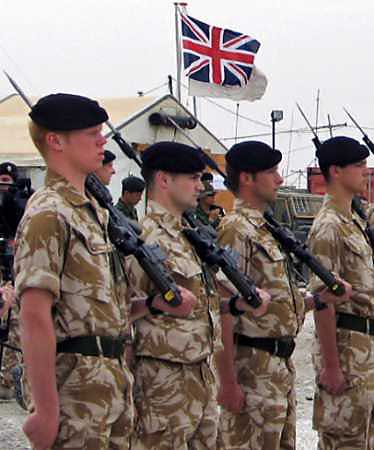
The British Army rebels against propoganda 6 Jun 2007 In his latest column for the New Statesman, John Pilger quotes from a letter received from a British army officer serving in Iraq and sent to the BBC. The officer calls the war unwinnable and wrong, and appeals to the media not to swallow "the office/White House line". For the first time, journalists are now being scrutinised by the soldiers whose war they report.


An experienced British officer serving in Iraq has written to the BBC describing the invasion as “illegal, immoral and unwinnable” which, he says, is “the overwhelming feeling of many of my peers”. In a letter to the BBC's Newsnight and Medialens.org he accuses the media’s “embedded coverage with the US Army” of failing to question “the intentions and continuing effects of the US-led invasion and occupation”.

He says most British soldiers regard their tours as “loathsome”, during which they “reluctantly [provide] target practice for insurgents, senselessly haemorrhaging casualties and squandering soldiers’ lives, as part of Bush’s vain attempt to delay the inevitable Anglo-US rout until after the next US election.” He appeals to journalists not to swallow “the official line/ White House propaganda”.

In 1970, I made a film in Vietnam called The Quiet Mutiny in which GIs spoke out about their hatred of that war and its “official line/White House propaganda”. The experiences in Iraq and Vietnam are both very different and strikingly similar. There was much less “embedded coverage” in Vietnam, although there was censorship by omission, which is standard practice today.

What is different about Iraq is the willingness of usually obedient British soldiers to speak their minds, from General Richard Dannatt, Britain's current military chief, who said that the presence of his troops in Iraq “exacerbates the security problem”, to General Michael Rose who has called for Tony Blair to be impeached for taking Britain to war “on false grounds” – remarks that are mild compared with the blogs of squaddies.

What is also different is the growing awareness in the British forces and the public of how “the official line” is played through the media. This can be quite crude: for example when a BBC defence correspondent in Iraq described the aim of the Anglo-American invasion as “bring[ing] democracy and human rights” to Iraq. The Director of BBC Television, Helen Boaden, backed him up with a sheaf of quotations from Blair that this was indeed the aim, implying that Blair’s notorious word was enough.

More often than not, censorship by omission is employed: for example, by omitting the fact that almost 80 per cent of attacks are directed against the occupation forces (source: the Pentagon) so as to give the impression that the occupiers are doing their best to separate “warring tribes” and are crisis managers rather than the cause of the crisis.

There is a last-ditch sense about this kind of propaganda. Seymour Hersh said recently, “[In April, the Bush administration] made a decision that because of the totally dwindling support for the war in Iraq, they would go back to the al-Qaeda card, although there’s no empirical basis. Most of the pros will tell you the foreign fighters are a couple of per cent and they’re sort of leaderless... there’s no attempt to suggest there’s any significant co-ordination of these groups, but the press keeps going ga-ga about al-Qaeda... it’s just amazing to me.”

Ga-ga day at the London Guardian was 22 May. “Iran’s secret plan for summer offensive to force US out of Iraq”, said the front-page banner headline. “Iran is secretly forging ties with al Qaeda elements and Sunni Arab militias in Iraq,” wrote Simon Tisdall from Washington, “in preparation for a summer showdown with coalition int- ended to tip a wavering US Congress into voting for full military withdrawal, US officials say.” The entire tale was based on anonymous US official sources. No attempt was made to substantiate their “firm evidence” or explain the illogic of their claims. No journalistic scepticism was even hinted, which is amazing considering the web of proven lies spun from Washington over Iraq.

Moreover, it had a curious tone of something-must-be-done insistence, reminiscent of Judith Miller’s scandalous reports in the New York Times claiming that Saddam was about to launch his weapons of mass destruction and beckoning Bush to invade. Tisdall in effect offered the same invitation; I can remember few more irresponsible pieces of journalism. The British public and the people of Iran, deserve better.

Friday, May 25, 2007

Imprisoning a whole nation by John Pilger


In an article for the New Statesman, John Pilger describes how Gaza in Palestine has come to symbolise the imposition of great power on the powerless, in the Middle East and all over the world, and how a vocabulary of double standard is employed to justify this epic tragedy.

Israel is destroying any notion of a state of Palestine and is being allowed to imprison an entire nation. That is clear from the latest attacks on Gaza, whose suffering has become a metaphor for the tragedy imposed on the peoples of the Middle East and beyond. These attacks, reported on Britain's Channel 4 News, were “targeting key militants of Hamas” and the “Hamas infrastructure”. The BBC described a “clash” between the same militants and Israeli F-16 aircraft.

Consider one such clash. The militants’ car was blown to pieces by a missile from a fighter-bomber. Who were these militants? In my experience, all the people of Gaza are militant in their resistance to their jailer and tormentor. As for the “Hamas infrastructure”, this was the headquarters of the party that won last year’s democratic elections in Palestine. To report that would give the wrong impression. It would suggest that the people in the car and all the others over the years, the babies and the elderly who have also “clashed” with fighter-bombers, were victims of a monstrous injustice. It would suggest the truth.

“Some say,” said the Channel 4 reporter, that “Hamas has courted this [attack]...” Perhaps he was referring to the rockets fired at Israel from within the prison of Gaza which killed no one. Under international law an occupied people has the right to use arms against the occupier’s forces. This right is never reported. The Channel 4 reporter referred to an “endless war”, suggesting equivalents. There is no war. There is resistance among the poorest, most vulnerable people on earth to an enduring, illegal occupation imposed by the world’s fourth largest military power, whose weapons of mass destruction range from cluster bombs to thermonuclear devices, bankrolled by the superpower. In the past six years alone, wrote the historian Ilan PappĂ©, “Israeli forces have killed more than 4,000 Palestinians, half of them children”.

Consider how this power works. According to documents obtained by United Press International, the Israelis once secretly funded Hamas as “a direct attempt to divide and dilute support for a strong, secular PLO [Palestine Liberation Organisation] by using a competing religious alternative”, in the words of a former CIA official.

Today, Israel and the US have reversed this ploy and openly back Hamas’s rival, Fatah, with bribes of millions of dollars. Israel recently secretly allowed 500 Fatah fighters to cross into Gaza from Egypt, where they had been trained by another American client, the Cairo dictatorship. The Israelis’ aim is to undermine the elected Palestinian government and ignite a civil war. They have not quite succeeded. In response, the Palestinians forged a government of national unity, of both Hamas and Fatah. The latest attacks are aimed at destroying this.

With Gaza secured in chaos and the West Bank walled in, the Israeli plan, wrote the Palestinian academic Karma Nabulsi, is “a Hobbesian vision of an anarchic society: truncated, violent, powerless, destroyed, cowed, ruled by disparate militias, gangs, religious ideologues and extremists, broken up into ethnic and religious tribalism and co-opted collaborationists. Look to the Iraq of today...”

On 19 May, the Guardian received this letter from Omar Jabary al-Sarafeh, a Ramallah resident: “Land, water and air are under constant sight of a sophisticated military surveillance system that makes Gaza like The Truman Show,” he wrote. “In this film every Gazan actor has a predefined role and the [Israeli] army behaves as a director... The Gaza strip needs to be shown as what it is... an Israeli laboratory backed by the international community where human beings are used as rabbits to test the most dramatic and perverse practices of economic suffocation and starvation.”

The remarkable Israeli journalist Gideon Levy has described the starvation sweeping Gaza’s more than a million and a quarter inhabitants and the “thousands of wounded, disabled and shell-shocked people unable to receive any treatment... The shadows of human beings roam the ruins... They only know the [Israeli army] will return and they know what this will mean for them: more imprisonment in their homes for weeks, more death and destruction in monstrous proportions”.

Whenever I have been in Gaza, I have been consumed by this melancholia, as if I were a trespasser in a secret place of mourning. Skeins of smoke from wood fires hang over the same Mediterranean Sea that free peoples know, but not here. Along beaches that tourists would regard as picturesque trudge the incarcerated of Gaza; lines of sepia figures become silhouettes, marching at the water’s edge, through lapping sewage. The water and power are cut off, yet again, when the generators are bombed, yet again. Iconic murals on walls pockmarked by bullets commemorate the dead, such as the family of 18 men, women and children who “clashed” with a 500lb American/Israeli bomb, dropped on their block of flats as they slept. Presumably, they were militants.

More than 40 per cent of the population of Gaza are children under the age of 15. Reporting on a four-year field study in occupied Palestine for the British Medical Journal, Dr Derek Summerfield wrote that “two-thirds of the 621 children killed at checkpoints, in the street, on the way to school, in their homes, died from small arms fire, directed in over half of cases to the head, neck and chest – the sniper’s wound”. A friend of mine with the United Nations calls them “children of the dust”. Their wonderful childishness, their rowdiness and giggles and charm, belie their nightmare.

I met Dr Khalid Dahlan, a psychiatrist who heads one of several children’s community health projects in Gaza. He told me about his latest survey. “The statistic I personally find unbearable,” he said, “is that 99.4 per cent of the children we studied suffer trauma. Once you look at the rates of exposure to trauma, you see why: 99.2 per cent of the study group’s homes were bombarded; 97.5 per cent were exposed to tear gas; 96.6 per cent witnessed shootings; 95.8 per cent witnessed bombardment and funerals; almost a quarter saw family members injured or killed.”

He said children as young as three faced the dichotomy caused by having to cope with these conditions. They dreamt about becoming doctors and nurses, then this was overtaken by an apocalyptic vision of themselves as the next generation of suicide bombers. They experienced this invariably after an attack by the Israelis. For some boys, their heroes were no longer football players, but a confusion of Palestinian “martyrs” and even the enemy, “because Israeli soldiers are the strongest and have Apache gunships”.

Shortly before he died, Edward Said bitterly reproached foreign journalists for what he called their destructive role in “stripping the context of Palestinian violence, the response of a desperate and horribly oppressed people, and the terrible suffering from which it arises”. Just as the invasion of Iraq was a “war by media”, so the same can be said of the grotesquely one-sided “conflict” in Palestine. As the pioneering work of the Glasgow University Media Group shows, television viewers are rarely told that the Palestinians are victims of an illegal military occupation; the term “occupied territories” is seldom explained. Only 9 per cent of young people interviewed in the UK know that the Israelis are the occupying force and the illegal settlers are Jewish; many believe them to be Palestinian. The selective use of language by broadcasters is crucial in maintaining this confusion and ignorance. Words such as “terrorism”, “murder” and “savage, cold-blooded killing” describe the deaths of Israelis, almost never Palestinians.

There are honourable exceptions. The kidnapped BBC reporter Alan Johnston is one of them. Yet, amidst the avalanche of coverage of his abduction, no mention is made of the thousands of Palestinians abducted by Israel, many of whom will not see their families for years. There are no appeals for them. In Jerusalem, the Foreign Press Association documents the shooting and intimidation of its members by Israeli soldiers. In one eight-month period, as many journalists, including the CNN bureau chief in Jerusalem, were wounded by the Israelis, some of them seriously. In each case, the FPA complained. In each case, there was no satisfactory reply.

A censorship by omission runs deep in western journalism on Israel, especially in the US. Hamas is dismissed as a “terrorist group sworn to Israel’s destruction” and one that “refuses to recognise Israel and wants to fight not talk”. This theme suppresses the truth: that Israel is bent on Palestine’s destruction. Moreover, Hamas’s long-standing proposals for a ten-year ceasefire are ignored, along with a recent, hopeful ideological shift within Hamas itself that amounts to a historic acceptance of the sovereignty of Israel. “The [Hamas] charter is not the Quran,” said a senior Hamas official, Mohammed Ghazal. “Historically, we believe all Palestine belongs to Palestinians, but we’re talking now about reality, about political solutions... If Israel reached a stage where it was able to talk to Hamas, I don’t think there would be a problem of negotiating with the Israelis [for a solution].”

When I last saw Gaza, driving towards the Israeli checkpoint and the razor wire, I was rewarded with a spectacle of Palestinian flags fluttering from inside the walled compounds. Children were responsible for this, I was told. They make flagpoles out of sticks tied together and one or two will climb on to a wall and hold the flag between them, silently. They do it when there are foreigners around and they believe they can tell the world.

Sunday, May 20, 2007

Blair’s Lies and Linguistic Manipulations My Dad used to call people like Blair a ‘twerp’. But I fear he is a vicious little man by Robert Fisk


By great good fortune, I studied linguistics at Lancaster University. Indeed, I read the books of Noam Chomsky, many years before he became a good friend of mine; to be honest, when I read his work, I thought Chomsky was dead. What a pleasure, therefore, to discover that he shared my world - and my views on Lord Blair of Kut al-Amara.


But I have to admit a moment of regret this weekend. Lord Blair is going from us. His self-serving memoirs will, of course, remind us of his God-like view of himself (and, heaven spare me, we share the same publishers) but I doubt if Chomsky’s “foregrounded elements” will save him. A “foregrounded element” was something unusual, a phrase placed in such a way that it warned us of a lie to come.


Take George Tenet, the CIA Ernest Borgnine lookalike who sat behind Colin Powell when the US Secretary of State was uttering all those lies about weapons of mass destruction in February of 2003. It now turns out that George is mightily upset with the White House. He didn’t refer to evidence of WMD as a “slam dunk”, he says - a basketball phrase which I don’t need to explain. He was talking about the ability of the US government to persuade the American people to go to war based on these lies. In other words, he wasn’t lying to the American president. He was only lying to the American people.


I was struck by all this last month when I came across one of Blair’s lies in my local Beirut paper. Sandwiched beneath a headline which read “Saudi reforms lose momentum” - surely one of the more extraordinarily unnecessary stories in the Arab press - it quoted our dear Prime Minister as saying that he was very angry that a review committee had prevented him from deporting two Algerians home because their government represented a “different political system”. The “foregrounded” element, of course, is the word “different”. This is the word that contains the lie. For the reason why the committee declined to return these men to their country was not - as Blair well knew - because Algeria possesses a “different” political system but because the Algerian “system” allows it to torture to death its prisoners.


I have myself interviewed Algerian policemen and women who have become perverted by their witness of torture: one policewoman told me how she now loves horror films because they remind her of the repulsive torture she had to watch at the Chateauneuf police station in Algiers - where prisoners had water pumped into their anuses until they died. I still remember the spiteful and abusive letter that the Algerian ambassador to London wrote to The Independent, sneering at Saida Kheroui whose foot was broken under torture. She was a “terrorist”, this man announced. This is the “different” political system that Blair was referring to. Ms Kheroui, by the way, never emerged from prison. She was murdered by her torturers.


Blair knows that the Algerian security forces rape women to death. He knows this. So how does he dare lie about the “different” political system which allows police officers to rape women? We Europeans now make a habit of lying about this. Take the Belgian government. It deported Bouasria Ben Othman to Algeria on 15 July 1996 on the grounds that he would not be in danger if he was returned to his country. He died in police custody at Moustaganem. A “different” political system indeed.


And now I have before me Blair’s repulsive “goodbye” speech to the British people, uttered at Sedgefield. Putting the country first didn’t mean “doing the right thing according to conventional wisdom” (Chomsky foregrounded element: conventional) or the “prevailing consensus: (Chomsky foregrounded element: prevailing). It meant “what you genuinely believe to be right” (Chomsky foregrounded element: genuinely). Lord Blair of Kut al-Amara wanted to stand “shoulder to shoulder” with Britain’s oldest ally, which he assumed to be the United States. (It is actually Portugal, but no matter.) “I did so out of belief,” he told us. Foregrounded element: belief.


Am I alone in being repulsed by this? “Politics may be the art of the possible (foregrounded element: may) but, at least in life, give the impossible a go.” What does this mean? Is Blair adopting sainthood as a means to an end? “Hand on heart, I did what I thought was right.” Excuse me? Is that Blair’s message to the families of all those dead soldiers - and to the families of all those thousands of dead Iraqis? It has been an “honor” to “serve” Britain, this man tells us. What gall.


Yes, I must acknowledge Northern Ireland. If only Blair had kept to this achievement. If only he had accepted that his role was to end 800 years of the Anglo-Irish conflict. But no. He wanted to be our Saviour - and he allowed George Bush to do such things as Oliver Cromwell would find quite normal. Torture. Murder. Rape.


My Dad used to call people like Blair a “twerp” which, I think, meant a pregnant earwig. But Blair is not a twerp. I very much fear he is a vicious little man. And I can only recall Cromwell’s statement to the Rump Parliament in 1653, repeated - with such wisdom - by Leo Amery to Chamberlain in 1940: “You have sat too long here for any good you have been doing. Depart, I say, and let us have done with you. In the name of God, go.”


Published on Saturday, May 19, 2007 by the Independent/UK
© 2007 Independent News and Media Limited

Saturday, May 19, 2007

General Strike Paralyzes Pakistan/The General vs. the Judge By TARIQ ALI

Tariq Ali


S
ixty years old this August, Pakistan has been under de facto military rule for exactly half of its life. Military leaders have usually been limited to a ten-year cycle: Ayub Khan (1958-69), Zia-ul-Haq (1977-89). The first was removed by a nation-wide insurrection lasting three months. The second was assassinated. According to this political calendar, Pervaiz Musharraf still has another year and a half to go, but events happen.

On 9 March this year the President suspended the Chief Justice of the Supreme Court. Unlike some of his colleagues, the Judge in question, Iftikhar Chowdhry, had not resigned at the time of the coup, but like previous Supreme Courts, had acquiesced to the bogus 'doctrine of necessity' that is always used to judicially justify a military take-over. He was not known for judicial activism and the charges against him are related to a ' corrupt misuse of his office', but its hardly a secret that Chowdhry's recent judgements against the Government on a number of key issues, including the rushed privatisation of the Karachi Steel Mills in Karachi, the demand that 'disappeared' political activists be produced in court and taking rape victims seriously, panicked Islamabad. Might this turbulent judge go so far and declare the military presidency unconstitutional? Paranoia set in.

TV stations engaged in objective reporting were raided by the police, thus destroying the regime's proud boast (hitherto largely true) that it interfered less with the media than all its predecessors.

The decision triggered off a remarkable social movement. Initially confined to the country's 80,000 lawyers and several dozen judges, it soon began to spread.This in itself came as a surprise to a country whose people have become increasingly alienated from elite rule whose roots are rotten. Also worth noting is that this civil society opposition to a crude decision had nothing to do with religion. It was a defence of judicial independence (however nominal) against the executive. The lawyers who marched on the streets did so to insist on a separation of constitutional powers. There is something delightfully outmoded and old-fashioned about this struggle. It involved neither money nor religion, but principle. As respect for the movement grew, bandwagon careerists from the Opposition (some of whom had organised their own thuggish assaults on the Supreme Court when in power) made the cause their own.

As often happens in a crisis, Musharraf and his advisers, instead of acknowledging that a mistake had been made and moving rapidly to correct it, decided on a test of strength. As Iftikhar Choudhry's cavalcades through various became more and more popular, Islamabad plotted its counter-strike. The Judge was due to visit the country's largest city, Karachi. Political power here rests in the hands of the MQM, an unsavoury outfit created during a previous dictatorship, addicted to violence and protection rackets and insensitive to moral and human realities. It consisted largely of poor muhajir families (Muslim refugees who fled to Pakistan at the time of Partition in 1947), who felt abandoned by the State. Musharraf too, hails from a middle-class refugee background. For this reason the MQM adopted him as one of their own (even though Musharraf's mother was a Communist sympathiser and the family as whole was progressive).

On Islamabad's instructions, the MQM leaders now decided to prevent the Judge from addressing any meeting in Karachi. That is what led to armed clashes and nearly fifty deaths in the city a few days ago. Footage of the killings, screened on Aaj (Today) TV led to the station being assaulted by armed MQM volunteers. All this provoked a successful general strike, isolating the regime. Were a Presidential election to be held today there is little doubt that the Judge would defeat the General.

Justice Choudhry's popularity can only be understood in a context where traditional politicians had become thoroughly discredited. First Benazir Bhutto (Pakistan People's Party appointed her husband Asif Zardari as the 'Minister for Investment' and the couple, together with their cronies, began to milk the country dry. The Bhutto/Zardari accounts in safe havens abroad are reputed to be in the region of a billion dollars. Bhutto's failure to do anything substantial for the poor who had voted her into office resulted in mass disillusion. She was removed from office for corruption and in the subsequent elections her old rival Sharif (Pakistan Muslim League) won a large majority on the basis of a very low turn-out (under 30 percent). Bhutto's disgusted supporters stayed at home.

Nawaz Sharif made his brother Shahbaz the Chief Minister of the Punjab. His late father became the unofficial President of Pakistan and was involved in negotiations with a disaffected Army. It was old man Sharif who advised his sons that Generals, not being angels from heaven, could also be bought and sold in the market-place. But not all of them. And not Musharraf. Nawaz Sharif's comic-opera attempt to retire Musharraf backfired disastrously.

9/11 made the Pakistan President a key player in the region. For the native elite this was a godsend. Money began to pour in, nuclear-related sanctions were lifted, and the EU granted trade concessions worth over a billion Euros and simultaneously relaxed tariffs on Pakistani textile exports. As the US became more closely involved the Pakistani military and political elite fell into line. Everyone----venal politicians, grovelling high officials, and harebrained society hostesses---- applauded Pakistan's return to its old status as a frontline state. Not the Islamists, of course, since the new war was against them and their friends in Afghanistan. For a while the only opposition to the regime came from the Islamists, moderates and extremists alike, though the methods were different in each case.

The attempt to browbeat a Judge has released a new fissure in Pakistani society. The violence in Karachi makes compromise difficult for both sides. There is an easy solution. The General should discard his uniform, the Judge should forego his wig and the two men should battle it out on the electoral terrain without hindrance from the MQM or the numerous apparatuses of the State. It may seem like attempting to square a circle, but there are imminent dangers unless the Generals agree to compromise.

Tariq Ali's new book, Pirates of the Caribbean: Axis of Hope, is published by Verso. He can be reached at: tariq.ali3@btinternet.com

from
CounterPunch May 17, 2007

Sunday, May 13, 2007

Famed As A Favourite Attack Dog In The Imperial Kennel by Tariq Ali


Blair’s First Loyalty Was to The White House. The Result Has Been A Legacy of Hatred That Ultimately Ended His Premiership

The departure, too, was spun in classic New Labour, Dear Leader fashion. A carefully selected audience, a self-serving speech, the quivering lip and soon the dramaturgy was over. He had arrived at No 10 with a carefully orchestrated display of union flags. Patriotic fervour was also on show yesterday, with references to “this blessed country … the greatest country in the world” - no mention of the McDonald’s, Starbucks, Benetton that adorn every high street - nor of how Britain under his watch came to be seen in the rest of the world: a favourite attack dog in the imperial kennel.

Tony Blair’s principal success was in winning three general elections in a row. A second-rate actor, he turned out to be a crafty and avaricious politician. Bereft of ideas, he eagerly grasped and tried to improve on Margaret Thatcher’s legacy. But though in many ways Blair’s programme has been a euphemistic, if bloodier, version of Thatcher’s, the style of their departures is very different. Thatcher’s overthrow by her fellow Conservatives was a matter of high drama. Blair makes his unwilling exit against a backdrop of car bombs and carnage in Iraq, with hundreds of thousands left dead or maimed from his policies, and London a prime target for terrorist attack. Thatcher’s supporters described themselves afterwards as horror-struck by what they had done. Even some of Blair’s greatest sycophants in the media confess to a sense of relief as he finally quits.

Blair was always loyal to the occupants of the White House. In Europe he preferred Aznar to Zapatero, Merkel to Schröder, was seriously impressed by Berlusconi and, most recently, made no secret of his support for Sarkozy. He understood that privatisation and deregulation at home were part of the same mechanism as wars abroad.

If this judgment seems unduly harsh, let me quote Rodric Braithwaite, a former senior adviser to Blair, writing in the Financial Times on August 2 2006: “A spectre is stalking British television, a frayed and waxy zombie straight from Madame Tussaud’s. This one, unusually, seems to live and breathe. Perhaps it comes from the CIA’s box of technical tricks, programmed to spout the language of the White House in an artificial English accent … Mr Blair has done more damage to British interests in the Middle East than Anthony Eden, who led the UK to disaster in Suez 50 years ago. In the past 100 years we have bombed and occupied Egypt and Iraq, put down an Arab uprising in Palestine and overthrown governments in Iran, Iraq and the Gulf. We can no longer do these things on our own, so we do them with the Americans. Mr Blair’s total identification with the White House has destroyed his influence in Washington, Europe and the Middle East itself: who bothers with the monkey if he can go straight to the organ-grinder?”

This, too, is mild compared to what is privately said in the Foreign Office and MoD. Senior diplomats have told me it would not upset them too much if Blair were tried as a war criminal. But while neither Blair nor any of those who launched a war of aggression and occupation in Iraq have been held to account, a civil servant and MP’s researcher were yesterday shamefully jailed for exposing some of the dealings between Bush and Blair that lay behind the war.

What this reveals is anger and impotence. There is no mechanism to get rid of a prime minister unless their party loses confidence. The Conservative leadership decided Thatcher had to go because of her negative attitude to Europe. Labour tends to be more sentimental towards its leaders, and in this case they owed so much to Blair that nobody wanted to be cast in the role of Brutus. In the end he decided to go himself. The disaster in Iraq had made him hated and support began to ebb. One reason for the slowness was that the country is without a serious opposition. In parliament, the Conservatives simply followed Blair. The Lib Dems were ineffective. Blair had summed up Britain’s attitude to Europe at Nice in 2000: “It is possible, in our judgment, to fight Britain’s corner, get the best out of Europe for Britain, and exercise real authority and influence in Europe. That is as it should be. Britain is a world power.”

This grotesque fantasy that “Britain is a world power” is meant to justify that it will always be EU-UK. The real union is with Washington. France and Germany are seen as rivals for Washington’s affections, not potential allies in an independent EU. The French decision to reintegrate themselves into Nato and pose as the most vigorous US ally was a structural shift which weakened Europe. Britain responded by encouraging a fragmented political order in Europe through expansion, and insisted on a permanent US presence there.

Blair’s half-anointed successor, Gordon Brown, is more intelligent but politically no different. It is a grim prospect: an alternative politics - anti-war, anti-Trident, pro public services - is confined to the nationalist parties in Scotland and Wales. Its absence nationally fuels the anger felt by substantial sections of the population, reflected in voting against those in power, or not voting at all.

Tariq Ali is the author of Rough Music: Blair, Bombs, Baghdad, Terror, London ,
tariqali3@btinternet.com

The Guardian/UK

© 2007 The Guardian/UK

from Common Dreams


Friday, May 11, 2007

Killing of Teachers Turns Iraqi Sunnis Against al--Qa'ida By PATRICK COCKBURN, Baghdad.

The murder of Juma'a, the headmaster of a primary school in the Ghaziliyah district of west Baghdad, explains why many Sunnis are increasingly hostile to al- Qa'ida in Iraq. At the same time, the Sunni community as a whole continues to support armed resistance to the US-led occupation.

Juma'a, a teacher in his forties with three daughters and one son, was told by members of al-Qa'ida in his Sunni neighbourhood to close his school. Other headmasters got the same message but also refused to comply. The demand from al-Qa'ida seems to have come because it sees schools as being under the control of the government.

Juma'a knew the danger he was running. A few months earlier, he was detained by another Sunni insurgent group as he queued for gasoline. The insurgents suspected he was carrying fake identity papers and was really a Shia. They held him for three days until he proved to them he was a Sunni.

Two weeks later, Juma'a was kidnapped again. This time there was no release. Other headmasters were kidnapped at the same time and their bodies found soon after. His family wanted to look in the Baghdad morgue, the Bab al-Modam, but faced a problem. The morgue is deemed by Sunni to be under the control of Shia militiaman who may kill or arrest Sunni looking for murdered relatives.

Finally, Juma'a's sister-in-law, Wafa, and niece went to the morgue on the grounds that women are less likely to be attacked. They passed through a room filled with headless bodies and severed limbs and looked at photographs of the faces of the dead. In 15 minutes, they identified Juma'a, but they were not strong enough to transport his body home in a cheap wooden coffin.

The revolt in Iraq against the occupation has been confined hitherto to the five- million-strong Sunni community. The growing unpopularity of al-Qa'ida in Iraq among the Sunni is partly a revulsion against its massacres of Shia by suicide bombers that lead to tit-for-tat killings of Sunni.

It is also because al-Qa'ida kills Sunni who have only limited connections with the government. Those killed include minor officials in the agriculture ministry, barbers who give un-Islamic haircuts and garbage collectors. The murder of the latter is because it is convenient for al-Qa'ida to leave large heaps of rubbish uncollected on roadsides in which to hide mines.

The most visible sign of the revolt against al-Qa'ida in Iraq is along the roads passing through the deserts of Anbar province to the west of Baghdad to Jordan and Syria. In recent weeks, the road to Syria has been controlled by members of the Abu Risha tribe, led by Mahmoud Abu Risha and supported by the US.

It may be al-Qa'ida has overplayed its hand. In January, its leaders announced the establishment of the Islamic State of Iraq (ISI) based in western Iraq. That united resistance groups sympathetic to al-Qa'ida. The ISI began to purge resistance activists disagreeing with its line. Sunni families were forced to make contributions and send some of their young men to fight alongside the ISI.

The Iraqi insurgency is notoriously fragmented and its politics are shadowy. By one account, the ISI got chased out of Mosul in the north soon after being formed and took refuge in the Himrin mountains south of Kirkuk. Though shaken, it remains effective under the leadership of Omar al-Baghdadi, a former army officer.

The ISI, as with other resistance groups, owes its military effectiveness in large part to well-trained officers from the Iraqi army and, in particular, the Republican Guards.

Windows at the US embassy in Baghdad were rattled by an explosion yesterday during a visit by Dick Cheney. The US Vice-President had arrived unannounced to see Iraqi political leaders. Washington may be getting worried that the so-called "surge", the 30,000 US reinforcements being sent to Iraq, are not producing the dramatic results hoped for by President George Bush.

Meanwhile, a suicide bomber in a truck packed with explosives killed at least 19 people and wounded 80 in the Kurdish capital of Arbil. It was one of the first bombs in Kurdistan for over a year and blew up outside the Kurdish Interior Ministry, leaving an enormous crater.

Patrick Cockburn is the author of 'The Occupation: War, resistance and daily life in Iraq', a finalist for the National Book Critics' Circle Award for best non-fiction book of 2006.

CounterPunch May 10 2007


Tuesday, May 08, 2007

We Soldiers Once Assumed Our Political Bosses Would Not Lie to Us. That is Over. by Leo Docherty


Photo Sharing and Video Hosting at Photobucket

Four years ago, I watched, with other young officers, the invasion of Iraq on TV in the mess. We were sick with envy. Our brother officers were having the most exciting time of their lives, at the center of history, while we, on ceremonial duties in London, marched about in red tunics and bearskin hats.

The invasion, it seemed, was a necessary evil to be redeemed by the creation of a free, democratic Iraq. The WMD issue was a pretext, we all concurred, an honorable white lie to knock an evil dictator off his perch and breathe new hope into the lives of a brutally repressed people.

Our turn soon came, and the ground truth in Basra and Maysan provinces was a shock. The statue-toppling euphoria had been replaced by the horrific chaos of a state in collapse, exacerbated by a rising insurgency and sectarian bloodshed. The truth gradually emerged. The police and army we were training were corrupt and probably loyal to the insurgency. The first supposedly democratic elections for half a century were a façade, dependent on the presence of our Warrior fighting vehicles at polling stations.

Then we realized the issue was not replacing tyranny with democracy, but gaining long-term access to oil. Blair, in bowing to American oil-mad energy hunger, had deployed the British Army on a lie, a much bigger lie than the one about WMDs. Today, the appalling sectarian violence killing hundreds of Iraqi civilians every week is the direct result of our invasion and botched occupation. As Blair prepares to leave office, Iraq is descending into deeper human tragedy, and British troops are still dying.

Those in the forces who, like me, were frustrated and disillusioned after Iraq, took new optimism from British intervention in Afghanistan. It looked like being everything Iraq should have been: reconstructive nation-building to improve the lives of poverty-stricken Afghans.

Sadly, political ill-preparation and haste dropped the military, again, into lethally hot water. Last year, British forces were sent into volatile Helmand, ill-equipped and inadequately supported. Scattered across the north of the province (the size of Wales), small teams occupied “platoon houses” in remote towns.

I was in Sangin where, as in everywhere else, we had no means of starting developmental reconstruction and stood no chance of winning Afghan hearts and minds. To the locals, the presence of British soldiers seemed to presage destruction of their poppy crop and their livelihoods.

Helmand produces 40 per cent of Afghanistan’s opium crop, the source of 90 per cent of global heroin. And the people there are tribesmen, infamous for their ferocious hostility to foreign interference. The savage backlash rages still; more than 50 British servicemen are dead in this sub-campaign, countless Afghan civilians have been killed, and opium production is at an all-time high.

The Taliban are thriving on this: every Afghan civilian killed by the British artillery round or helicopter gunship has a dozen brothers, cousins, and friends seeking British blood for vengeance. Today, our troops are risking their lives in a pointless conflict, a nightmare scenario of counter-insurgency gone wrong.

There is the mismatch between Blair’s huge military ambition overseas and the scarce resources the forces get to fulfill it. The Army has lost four infantry battalions. Soldiers serving a fourth tour struggle to maintain relationships at home. Half the Navy’s fleet is threatened with mothballing.

When you join the Army, you swear allegiance to Her Majesty the Queen and, by extension, the Prime Minister. We commit ourselves, with unquestioning loyalty, to the State. This is founded on trust in our political masters, and the belief that they are honorable people who will not lie to us, will resource us correctly and deploy us with sound judgment, after thorough strategic planning. This bond is unique, set in stone regardless of party politics. Today, this bond is broken. Catastrophes in Iraq and Afghanistan and years of resource-starvation have taken their toll; this is Blair’s legacy.

Late last year, the head of the Army, General Sir Richard Dannat, publicly called for our withdrawal from Iraq. Other senior officers voiced concern. Such public statements, unthinkable before Blair, are a glimpse of the military’s anger and frustration.

Of those officers I sat with in the mess four years ago, many, like me, have left the Army. Those who remain have no trust in the Government. One told me: “We won’t be fooled again.”

Leo Docherty is author of ‘Desert of Death: A Soldier’s Journey from Iraq to Afghanistan‘, published by Faber and Faber.

© 2007 Independent News and Media Limited

from Common Dreams

Saturday, April 28, 2007

Fisk Takes Western Officials - and Reporters - to Task‘How do our journalists go to war without history books?’ by Theodore May


BEIRUT - In wide-ranging remarks during a lecture at the American University of Beirut on Thursday, veteran British journalist Robert Fisk sharply criticized US policy in Iraq, analyzed shortcomings in Western journalism on the Middle East and reflected on the state of politics in the region, saying he was “distressed” by what he called the people’s hesitancy to question rulers.The lecture, entitled “After the Collapse: Disengagement in the Middle East,” ran for about 45 minutes and was followed by more than 20 minutes of questions. A live telecast of the remarks was broadcast in a second room to accommodate an overflow crowd.

Fisk, who lived and reported in Lebanon throughout the Civil War, has for many years worked in the region as a correspondent for Britain’s Independent newspaper. He is also the author of the widely read “Pity the Nation: Lebanon at War,” among other titles.
In a spirited style that kept the audience laughing, Fisk lampooned Western journalists for their lack of historical perspective when reporting from the Middle East.
“I asked myself, how do our journalists go to war without history books?” he said.


In order to drive home his point about how poorly journalists had covered the Iraq war and how ignorant of history they had been, Fisk retold the story of the failed 1917-1920 British occupation of the country in a way that mirrored the current track of the United States there. The US excursion has been a “fingerprint parallel of history,” he said.


Again pointing a finger at Western journalists, Fisk ran through articles from The New York Times and The Los Angeles Times, noting that although the incidents reported in the articles took place in Iraq, the only sources cited were US officials.


Fisk discussed journalists’ tendency to illustrate division in the Middle East, such as divisions between Sunnis, Shiites and Kurds in Iraq, by using maps. He then noted that journalists rarely dare to show such disunity within their own countries, noting that a US paper would never run maps of the racial divisions in Washington.


Turning to foreign policy, Fisk recommended that Western countries adopt a more compassionate approach in their interactions with Middle Eastern countries. “I don’t think that we Westerners care about the people of the Middle East, care about you,” he said.
Fisk also charged that democracy was never part of the plan for Iraq.
“It was only when the Shiites threatened to join the insurgency that we wanted democracy,” he said.


Criticizing what he believes are “futile, appalling policies in Iraq,” Fisk said of the US, “I think that superpowers have a visceral need to project military strength.”


Fisk said he believes that people in the Middle East want democracy and that they may want Western products as well. What they don’t want, he argued, is the West.
Asked during the question-and-answer session if he had any criticisms for people in the Middle East, Fisk said he had two.


First, he said he was “deeply distressed and deeply depressed” by the people’s willingness to accept things like torture and dictatorship. “I would like to see a Middle East that questions its own rulers much more than it does,” he said.


Second, Fisk said residents of the Middle East would do well to learn more about the United States. He lamented what he called a lack of American Studies departments at Middle Eastern universities in comparison with the numerous Middle Eastern studies departments at American universities.


Fisk punctuated his remarks with moments of optimism. “Lebanon’s refusal to re-enter civil war is probably the finest thing I’ve witnessed,” he said.
Ultimately, Fisk had a simple message for all Middle Easterners: “The only people who can decide your future is you.”


Copyright (c) 2007 The Daily Star from


Published on Friday, April 27, 2007 by Daily Star (Lebanon) from Common Dreams