ABC press release
John Tognolini ventures onto the high seas for the third in a series of radio features about working life in Australia.
After painting vivid aural portraits of volunteer firefighters and scaffolder/riggers, Togs returns to his former workplace, the Cockatoo Island dockyard in Sydney Harbour.
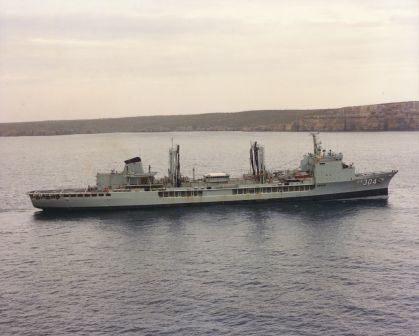
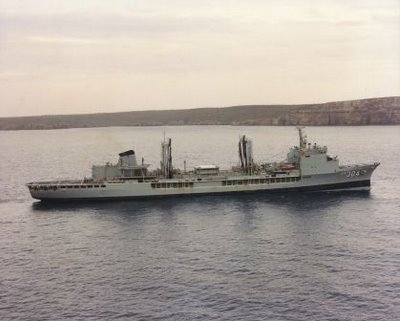
It was at Cockatoo that the last big ship was built in Sydney -- the navy supply ship HMAS Success. Cockatoo Island has a history stretching from the days of convict labour to the intense industrial disputes over its closure by the Hawke Labor government in the late 1980s.
Contrasting stories of the lives of workers at Cockatoo with moments from the working life of the Success as it steams from Hobart to Sydney, Togs narrates a social history that was once a staple of Australia's port cities.
But don't expect a completely sombre account of shipbuilding or life aboard a navy ship. Togs uncovers plenty of funny stories, some great characters and one especially terrifying encounter with sea-sickness.
Radio National
Sunday June 28 1998
Sharon Davis: To begin the night, producer John Tognolini ventures on the high seas to offer a third in his series of programmes documenting aspects of working life in this country. In The Last Ship John returns to his former workplace. The enormous Cockatoo Island Dockyard in Sydney Harbour. Cockatoo's history spans from the time of convict labour through enormous industrial development and upheaval to the final closure by the Hawke government in the late 1 980's. The HMAS Success commissioned for the Royal Australian Navy was the last ship built on Cockatoo. With its launch a whole aspect of working life came to an end. Mirroring similar changes around the country. On a recent sea trip between Tasmania and Sydney, John Tognolini had the opportunity to reflect on the last ship built on Cockatoo Island.
[The sound of crossing Storm Bay as we leave Hobart.]
Royal Australian Navy: HMAS Success OR 304 Mr. John Tognolini.
Welcome onboard HMAS Success the greatest Auxiliary Oiler
Replenishment ship afloat and the most capable AOR in the Southern Hemisphere.
Togs: Here I am on the last ship built at Cockatoo Island leaving Hobart going back to Sydney.
RAN: We supply fuel, food, ammunition, water, beer, electricity and cargo to other naval combat units whilst underway.
[Just out of Storm Bay.]
Young woman sailor: We're on the flag deck which is above the bridge. The highest point of lookout and at the moment we are just looking out for different boats, fishing vessels, yachts other warships. There aren't any around and marine life that could affect the course of the ship.
Togs: What sort of marine life you talking about?
Woman Sailor: Anything large, whales, maybe schools of dolphins or dugongs anything like that. We need to steer clear of them. Everything we see gets reported back to the bridge and they alter course accordingly.
[Just before the HMAS Success leaving Hobart.]
Captain Anthony Flint: It's about 6 to 8.4 right now outside and the swell should be around about 6 to 8 feet. In this ship it is not to bad. It's a good sea handling and sea keeping ship and it's quite large. So I expect the swell to be at our stern.
[The sound of Sydney Harbour.]
Togs: Cockatoo Island Dockyard was Australia's oldest workplace, it's first workers wore chains. They were convicts. I worked on submarines as a Painter and Docker. Ships were built there, turbines for power stations, all the steelworks and rigging for Sydney's Centerpoint Tower and the last ship built was the Success.
[The sound of Sydney Harbour.]
Georgie Lar: When you see the Success come in. You go yeah.
Sometimes I go down Woolomloo and I see some ships there. I worked on that one and that one. You get a bit of a kick out of it.
Really no. Ship's steel is too cold. It's to noisy and it's got no give. I wouldn't recommend working in a dockyard to many people.
[The Success in the Tasman Sea going north along Tasmania's East Coast.]
Togs: The dockyard's been closed now for nearly eight years and this ship is twelve years old. What was it like to build it?
[Sound of welding steel.]
Max Callahan: When I went there, there were two and half thousand workers there. Many of them had actually come to Australia to work specifically on the Success. We had New Zealanders. We had a lot of people from Scotland. We had people from France. A huge workforce at times.
[Dockyard workers marching on Australian Parliament.]
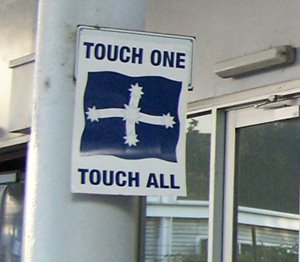
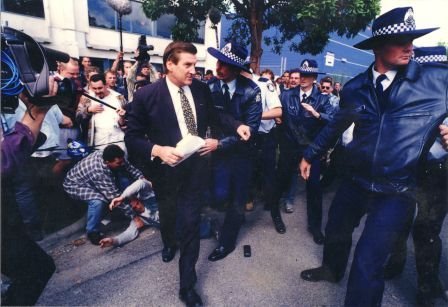
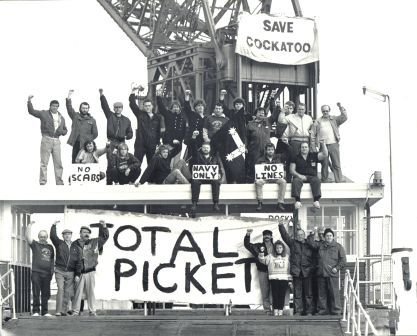
Togs: I was involved in the three month strike‑occupation to stop Bob Hawke and Kim Beazely from closing the island dockyard down. The dockyard unions marched on parliament house in 1983 when Bob Hawke broke his promise to build a second ship.
[Dockyard workers outside the Australian Parliament
Bob Galleghan, Federal Secretary of Ships Painters and Dockers Union:
There won't be a second ship built unless your going to do something about it.
Dockyard worker: Let's go up there and do it.
Frances Kelly: Hawke didn't keep his promise to build a second ship at Cockatoo.
Dockyard workers: We want work. We want work. We want work.
Frances Kelly: This resulted in over 1600 workers getting sacked in 1985.
On May 101989 the Dockyard workers voted unanimously to occupy the island effectively placing themselves in control of everything.
[Dockyard mass meeting during the 93 day strike/occupation.]
Peter Casser: We've been on this island struggling to keep this fight going because we believe that we wont be beaten right. And I know there is a lot of people suffering out there. I understand that. I suffering. We're all suffering. I've got a mortgage just like a lot of other people. I've got to battle but I want to keep battling because I believe that if we get defeated here we Donna loose our pride.
If you lose your pride your ratshit!
Once you loose your pride they've got the better of you!
Robert Wyatt's song Shipbuilding:
Is it worth it?
A new winter coat and shoes for the wife,
And a bicycle on the boys birthday,
It's just a rumour that was spread around town
By the women and children,
Soon we'll be shipbuilding,
[The sound of the Tasman Sea. As the HMAS Success goes up
Tasmania's East Coast]
Togs: We lost and became another example of blue collar genocide. I was laid off two weeks before my daughter’s birth. It wasn't a great introduction to parenthood.
[Fire sirens]
HMAS Success PA system: There is now some smoke and flames in the cabin. Crash on deck. Crash on deck. Crash on deck. Hands to emergency stations. The ship damage control condition Zulu.
Royal Australian Navy: You may hear various emergencies piped in the main broadcast don't panic we are trained. You will here the word safeguard included in an announcement for a real emergency.
Young Woman Officer: There are a lot of hazards as again we go through all these exercises so we know how to deal with it so if it does happen we just go straight back into a routine. You get used to dealing with an episode. You don't become blasé but it's not so unfamiliar when it does happen. You got a replanned response. It automatically kicks in.
First ABC Newsreader: Four Navy crew members are confirmed dead following a major fire aboard the HMAS Westralia.
ABC Journalist: A large fire broke out in the main engine room of the tanker.
Second ABC Newsreader: The four crew were working on a ruptured fuel line in the main engine room of the Navy tanker HMAS Westralia when the blaze broke out this morning. Nine other crew members have been injured.
Senior Naval Officer: Search parties were sent back into the blazing inferno of the engine room but were beaten back. Additional resource being called in from all fleet units in the vicinity which included HMAS Success and the frigates Darwin, Adelaide and Sydney. Initial reports of four missing are confirmed and it is my melancholy duty to inform that we have four bodies as a result of that search.
[The sound of the Tasman Sea.]
Togs: If someone asked me what I'm doing on board the Success well I guess there's a few reasons. There is the story of a ship still going. Of the dockyard that sort of been wrapped up in moth balls and the workers there. They've all gone to the four winds. All that culture is gone and this a product of their work and dedication.
[The sound of the Cockatoo dockyard and Sydney Harbour.]
Max Callahan: Many of the people working at Cockatoo Island were second and third generation employees of the island.
Togs: This is Max Callahan who was an ironworker/rigger who worked on the Success.
Max Callahan: A large number came from around Balmain, Drummoyne,Leichhardt further a field I guess Western Sydney and the Blue Mountains. A huge number would congregate at Circular Quay and all travel out on the old Kanangra which is an old wooden vessel. One of the Lady Class vessels later on. It was quite a pleasant way to go to work as we cruised up the harbour and the same thing in the afternoon. For a lot of people they would find quiet unusual the way in which we travelled.
[Dockyard industrial noise.]
Georgie Lar: Oh well it was another Monday morning we were all going into work.
Togs: This Georgie Lar who was a Painter and Docker who worked on the Success.
Georgie Lar: We were coming through the tunnel on Cockatoo. You have this cattle grid cause there's some sheep on the island. And this bloke's walked across the cattle grid and went down. Straight away we got him to the first aid. Well the funny thing was he had a wooden leg. Nobody knew he had a wooden leg and it been broken. So we took him from the first aid shed to the carpenters shed and the carpenters said they could not do to much with it and while we were mulling it over one of the tinsmiths took the bloke down to the tinsmiths took the bloke down to the tinsmiths shed and he got a fantastic tin leg with in about an hour and half. And I think he went off maybe on compo I don't know. That was funny because like this guy. Nobody knew who he was. He just come on the island one morning, broke his leg and got a tin leg leaving the Island. Cockatoo was pretty good over there. [Industrial noise of the dockyard.] Up on the hill on Cockatoo Island they had these great big coconut shaped caves. Up the top and they just go in and comes out. They used to store water and grain. There is a prison up there. There is a chapel built by the convicts up there. They actually cut that cave running through the centre of the island by hand. That was cut out by convicts.
[Christy Moore's rendition of Ger Costello's Back Home in Derry based an Bobby Sands poem The Voyage.]
In 1803 we sailed out to sea.
Out from the sweet town of Derry.
For Australia bound if we didn't all drown.
And the marks of our fetters we carry.
In our rusty iron chains we sighed for weans.
As our good lives we left in sorrow.
As the mainsails unfurled our curses we hurled.
At the English and thoughts of tomorrow.
Oh Oh Oh I wish I was back home in Derry.
Oh Oh Oh I wish I was back home in Derry.
I cursed them to hell.
As our bowels fought the swell.
And we danced like a moth in the Delight.
White horses rode high
As the devil passed by taking souls to Hades by twilight.
Five weeks out sea we were now forty three.
And we wept bitter like children.
Oh Jesus we shrieked as our god we beseeched.
All we got was the prayer of the pilgrim.
Oh Oh Oh I wish I was back home in Derry.
Oh Oh Oh I wish I was back home in Derry.
Success's PA: Stop both engines.
Togs: Success has stopped on it's first day out from Hobart as the sun sets down and the pipes have been played. We are looking at Maria Island. a daunting sort of place. The crew up here on the focsle have just dropped the anchor. And the island just takes you back to Marcus Clarke's For The Term Of His Natural Life, it feature in it. That novel. What a cold and desolate place it is. Looks pretty stunning to me but I didn't come out from England two hundred years ago did I?
The sound of the Tasman Sea.]
Young Woman Officer: We use three visual points because vision is the most accurate. At the moment we've got the light of Tasman Island and the Cape behind us and they form a triangle. This is where we were. It's not actually real time information. It is more historical fact because we are proceeding at 18 knots. In six minutes we go 1.8 miles so it is a fair distance to travel while we still trying to work out we are. So by keeping it going at six minute intervals we know a really good pattern of where we have been. I can say historically zero nine five in these conditions will make good zero nine zero.
Togs: The Success is a warship, when I travelled on it there were some relatives of the crew on board for what the Navy calls a Searide.
Captain Anthony Flint: You shouldn't feel that you are intruding on us and you shouldn't feel awkward on board because this is as much your ship as it ours. We happen to run the ship. The current crew but with out the support and everything that comes with the family association of backing us up on board we couldn't do our job. So very much this ship is your ship too and I hope you will treat that way during the week. So we'll see you all around.
Royal Australian Navy: Like most modern warships accommodation and recreation areas are spacious and well designed for it's ship's company of two hundred and five. Meals are provided from one centralized galley which includes a bakery. The medical centre includes an operating theatre, an infirmary and dental surgery. With it's well trained crew and high quality equipment Success gives RAN fleet units the ability to operate with a greater degree of flexibility and independence from shore support than has been previously possible.
[Togs walking through the Success with a Sailor.]
Sailor: What are you doing a doco on this time? Just on this ship or all Navy ships?
Togs: Well the Success and the dockyard where it was built, Cockatoo I used to work there.
Sailor: Oh yeah.
Togs: The idea of the story the dockyard is closed down and here's the last ship that was built there.
Sailor: Oh yeah Cockatoo. Did you build this?
Togs: I worked on the submarines. A cast of thousands worked on this one though.
[The sound of going through a hatchway. Then the sound of dockyard noise.]
Georgie Lar: Like the Titan you know there was a job on Cockatoo. It was the second biggest floating crane in the world it lifted some of the materials for the Success.
Togs: The Titan was the floating crane that was designed by a woman engineer in Sheffield England during the First World War. It was assembled at Cockatoo and it's log book started in 1917. It could do a one hundred and fifty ton lift.
Georgie Lar: You wouldn't believe how deep it was. because you go in one tank which is as big as football ground and then you go to the opposite corner and you take a lid off and your into another tank about as big as a football ground and then you hit the honeycomb system which is about six maybe eight layers down. and these are just oblong boxes with holes at opposite ends. And you have to slot in. Go in head first and take your piece of string with you on your ankle. So the top man he'll pull the rope every few minutes and if you never responded he try and get someone down there to help you. It's a weird job you got a lamp in your hand. It's all dark, you got a bucket and a scraper, a hammer. Chipping hammer for the paint and you go down to the bottom of this crane and take samples. Well we gets down there and it's pretty dark and you know your all on your own and the piece of string on your ankle is not going to help. There all paint crusted up about four inches deep. You know it's crunch, crunch everywhere you go. When you start scraping all the water starts pissing in. Not big holes but your just coming through. You just didn't want scrape any more because you might be on the bottom of the harbour.
[Industrial noise.]
Togs: The dockyard where the Success was a mad, friendly sort of place but it had it's accidents when the ship was being built.
[Industrial noise.]
Georgie Lar: There was an accident on Titan once. She's tying up along shore. it was like a zing sound. There was one bloke screaming at the end of it. The cable had gone and cut his leg fairly clean off. Never cut his overalls. Cut his leg.
Max Callahan: At times safety went out the window. We had situations where there be a lot of a push from management so workers try to cut corners. I remember one incident where a piece of bow section of the vessel got jammed and couldn't be put into place. And a well known shipwright who'll remain anonymous stuck his head out between the ten or twenty ton section of vessel. He pulled his head in just in time because the two sections of vessel collided with quite dramatic results. We were quite pleased to see this man still had his head. We really thought he lost it.
Georgie Lar: When she was on her first sea trials. They wanted men to got to sea with her to mop up and clean up should there be any leaks arise. When we gets there we were told to stand by all these big doors and wait for any leaks coming through the seals. We had mop buckets with wheels on them and every time you took your mop away and the ship was going around in circles all these mop buckets are going for one corner. It's just moving around. You get seasick just chasing mop buckets over threw. The sailors were all laughing some of them lost there buckets. We're all on standby for about six hours while this ship is going around and round and the circles are getting smaller and smaller. it was a bit like a fun fair better than Luna Park lad. This was a six hour ride with twenty buckets coming at you in the half semi darkness and the ships rolling and you can hear the engine grrrring. Yeah that was a fun day.
[The sound of the Success at sea.]
Success PA: We are crossing Storm Bay now you can feel the swells now are growing. Remind you to not chunder into the wind or in any passage ways or in any where you make a mess. If your feeling sick I suggest you carry a garbage bag with you. You have one with you at all times in your pocket. If you have the need you don't make a mess of yourself or the ship.
[Brian Eno's instrumental song Deep Blue is mixed the sound of the Tasman Sea.]
Georgie Lar: I wouldn't do it again. I don't think I'd enjoy going around circles on a brand new ship ever again. There's too many creaks andhorns going off. There's a couple of alarms going off here and there. You just don't know your on tenterhooks. Half of your mates are going downstairs and there on the bed. Spewing up all over the fucking place. You can't get off. Even your beers everyone is burping after about your second beer because it's sloshing around in there. You know it's terrible.
It's a ride for a day.
[Brian Eno's instrumental song Deep Blue is mixed with the sound of the Bass Straight.]
Togs: There is the roll the ship going from side to side.
There is the pitch from bow to stern.
We're in Bass Straight and it's rough.
Ship's Doctor: If you don't get seasick it's a good idea to have some and sometimes they cause blurred vision but that's not a major problem with them.
Togs: I've survived breakfast. Talking to the doctor. "Are you alright she asks?" Oh yeah. Then I have this feeling and I run to the heads, Navy for toilet and chunder. And I feel a hundred and ten per cent better.
Young Woman Officer: In compartments along this side we've got chlorine gas in drums and chlorine is corrosive if it is spilt it'll it your hand off basically.
Togs: The average age on the Success is twenty one and thirty per cent of the crew are women.
Young Woman Officer: There's Otto fuel which is used to power torpedos. It's a very thick. It looks strawberry ice cream topping. It's got its' own oxygen composed in it. Combust and it will it its' way through it. It's poisonous touch it and don't wash you hands you become sick. It's very, very corrosive and burns. The only way to deal with it is to put mats around so it can't spread and then either plain flour or kitty litter sought of stuff and you just shovel it all up and put it drums. You can't put over the side it will burn anything it comes in contact with. Hopefully it never actually happens but if it does you can sleep in your bed at night knowing that you know how to deal with it.
[ The Guided Missile Frigate HMAS Sydney comes along side the Success for a replenishment at sea exercise. There is only fifteen meters between the two ships.]
Sailor: Keep your bat down your right hand side not across your body Tashy.
Royal Australian Navy: Replenishment ships, modern maritime operations demand that naval combat units be supplied with fuel, ammunition, food and stores at sea while they are underway. Success is capable of day and night replenishment to ships along side and with her Sea King helicopter to other ships in company.
Togs: it is quite a detailed operation this. There is about fifteen sailors on the Sydney towing lines that have been shot across from the Success to allow for the actual pumping of fresh water into the Sydney from the Success.
Royal Australian Navy: Four main replenishment at sea. RAS stations are fitted. Two of which have dual functions and can be used to transfer either solids or fuel. The RAS system is designed to cope with the extreme demands caused by ship motion in rough weather and works exceptionally well.
Togs: The ship is quite big it is nearly about eighteen thousand tonnes fully loaded. It's 157.7 meters in length but there is that sense of confinement. This is your world. There is no land in sight and that's it just the sea, you and the crew.
Max Callahan: There was a certain amount of rapport between the naval personnel. they were all very keen and excited to be taking delivery of a new vessel. There was quite a lot of pride amongst the workers at Cockatoo Island for a lot of us it was quite a significant thing to be involved in. having spent four years involved in the construction we had rather mixed feelings slipping into the water and again when the fit out was completed we saw sailing down the harbour for the last time. It was a big chunk of our lives.
Robert Wyatt's song Shipbuilding:
Well I ask you,
The boys say their going to take me task,
That I'll be back by Christmas,
It's just a rumour that was spread around town
Somebody said that somebody got filled in,
For saying that people get killed in,
The result of their shipbuilding,
With all the will in the world,
Diving for dear life,
When we could be diving for pearls.
Togs: The Last Ship was produced by me- John Tognolini and Brent Clough, sound engineer John Jacobs. Special thanks to Tim McGunn, Georgie Later and Max Callahan. Special thanks to the Royal Australian Navy and Captain Anthony Flint and the ship's company of Her Majesty's Australian Ship Success.