John/Togs Tognolini

John/Togs Tognolini
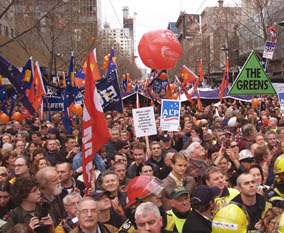
March for Humanity August 3 2025. On the Sydney Harbour Bridge with 300,000 other people protesting against Israel's Genocide against the Palestinians in Gaza.

Blog Archive

Popular Posts

Pageviews last month

Showing posts with label Howard's Workplace Laws/The Fight of Our Working Lives 2. Show all posts

Monday, April 09, 2007

Right-Wing Attempts Takeover of Victorian AMWU by Ben Courtice, Melbourne


The most important elections for many years in the Victorian branch of the Australian Manufacturing Workers Union (AMWU) are set for mid-April. This election will be a showdown between the incumbent unified Victorian branch leadership and the conservative vehicle division of the union and its supporters.

The important positions of state secretary, assistant state secretary (metal division) and food division state secretary will be contested, as well as some organiser positions in the food and metals divisions of the AMWU.

Current Victorian printing division secretary Jim Reid will be challenging Dave Oliver for the union’s national secretary position. Oliver has been acting national secretary since Doug Cameron vacated the position to contest an ALP Senate seat. Assistant national secretary Glenn Thompson will be challenged by Doug McMinamee.

The Workers Rights team, which represents the current leadership of the union, formed as an act of unity against the Work Choices legislation late last year. Despite years of hostility and conflict within the union, the Workers First and National Left groups in Victoria put aside their differences and merged to better combat the federal government’s anti-union laws.

The vehicle division leadership regards this election as an opportunity to deliver the Victorian branch of the AMWU to the conservative vehicle division national secretary Ian Jones. It has united with the Victorian printing division leadership and a disaffected food division organiser in the New Directions team.

Court challenges over the eligibility of candidates to stand for various positions may delay the election past its scheduled date of April 12.

Long-running factional conflict between the vehicle division and the branch leadership re-ignited last September after a dispute at the Toyota plant in Melbourne. Toyota management attempted to sack metal division shop steward Tony Brooks instead of relocating his job as promised from the closing Port Melbourne plant to the Altona plant.

A community picket line supported by the AMWU metal division and Electrical Trades Union members on site won Brooks’s job back. However, the vehicle division organisers angered many AMWU members by instructing their members to cross the picket line.

Subsequently, the December 1 Melbourne Age reported on a County Court hearing into misconduct by serving police officer Constable Norman Dunn and former police officer Kerry Milte. Milte had persuaded Dunn to conduct illegal police searches on a number of people, including an AMWU metal division shop steward, Tony Carvalho, who worked at Toyota.

According to the article, the County Court heard that AMWU vehicle division national secretary Ian Jones was present at a meeting with Milte where a request was made to find evidence that could be used to disqualify Carvalho from running in union elections.

Both Milte and Dunn were found guilty of misconduct and fined.

Workers Rights candidate for Victorian secretary Steve Dargavel, who is being challenged by vehicle division organiser David Nunns, described the Jones team’s politics as “corporate unionism”.

Workers Rights supporter Stuart Martin agrees. Martin worked at Toyota subsidiary Araco, which was set up in 2003-2004 to take over the manufacture of car upholstery seats from the Toyota division at the now-closed Port Melbourne plant.

Despite many Toyota workers coming over from the old plant to the Araco site, the vehicle division had already signed a “greenfields” agreement with Araco that resulted in drastic cuts to wages and conditions. Greenfields agreements are those signed by a union and a new company before any workers are hired.

Martin told Green Left Weekly that a fitter at Araco earned around $18 per hour, whereas the industry average was $22. The labour-hire fitters on the site were paid more than $23 per hour on a metals division agreement. Production workers only saved some of their overtime conditions from Toyota because they spontaneously took strike action over the issue.

The incumbents who formed the Workers Rights team have led the Victorian AMWU in the most militant defence of workers’ rights of any union under the federal government’s anti-union Work Choices. The AMWU nationally has been responsible for 42% of protected strike action since Work Choices became law on March 27, 2006. The majority of AMWU industrial action has taken place in Victoria.

From: Australian News, Green Left Weekly issue 704 28 March 2007.

Labor Yet To Commit On Scrapping Work Choices by Graham Matthews

As the ALP’s electoral fortunes lift with each new poll, unionists want to know exactly how a federal Labor government would carry out its promise to “tear up” the Coalition’s anti-worker Work Choices laws.


Kevin Rudd and Julia Gillard

Labor has already committed to maintaining the Individual Contractor’s Act, passed (with Labor and union opposition) in December. Julia Gillard, shadow spokesperson for industrial relations, has refused to commit her party to reinstating the pre-existing unfair dismissal law, saying in February that Labor would be “mindful of the requirements of small business” when dealing with this law. Labor is also committed to maintaining the system of common law contracts to replace the Coalition’s Australian Workplace Agreements (AWAs or individual contracts).

Dick Williams, Queensland state secretary of the Electrical Trades Union (ETU), told Green Left Weekly that his union was grappling with the ramifications of the Individual Contractor’s Act. Like it or not, he said, there’s now a “class” of workers who “have determined that they would prefer to work for themselves”.

Williams said he has had discussions with Labor’s Craig Emerson and while “not happy entirely with the answers to some questions”, he agrees with Labor’s proposal to amend the act to ensure that independent contractors worked no more than 80% of their time for any one employer. “That would cut off at the knees the bogus contractors currently doing the rounds in our industry”, Williams said.

Joan Doyle, Victorian state secretary of the Communication Workers Union, believes Emerson is “very naive” about individual contractors with his argument that people who want to be self-employed should have that right.

Tim Gooden, secretary of the Geelong and Regional Trades Hall Council told GLW that the issue is not so much about wages but about employers off-loading costs such as superannuation, long-service leave and workers’ compensation on to individual workers. “That’s a doubling of the burden for working people.” Commenting on Labor’s solution, Gooden said, “Whatever the percentage of time [worked for one employer], some employers could use this law to break down solidarity in the workplace, dividing workers from one another and their union.”

The unionists who spoke to GLW also differed over how to respond to Labor’s plan to maintain common law contracts as a partial alternative to AWAs. “Common law contracts are a fact of life”, Williams said. “We are happy to deal with those because common law contracts are enforceable in a court. The way the current workplace law is structured AWAs can eliminate any fair or equitable way of having a dispute resolved.”

Doyle agreed that the union movement could live with common law contracts. “Some of our ‘baby managers’, postal managers in charge of four people, are on common law contracts which feed back into our EBA [enterprise bargaining agreement]. Those people’s [contracts] are very secure, unlike those people on AWAs. Because they remain part of the collective, it’s not too bad a position for them to be in.”

Gooden, on the other hand, said common law contracts would help destroy collective agreements. “It’s the same as any other contract”, he said. “If one party breaches any part of the contract, the other party can sue for damages. To do that, you’ve got to go to the courts, and you’re looking at $30,000 to run a case. It’s only a mirage of fairness.”

Gooden pointed to the 1993 Weipa dispute where Rio Tinto offered workers an extra $20,000 to sign over to common law contracts. “It broke the collective bargain, and those workers have been paying for it ever since.”

Susan Price, National Tertiary Education Union branch president at the University of NSW, remains vehemently opposed to common law contracts. “Companies, like Rio Tinto, have enormous influence over the ALP, including over its industrial relations policy. Kevin Rudd and Gillard’s equivocal position on AWAs, and whether to abolish individual common law contracts, is the result of this influence”, she told GLW.

“The ALP-controlled unions covering heavy industry have, in many cases, tied their futures to the fortunes of the mining and manufacturing industries. This puts them in a position of balancing those interests against those of their members. Taking up the fight over AWAs will therefore depend on the more militant sections of the trade union movement, and on those unions who represent low-paid workers.”

The unionists who spoke to GLW were opposed to any watering down of a restored Unfair Dismissals Act. Doyle said that anything but a complete reversal of this law would be a “disgrace”. For Williams and the ETU there should be “no distinction” between whether a company employs one person or 1001 people. “All should be treated with the same dignity and rights when it comes to unfair dismissal.”

Gooden said the ALP’s unfair dismissals policy, released under former leader Kim Beazley, which called for the introduction of a free mediation service, was extremely weak. “The reality is that mediation remedies result from consensual agreement. If you don’t agree, nothing can happen. I suspect that is what the ALP will finally offer: it might sound okay, but it’ll have no teeth.”

Gooden said if a future Labor government was to be held to its promise on Work Choices, the trade union movement would have to change focus away from a simple re-elect Labor campaign.

“While the [Australian Council of Trade Unions-led] Your Rights at Work campaign has been successful in focusing the spotlight on workers’ rights, it needs to also focus on pushing back the bosses. If Howard is booted out this year, something I want to see happen, Labor will be under huge pressure to compromise. That much has already been made clear by ALP leaders’ comments on the Independent Contractors Act and Common Law contracts.

“What’s been lacking in the anti-Work Choices campaign is a focus on compelling businesses to back down. The only way unions have ever won major industrial victories is when we mount a national industrial campaign against the bosses, and eventually they end up offering a compromise, or a concession is extracted. We have to remain independent of both major parties, and run our own campaign. That’s the only way we’ll be in a position to hold Labor to its promise to rip up the laws.”

From: Comment & Analysis, Green Left Weekly issue 704 28 March 2007.

Friday, April 06, 2007

Industrial Relations: Choice Cuts by David Peetz


On the grass outside an abattoir on the Western Plains of New South Wales, in the dark, cool air, a few workers are forming the late-night shift of a picket. Some journalists are hanging around, talking to them. It is less than a week after the federal government’s new industrial relations legislation, known as Work Choices, has taken effect. The men are outside the Cowra abattoir, not inside, because they have received termination notices. Twenty-nine have been sacked from their jobs for “operational reasons”.

They have been offered re-employment — to be precise, an unidentified 20 of them will be offered re-employment — if they go back to work for substantially less than what they had been earning before the new law came into force. The drop in pay is typically around $180 a week, nearly a quarter of their wage. For some shift workers, it is as much as $300 a week. The men are angry. Some do not know how they will meet their mortgage repayments on the lower rate of pay.

What is happening on this April night in Cowra tells us much about the Work Choices legislation.

I met Brad at a local meeting that had been organised by a Brisbane community group to talk about Work Choices. He was an EFTPOS technician — well-dressed, tall and quietly spoken. He told how his workplace life had been getting harder. He had been harassed, mainly by his supervisor. Eventually he lodged a complaint. A top manager came to Brisbane, met with Brad, his supervisor and others, sorted it out and went away. Mission accomplished.

Except it wasn’t. The harassment started again. And it got worse. So Brad lodged another complaint, to someone else at the top. On his first day of holidays, Brad got an SMS from his general manager, asking for his home address; he was told they had some important “confidential documents” to send him. When he got back, there was a registered letter waiting for him. It said that he had been made redundant with the offer of a few weeks’ redundancy pay.

His firm had more than 100 employees. But Brad had been dismissed for “operational reasons”, just like the Cowra workers. And under this provision, even if you have been unfairly and capriciously targeted for dismissal — whether you have been singled out because you ask too many questions or do not share the corporate culture — the reason you were selected for redundancy is “irrelevant”. An operational reason — that is, something of a technical, economic or structural nature — does not have to be the main reason why you lost your job. It just has to be part of the reason.

Cuts

I do not wish to overstate the problems with Work Choices. Whatever the negatives Work Choices holds for Australian workers, exaggerating them only serves to disempower the already weakened, making it harder to move forward.

That said, there are many examples of cuts in pay and conditions — particularly through the use of AWAs (Australian Workplace Agreements — individual contracts) — that have become widely known. The examples mount, yet the advocates of Work Choices tell us that it is bringing higher wages: real wages (that is, the purchasing power of your wage after allowing for price rises) have risen by 16% since 1996. But that is barely the long-term growth rate in real wages anyway. Most of the increase has been obtained by managers and professionals with the top 10% of incomes. For the median worker or the low paid, real wages have increased at barely 0.4% a year in recent years.

Most recently, in the first six months of Work Choices, average real wages (measured by the wage price index) fell by 0.6%. At the same time, in Queensland and Western Australia, there are major labour shortages. Employers are offering huge wages to get people to work in the resources sector. Yet, on average, real wages fell. It would be surprising if this situation continued, but nonetheless it is remarkable that this should have been the case in an economy with the tightest labour market in three decades. Something strange is going on, especially in the part of the labour market where workers do not have strong bargaining power.

In part, this is because the protections that used to exist for those signing AWAs are no longer there. Under the old system, agreements were meant to leave employees no worse off than they would be under the award. If you lost your penalty rates or another entitlement, you were meant to be compensated — most probably through an increase in the base hourly rate of pay. Now you can lose any or all award conditions and not receive a cent in compensation.

The trouble is that it is hard to know what is happening in that less prosperous part of the labour market, because the government does not publish data letting us see into it properly. We know that average real wages fell most markedly in retailing and hospitality — where penalty rates are most at risk — in the first six months of Work Choices. But that does not tell us the specifics of AWAs in those industries.

We know that, before Work Choices, wage increases under AWAs nationally were typically only 2-2.5% — barely half the 4-4.5% that workers obtained under union collective agreements. But nothing has been, or will be, published about wage increases under Work Choices AWAs — except that 22% of Work Choices AWAs provide for no wage increase during the whole period of the AWA, which may last up to five years.

This glimpse came when the employment advocate, Peter McIlwain, answered questions asked by the Senate estimates committee last year. His office had examined a sample of 250 AWAs registered in the first month after Work Choices took effect. It also showed that just over half had abolished overtime pay. This was interesting because it meant that overtime was being abolished much faster than previously.

A further one-third of AWAs reduced overtime pay. This meant that, in total, 82% of AWAs either reduced or abolished overtime pay. The story was no better for other conditions of employment. Most AWAs abolished penalty rates, shift loadings and annual leave loading — all representing notable acceleration of the pre-Work Choices patterns. Large proportions also abolished rest breaks, public holiday pay and allowances.

All these disappearing conditions, government commercials told us in 2005, were “protected by law”.

These numbers only tell a small part of the story. They do not tell us about the differences between industries where workers are strong and where they are not. After all, AWAs are also used extensively in mining, where there is a severe labour shortage, and those AWAs — like the collective agreements they try to outbid — are very generous.

Yet, instead of publishing more detailed information, the government is now publishing no information at all.

Abuse of law?

When the Cowra abattoir workers were sacked, they had few options. The most effective industrial weapon — going on strike — is impossible to implement if you have already been sacked. They could not seek reinstatement from the industrial tribunal because they had been sacked for “operational” reasons, and under Work Choices that disqualified any claim for reinstatement, no matter how unjust, harsh or unreasonable the dismissal. But they, and their union, had one major weapon at their disposal: the media. Within hours, press and TV camera operators were outside the abattoir. The workers’ plight was beamed into homes across the country.

The minister realised he faced a problem. This was just one of several cases in the national media of workers being sacked or abused under the new laws. He went on television to say that some employers, like the Cowra abattoir, had “jumped the gun”. It seemed “quite possible” that the employer there had acted “contrary to the provisions of the law itself”. The Office of Workplace Services (OWS) was told to investigate and speak to the company. The unions negotiated with management. Under media and political pres­sure, the company reinstated the workers. The minister was triumphant: “This shows that the law works.”

Except that the company had not broken the law at all in sacking the workers as it did. An OWS report to the minister eight weeks later cleared it of wrongdoing. Fortunately, through judicious use of the media, the workers had got their jobs back for the time being.

As with Cowra, much of the battle over Work Choices is fought out in this symbolic domain. For the unions, the ability to mobilise media and create images of workers being disadvantaged has become a key tool in preventing employers from exploiting opportunities the law now gives them.

No doubt many employers have decided that the cost to their reputation of adopting an aggressive approach would not, at the moment, be worth it. At least, that is the case for unionised workers who have the resources of a politically savvy union movement behind them.

But those who do not belong to a union, lacking media access, remain largely invisible and much more easily exploitable.

[David Peetz is the author of Brave New Workplace (Allen & Unwin, 2006) and professor of industrial relations at Griffith University. This is an edited excerpt from Griffith Review 15: Divided Nation (ABC Books). Visit http://www.griffith.edu.au/griffithreview.]

From: Comment & Analysis, Green Left Weekly issue #705 4 April 2007.

Monday, January 15, 2007

Campaign for Sacked Delegate Continues by Alex Bainbridge, Sydney


Barry Hemsworth

December 14 marked the 100th day since the unfair dismissal of Construction, Forestry, Mining and Energy Union (CFMEU) construction division delegate Barry Hemsworth from his job at Botany Cranes. The managers used the federal government’s new anti-union laws to sack Hemsworth for the purported crime of “insubordination” — in fact because he was defending the occupational health and safety standards at the company.

Worker Solidarity, a new community support group for unionists struggling against John Howard’s IR laws, organised an action on that day at the Chatswood Transport Interchange construction site. The builder on the site had previously been a regular user of Botany Cranes.

Pat Donohoe from Worker Solidarity told Green Left Weekly that around a dozen people handed out leaflets to workers on the site and truckies making deliveries. “The response was very sympathetic and we were told that the builder there had stopped using Botany Cranes, presumably because of the threat of our action”, he added.

Worker Solidarity will continue to target companies using Botany Cranes until Hemsworth wins his job back.

Also on December 14, Unions NSW secretary John Robertson spoke at a solidarity event at the Botany Cranes site to mark 100 days of the campaign. The unions represented at the event included the NSW Teachers Federation, the Maritime Union of Australia and the construction division of the CFMEU. Worker Solidarity activists also attended.

Wednesday, December 27, 2006

Second legal victory against Godrey Hirst AWA by Tommy Clarke


15 December 2006

On December 11 the Textile Clothing and Footwear Union said that the Australian Industrial Relations Commission’s (AIRC) second consecutive rejection of carpet manufacturer Godfrey Hirst’s sub-standard AWA (individual contract) is a clear message for the company to scrap it plans to strip existing rights and conditions from more than 300 Feltex workers.
TCFUA state secretary Michele O’Neil said Godfrey Hirst’s attempt to re-hash its original AWA didn’t fool anyone.

“Godfrey Hirst has to wake up and realise that they simply can not get away with their extreme attempts to deprive Australian workers of their rights and conditions. Having now been told twice by the AIRC that these AWAs are simply not acceptable, Godfrey Hirst must respect the existing Union collective agreement that’s already in place”, O’Neil said.

The Feltex Australia receiver’s first attempt to have Godfrey Hirst’s controversial AWA approved by the AIRC was defeated by the TCFUA in November, but following a series of cosmetic changes to the individual contracts, the company snubbed negotiations with the union and foolhardily rushed back to the AIRC.

In his decision, the AIRC’s senior deputy president, Ian Watson, said he remained of the view that the amended AWAs do not constitute acceptable alternative employment.

O’Neil said Godfrey Hirst’s efforts to reduce workers’ rights and conditions have implications for workers and their families right around Australia and the union would intensify its growing industrial and community campaign to get Godfrey Hirst to honour and transmit the existing Feltex Union collective agreement that does not expire until September 2007.

“It’s time this company got on with making carpet and winning back consumer confidence, instead of threatening low paid textile workers and their families”, O’Neil said.

From: Australian News, Green Left Weekly issue #693 6 December 2006.

Ajax Fasteners workers hold sit-in by Chris Slee, Melbourne


10 December 2006

Workers at the Braeside bolt-making factory of Ajax Fasteners are waging a struggle to protect their redundancy entitlements. The company has gone into liquidation. The workers have been stood down and fear they will soon be sacked.
They are occupying the factory to prevent the removal of plant and stock unless their entitlements are guaranteed. Most of the factory's products are normally sold to the car industry. In recent years the price of steel has gone up 70%, but the car companies have refused to increase the price paid for bolts. This made production unprofitable, and caused the company to go into administration on August 7. The car companies agreed to pay a higher price for bolts for a six-month period, but reneged on the deal after only three months. Workers believe they are now importing bolts from overseas.

Ajax Fasteners then went into liquidation. Workers were stood down in late November and began their sit-in.

Workers told Green Left Weekly that the aim of the sit-in is to publicise their plight and put pressure on the car companies to buy bolts from the Braeside factory at a reasonable price so that some of the revenue could be used to meet their redundancy entitlements.

On December 6 workers marched the 15 kilometres from Braeside to the GMH plant in Dandenong.

Donations for the workers can be sent to the Australian Manufacturing Workers Union office at level 1, 251 Queensberry Street, Carlton, Victoria.

From: Australian News, Green Left Weekly issue #693 6 December 2006.

Tuesday, December 05, 2006

N30: Slavery on the Gold Coast by Amelia Taylor


Four thousand Gold Coast workers rallied on November 30, in one of the biggest protests ever seen in the city. Even threatening grey skies didn’t lessen the turn-out. However, threatening business owners and bosses did cause the numbers to dwindle as 9am approached and many were forced to leave for work.

A widespread campaign of fear and intimidation had been waged across the Gold Coast during the weeks leading up to November 30, and workers took the opportunity to show their support early in the day, whilst still holding onto their jobs.

Socialist Alliance members countered this by taking their own protest to the workers — in the form of a chain gang that spent the day shuffling about Southport and handing information packs to workers, community members and students from the local TAFE.

The response was unbelievable!” said slave #1 Shane Carter, who works in the hospitality industry. “We expected to get some interest from the public, but workers were actually walking out of shops and cafes to talk to us and read the information packs that we had.”

The gang hands out packs, dubbed “survival guides”, with information from the Australian Council of Trade Unions, the United Casual Workers Alliance, Socialist Alliance and a variety of unions. They see this as a great way of getting information on the new industrial relations laws to members of the public.

“Many people know bits and pieces about the new laws, but it can be hard to get concrete information. This is a way of letting people go through the information in their own time — they can read the pack at home or on the bus. If they have any questions, there are telephone numbers to call contained in the pack”, Carter explained.

Many people encouraged the group to make the chain-gang a regular thing, and the group plans to be shuffling around the Gold Coast at least once a week.

From: Australian News, Green Left Weekly issue #693 6 December 2006.

Monday, December 04, 2006

Workers mobilise for their rights by Sue Bolton


Despite generally being smaller in number compared to last year’s November anti-Work Choices protests, many of the November 30 city-wide rallies were as lively.

From Melbourne, Sue Bull reports that workers from across Victoria poured into the MCG, and later jammed the city all the way to Federation Square. Teachers, building workers, nurses, shop assistants, factory workers and security guards danced and chanted. The firefighters brought out an antique fire engine that reminded everyone just how far back PM John Howard’s reactionary laws will take workers if they take hold.

The Australian Council of Trade Unions (ACTU) estimated that 60,000 workers attended; some said that number swelled during the march. While the “G” was not full, from talking to activists from Portland, Mildura and Geelong, who had crammed onto buses and trains, no-one felt the day had been a failure. One building industry figure estimated that 95% of the industry had been shut down for the day.

Comedians Corrine Grant and Dave Hughes from recently axed ABC comedy program The Glasshouse warmed up the crowd. Grant said that as three train lines were down, several thousand workers would be late. She quipped that workplace minister Kevin Andrews had been seen leaving Frankston Station with a pair of bolt cutters. Comedian Gerry Connolly, dressed as the queen, said “she” had initially hired the PM on a collective agreement, but since he was no longer a team player she decided to sack him and re-hire him with a 30% pay cut. The comedy was interspersed with video footage of the Spotlight and Heinemann Electric workers’ campaigns against the IR laws.

Listening to Labor Premier Steve Bracks and the ALP’s Kim Beazley, one could be forgiven for thinking that it was a really big election rally. ACTU leaders Sharon Burrow and Greg Combet described how the laws have affected workers, with Combet outlining the extraordinary coercive powers of the building industry task force.

Asbestos sufferer and campaigner Bernie Banton reminded everyone just how inhuman these new laws could be if fully enacted. “Without the support of the unions, we would not be standing here today with victory at hand. The new laws will stop this.” Singer Jimmy Barnes belted out“Working Class Man” and said the band was proud to offer its services. No-one could have missed the drummer’s Union Solidarity T-shirt.

Russell Pickering reports from Perth that 4000 angry, chanting workers marched from the city centre to join several thousand more at the UnionsWA-organised protest at the Member’s Equity Stadium in East Perth. The earlier rally was organised by the Construction, Forestry, Mining and Energy Union (CFMEU), the Maritime Union of Australia (MUA), the National Tertiary Education Union (NTEU) and the Australian Manufacturing Workers Union (AMWU). Among the many passionate speeches, including from the Islamic community and a speaker from the Queer Bloc, MUA state secretary Chris Cain called on the fired-up crowd to bring PM John Howard down.

At the stadium, UnionsWA secretary Dave Robinson addressed the smaller than expected crowd, as did WA Labor Premier Alan Carpenter. Carpenter announced that a Fair Employment Advocate would now be informing the public about the disastrous impact of Work Choices. One of its first tasks may be to publicise possible fines for hundreds of construction workers after most were absent from the BHP Billiton project at Ravensthorpe. According to the December 1 West Australian, a spokesperson would not comment on whether BHP or its contractors would be calling on the Australian Building and Construction Commission to investigate the absences.

From Hobart, Susan Austin reports that about 2500 people, from a range of unions, marched first and finished with a rally to hear the Sky Channel hook-up.

Simon Cocker, secretary of Unions Tasmania, reported on the huge number of people wanting to take action on unfair dismissal cases, but who could not because of the new laws. He critised the Howard government for withdrawing funding from community organisations, saying that in 2007 the Working Women’s Centre and the Launceston Community Legal Centre would be unable to represent or advise aggrieved workers.

Cocker condemned the laws for allowing employers to cut pay and persecute unions. “There may not be bruises, but these laws are state-sanctioned violence against working people”, he said.

Despite the ALP-dominated platform, a huge cheer went up for Greens leader Bob Brown when he appeared on Sky Channel.

John McGill from Adelaide reports that the turnout of 15,000 (UnionsSA estimated 30,000) was larger than for the June 28 protest of around 8000, largely because the AMWU put in big effort to mobilise their members. This time, the car plants closed down — in June, the AMWU made an agreement with management to allow delegates to attend while production was kept going.

Melbourne comedian Rod Quantock, who chaired the rally, humorously contrasted the successful French protests against the attempt to introduce anti-union laws there, with the movement here. He said that while there were massive marches against the former Victorian Liberal premier Jeff Kennett there were many who, while being vehemently opposed the government, didn’t protest because they “had to mow the lawn”. Quantock quipped that it was likely that there were not many lawns in France, and that was why people took to the streets all the time!

From Sydney, Susan Price reports that workers started arriving from 7.30am at Belmore Park, with some unions putting on a breakfast for their members. A large NTEU contingent marched down from Sydney University, linking up with TAFE unionists. By the time of the video hook-up, more than 20,000 people had gathered in Belmore Park and up to 10,000 at Tumbalong Park at Darling Harbour, the rallying point for members of the Transport Workers Union; the Media, Entertainment and Arts Alliance; the Finance Sector Union (FSU); the NSW Teachers Federation; and others.

The two rallies converged at Goulburn Street, and marched along George Street to meet at Bridge Street not far from the Stock Exchange. The combined crowd, which swelled during the march, was estimated by Unions NSW as up to 40,000.

Speakers included NSW ALP premier Morris Iemma and Carmel Burke, an employee of Westpac Bank and member of the FSU, who outlined her union’s recent victory against Westpac’s intention to take jobs off shore.

Across NSW, there were some 200 localities where rallies and hook-ups to the MCG were held. Around 500 people gathered at Bankstown, up to 1000 at Parramatta, and 300 rallied at each of the two Penrith venues.

Nick Fredman reports from Lismore that around 1200 people took part in the national day of action. The Workers Club was packed with 1100 union members for the broadcast, about a third of whom also rallied outdoors. Some passers-by then joined a march that involved up to 600 people.

Although somewhat smaller than the previous two anti-Work Choices marches, the mood was upbeat, particularly with funky marching beats supplied by progressive percussion group the Samba Blisstas.

Speakers included Jodi Wilff, whose recent unfair sacking from the local Harvey Norman outlet has been highlighted by the Northern Rivers Unionist Network, the organisers of the march and rally. Peter Lanyon, ALP candidate for Lismore in the March NSW elections, argued that a conservative state government would be disastrous for workers.

Greens candidate Andy Gough responded that state Labor governments have not done nearly enough to protect workers, citing the Bracks Victorian government’s refusal to reinstate a state industrial system. Bernie Wunsch, from the Socialist Alliance, denounced the “corporate greed” of employers, such as the Commonwealth Bank, and he was cheered when he called for “a society in which bosses and not workers have to come crawling on their knees for a few rights”.

Steve O’Brien reports from Newcastle that more than 5000 people enthusiastically greeted Mal Peters, one of the 107
construction workers fined in Western Australia, at the Newcastle rally in the Energy Australia Stadium. Referring to the WA 107 workers, he said, “If you don’t fight, they lose”. CFMEU leader Dave Noonan accepted a $40,000 cheque from the local branch of the union. A motion to continue the fight was endorsed by acclamation.

Andrew Martin reports from Brisbane that 12,000 workers rallied at the Southbank Cultural Forecourt. After hearing from footballer Tommy Roudonikas who urged people “to keep fighting”, more than 1000 ETU members, led by a marching band and a large contingent of apprentices, marched from Musgrave Park. The Liquor, Hospitality and Miscellaneous Union (LHMU) also had a pre-rally meeting at Musgrave Park with more than 500 members.

No other manufacturing or construction unions marched to the rally, but rows of blue Builders Labourers Federation T-shirts and corflutes were prominent.

Premier Peter Beattie addressed the Southbank rally pledging to establish a telephone hotline for workers to report unfair treatment complaints over Christmas. He said that Labor was fighting “for the Australian way of life”. Queensland Council of Unions general secretary Grace Grace repeated the theme that workers’ rights were “worth fighting and voting for”.

Up to 40000 people gathered at 42 venues across Queensland, with 1300 gathering at the Ipswich Bundamba Turf club. The local newspaper, the QT Times, reported that only one person applauded when Kim Beazley took to the platform at the MCG.

Karl Miller from Canberra reports that around 2000 people gathered on Manuka Oval. Numbers were down from 5000 at last November’s rally, but a big increase from June 28 when there was no central rally. After Sky Channel presentation, the protestors marched to Parliament House where a line-up of ALP MPs was followed by an address from Kim Sattler of UnionsACT.

There were prominent union contingents from the Community and Public Sector Union; the CFMEU; the Australian Services Union (ASU); the LHMU; the NTEU; the United Firefighters Union; the Australian Nurses Federation; the Australian Education Union; the Electrical Trades Union; and the Communications, Electrical and Plumbing Union.

Will Williams reports from Wollongong that the Illawarra Mercury said more than 7000 people filled the WIN Stadium, about the same size as the June 28 anti-Work Choices protest. It was smaller than the hoped for 10,000-strong protest probably because the majority of BlueScope workers did not stop work due to intimidation. The steelworkers are mainly covered by the Australian Workers Union.

The biggest contingents were the MUA; the United Firefighters Union; the ASU; the LHMU; and the NSW Teachers Federation. The loudest and most vibrant contingent was the Socialist Alliance.

Across regional Australia, the numbers tended to be much the same as for the last two big union mobilisations. While not all the figures are in yet, the Queensland Council of Unions estimated: Cairns 1500; Gold Coast 5000; Gladstone 3000; Mackay 3000; Rockhampton 1000; Toowoomba 1500; Townsville 1500; Ipswich 1300; and Mt Isa 100.

For regional NSW, UnionsNSW estimated: Tweed Heads 600-700; Bathurst 800-1000; Murwillumbah 200; Lismore 700-800 at the Lismore Workers Club and 1000 at the march and rally; Goulburn more than 500; Wagga Wagga 700-800; Albury 4000; Newcastle 8000; and Gosford 800.

Hundreds of Thousands Mobilise against Work Choices by Graham Matthews & Sue Bolton


[Melbourne's November 30 protest.]
Across Australia on November 30, hundreds of thousands of workers answered the Australian Council of Trade Unions’ call to protest against Work Choices. The ACTU estimated that around 270,000 people took part, the majority hooked up to the Sky Channel broadcasts from the Melbourne Cricket Ground (MCG).

[Sydney unonists watch Greg Combet address the MCG rally.]
30 November 2006
Alex Bainbridge

While rallies remained sizeable in most cities — the largest component an estimated 116,000 across NSW — with the exception of Adelaide, numbers were down on previous ACTU protests. A massive 600,000 people protested on November 15, 2005. It also fell short of the target of 500,000, with the ACTU blaming “intimidation from the federal government and strong pressure to stay at work from many employers”.

The ACTU used the day to articulate its new strategy, with secretary Greg Combet telling the MCG crowd: “Your rights at work are not just worth fighting for — they are worth voting for”. As he did so, the word “fighting” was replaced by “voting” in the centrefield.

Citing the failure of the state governments’ High Court challenge against Work Choices, Combet argued that the only practical strategy left now was electoral. “John Howard is not prepared to repeal the laws, so we must elect a government that will”, Combet said. His message was backed up by the ALP’s Kim Beazley who said, “The only way to get rid of these extreme laws is to throw Howard out”.

In Sydney, Unions NSW secretary John Robertson told protesters the campaign had to take account of bosses’ attempts to stop workers attending rallies, later saying a protest planned for April 2007 would take place on a weekend to allow more workers “to freely attend”.

The clear message from ALP and state labour council leaders on November 30 was that the only way to defeat Howard’s IR laws was to vote Labor in at the next election.

Unions believe that the smaller turnout was because of the impact of the new IR laws, which have made the task of organising workers more difficult.

Individual workers can be fined $6000 for taking industrial action outside of protected action, while unions can be fined up to $33,000. Workers in businesses of less than 100 employees can also be sacked for no reason, with 90% of workers in private industry not covered by unfair dismissal laws.

A federal public servant, Greg McCarron, was forced to appeal to a full bench of the Federal Court for the right to use his leave entitlements to attend the rally. In Wollongong, Blue Scope steelworkers were forced to attend one-on-one meetings with managers and warned off attending the rally.

Many workplaces experienced this sort of intimidation, although the results were mixed: in some cases it made workers more determined to attend. For example, when Amcor Flexibles in Melbourne threatened the work force with $6000 fines, they shut the plant down for 24 hours to attend the rally. The same workers already face $6000 fines for industrial action earlier this year.

Because unions are so worried about the consequences of illegal industrial action, none were prepared to openly call for a strike. This makes individual workers far more cautious.

While most unions in Melbourne put in a lot of work to build November 30, including some of the less active unions, most leaderships left it to members to work out whether to take annual leave, flex time, sick leave, or strike. Other unions left it to individual workplaces to work out whether to shut down completely, or send a delegation.

The November 30 Herald Sun’s online report quoted Combet as saying unions had tried to minimise the protest’s disruptive effect on businesses and schools. Asked why the rally wasn’t held on a Saturday, Combet replied: “One of the factors we took into account … was the availability of the MCG, which was pretty tight.”

Geelong Trades Hall secretary Tim Gooden believes that the ACTU is demobilising the campaign with its vote Labor message. “Why would you brave threats from your boss to attend a rally if you’re being told by the ACTU that rallies don’t achieve anything, only voting does? It reinforces a feeling of powerlessness”, he told Green Left Weekly. He also disagreed with the argument that disrupting business with industrial action doesn’t have a role in this campaign.

The ACTU isn’t attempting to build the sort of campaign that could force Howard’s hand on these laws, he said. “We all want Howard out, but a ‘Vote Labor’ campaign will leave workers feeling used, and given levels of cynicism about the two-party game, less interested in organising for next protest”, Gooden said. “What if Labor isn’t elected? Does that mean the campaign to protect our rights at work is over? Of course not.”

The union movement will pay a price for turning the anti-Work Choices campaign into a Labor Party election campaign. A serious campaign to defeat Howard and his reactionary IR laws would require another round of mass protests early in 2007, in which unions call on their members to take strike action to attend the rally. The rally platforms should also include Green and socialist as well as Labor unionists. Importantly too, the campaign has to switch from its narrow election focus to rebuilding workers’ confidence that it is possible to build a mass campaign against the anti-worker laws that is powerful enough to force the Howard government to back down from the laws or pay a big political price. The rallies also need to demand that Labor commit to repealing every single piece of anti-union law. To date, it hasn’t done this.

From: Comment & Analysis, Green Left Weekly issue #693 6 December 2006.

Monday, November 20, 2006

Victory for Thompson's strikers by Liam Mitchell, Sydney


Eight workers on strike at Thompson’s Roller Shutters in Turella returned to work on November 15 after winning a 12% wage rise over three years and other conditions in a collective agreement. The company had been the target of a number of community pickets over the preceding week.

The workers had been trying unsuccessfully to negotiate a collective agreement with their employer for several months. When the boss offered individual contracts (AWAs) with a 5% pay rise and said the most the workers would get on a collective agreement was 3%, they decided to strike. The AWAs were rumoured to worsen working conditions in exchange for the pay rise.

Seven of workers signed the AWAs, while the other eight took strike action with the support of their union, the Australian Manufacturing Workers Union (AMWU). They also demanded that redundancy entitlements be increased from the minimum eight weeks to the industry standard.

At the same time, another union member was sacked after he had repeatedly complained about racial harassment. The company had refused to act on his complaints. This unlawful dismissal case remains unresolved and will be taken to court.

The company brought in labour-hire workers from notorious anti-union firm Frontline to replace the strikers. Unionists who attended the community pickets attempted to explain the issues behind the strike to these casual workers, with some expressing sympathy for the strike.

With labour-hire the only avenue for employment many workers are able to get as companies casualise their workforces, those brought in to scab were in a bind. If they told their employer they wouldn’t work at Thompson’s because of the indutrial dispute, they might not be offered more work. Under PM John Howard’s Welfare to Work laws, they would face a 12-week wait for any social security benefits if they refused work.

After a discussion at one of the early community pickets, those present agreed not to harass these labour-hire workers, but to seek to win their support and to join them to the union.

The community pickets were called by Worker Solidarity, a network of community activists opposing Howard’s IR laws. Before the pickets, Thompson’s management had been very cocky, openly defying the picketline. After three days of turn-outs by 30-40 community picketers, a change in attitude from the boss led to his representatives approaching the AMWU with an offer to sign an enterprise agreement to end the dispute.

A further community picket was held on the morning the negotiations were to take place to let Thompson’s know that if it wasn’t serious about resolving the dispute, the pickets would continue. At this last action, picketers decided they would not seek any confrontations with management or workers going inside the plant.

The striking workers won a wage rise, backdated to July 31, an increase in redundancy entitlements and recognition of the union as their representative. They also obtained a written agreement that there would be no recriminations from management over the dispute.

At the final picket, when it was known that management was willing to negotiate an end to the dispute, the delegate and union organiser thanked Worker Solidarity for its support, saying that a result could not have been achieved without it. Picketers pledged ongoing support for the union in its disputes with employers.

To get involved in Worker Solidarity,

email workersolidaritynsw@gmail.com.

From: Australian News, Green Left Weekly issue #691 22 November 2006.

Work Choices:: Unions plan new protests by Graham Matthews


In a majority decision of five to two, the High Court dismissed the legal challenge brought by state governments, Unions NSW and the Australian Workers Union (AWU) against Work Choices on November 14.

The challenge, a cornerstone of Labor state governments’ opposition to PM John Howard’s new IR laws, argued that the federal government had used a too-liberal definition of powers granted to it under the federal constitution which allows it to regulate corporations. The court rejected the states’ argument, upholding the entire Work Choices laws.

The ruling paves the way for the federal government to override state industrial relations systems. This means that workers covered by state awards may now be subject to Work Choices’ provisions.

Some union leaders have interpreted the High Court ruling as signifying that the only remaining way to defeat Work Choices is through the ballot box.

“The only option for working people is to come together and throw this government out so we can get rid of these laws”, John Robertson, secretary of Unions NSW told the Australian on November 14. Labor IR spokesperson Stephen Smith and AWU national secretary Bill Ludwig backed Robertson’s comments.

Tim Gooden, secretary of the Geelong and Regional Trades Hall Council, took a different view. “The High Court challenge to these laws was always a long shot”, he told Green Left Weekly. “The only time we’ve had wins from the courts is when we’ve already won the fight on the ground, like in 1998 with the battle against Patrick [Stevedores]. This decision just shows that the union movement has a lot of work to do to defeat these laws.”

“We should be looking to vote Howard out at the next election, but that’s no certainty”, Gooden continued. “The ACTU needs an industrial strategy as well as a political one. Everything we’ve ever won has been the end result of an industrial struggle where the bosses have been forced to make concessions.

“Even during the Menzies Liberal government, unions and progressive movements made some gains for workers’ rights, despite the difficulties, because they waged industrial and political struggles. They certainly campaigned against Menzies at the ballot box, but that isn’t all they did.

“Right now, we need an industrial campaign to put pressure on the bosses who are backing Howard. This is what the trade union movement does best.

“We also need to be prepared to keep up the pressure if a Labor government is elected. We’ve seen Labor in government; unless we keep up the pressure, Labor will chicken out of following through on the promise to scrap these laws, especially when companies like Rio Tinto put the screws on.”

Federal workplace relations minister Kevin Andrews announced a range of amendments to Work Choices on November 13. The changes largely come at the behest of Australia’s largest employer group, the Australian Chamber of Commerce and Industry, which has lobbied the Howard government to fix the legislation since its introduction in March. Andrews presented the amendments to Work Choices as necessary changes to streamline the legislation. They give the bosses greater power to strip workers’ conditions, and reduce bosses’ accountability.

Among the amendments, workers will be given the “right” to cash-out their sickness/carer’s leave entitlements (provided they maintain a minimum of 15 days). As with the provision giving workers the “right” to cash-out two weeks of their annual leave, the only safeguard against abuse is that an employee must sign a written request — hardly a guarantee of fair play.

A second amendment is supposedly intended to preserve workers’ redundancy payments for up to 12 months after the end of a workplace agreement, or the sale of a company. The provision only applies however, if workers are not convinced to sign a new agreement in the 12 month period, meaning that workers may be faced with the threat of signing away their redundancy entitlements, or losing their job.

This is the Hobson’s choice facing workers in Melbourne’s west, who are being told by their new employer Godfrey Hirst, who bought the insolvent Feltex company, to either sign individual contracts (AWAs), which substantially reduce their redundancy entitlements, or lose their jobs. The government’s amendments to its industrial relations legislation offer them no recourse at all.

The third amendment gives bosses the right to stand down workers without pay, “where work is unavailable due to factors outside the employer’s control”. This provision extends to bosses the right to stand their workers down for practically any reason, be it a Christmas slow-down, a strike at another company, or even inclement weather. It places yet another cudgel in the hands of the bosses to drive down wage costs, while leaving workers vulnerable.

If workers are stood down but still “employed” they get no wages from the company but they are not entitled to claim unemployment benefits because they are “employed”. When the same bosses experience a boom in profits, are they going to share this success with their workers with a big wage increase? That’s not likely, and yet they want workers to share in the business risk but not the profits.

In an attempt to “close a loophole” the government will also legislate to prevent the accrual of annual or sick leave while working overtime. Leave will accrue for a maximum of 38 hours worked in any week, meaning that leave will accrue more slowly for many workers required to work regular overtime. In addition, sick/carer’s leave will only be paid at the base rate of pay, without penalty rates or regular overtime factored in, meaning that workers who are sick, or needed to care for a sick family member will lose money for taking leave in many cases.

The final amendment relieves business of the responsibility of maintaining detailed records of hours worked by staff. Records of overtime and other extra payments will still have to be kept. Justified it as reducing “red tape” for business, ACTU secretary Greg Combet said that “in the event there is a dispute, this will make it harder for workers to argue that they have been underpaid”.

The amendments will not be the last that the federal government is likely to make to Work Choices. “We’ll continue to finetune the legislation, there could be more changes”, Howard told the ABC on November 13. Finance minister Nick Minchin also admitted as much to the HR Nichols Society in March, when he told them: “We do need to seek a mandate from the Australian people at the next election for another wave of industrial relations reform”.

Susan Price, National Tertiary Education Union activist and Socialist Alliance candidate for the NSW legislative council told Green Left that unless Work Choices is met with “stiff resistance” from the union movement, Canberra is certain to continue “bulldozing our rights at work”.

“The High Court’s rejection of the states’ challenge to Work Choices doesn’t let them off the hook though either. These laws need to be resisted at all levels. [NSW Labor Premier] Iemma and the other Labor premiers have to mount a campaign of non-cooperation with these laws. He could start by giving public servants paid time off to attend the November 30 rallies.

“He could pledge that state government employees will not be forced to abide by any aspects of the Work Choices law. He could pledge that no state government contract will be given to a company that doesn’t have a union agreement or that insists on Australian Workplace Agreements. That would show that state Labor doesn’t support these anti-worker laws”, Price concluded.

From: Australian News, Green Left Weekly issue #691 22 November 2006.

Thursday, November 16, 2006

Current Picket Lines in Sydney


Victory this week for the workers at Thompson's Roller Shutters in Turella. The Thompson's workers had been out for 4 weeks and the turnaround in the dispute was a number of community pickets of 30-40 each.

Botany Cranes
5 Exell St, Banksmeadows (Southeastern suburbs)
CFMEU

Delegate sacked after disagreeing with management over OH&S issue.
Have been 4 community pickets at site and will be more to come. We are heavily involved in this campaign.


Trafalger Building Products
42 Lisbon St, Villawood

Australian Manufacturing Workers Union (AMWU)
EBA campaign as part of Campaign 2006? Company seeking AWAs.
6am to 3pm

Australian Aluminium Finishing
23 Davis Rd, Wetherill Park

AMWU

Futuris Brakes
6 Wenban Pl, Wetherill Park

National Union of Workers
Company trying to impose AWAs on workers who want a collective agreement, won't negotiate with union.

Saint Gobain Abrasives
Nyang st, Lidcombe and
148 Netwon Rd, Wetherill Park

National Union of Workers

Company trying to terminate an existing collective agreement to impose AWAs, refusing to enter into discussions with the Union. Has sacked two long-time Delegates who refused to sign AWAs (reinstated earlier this week).